

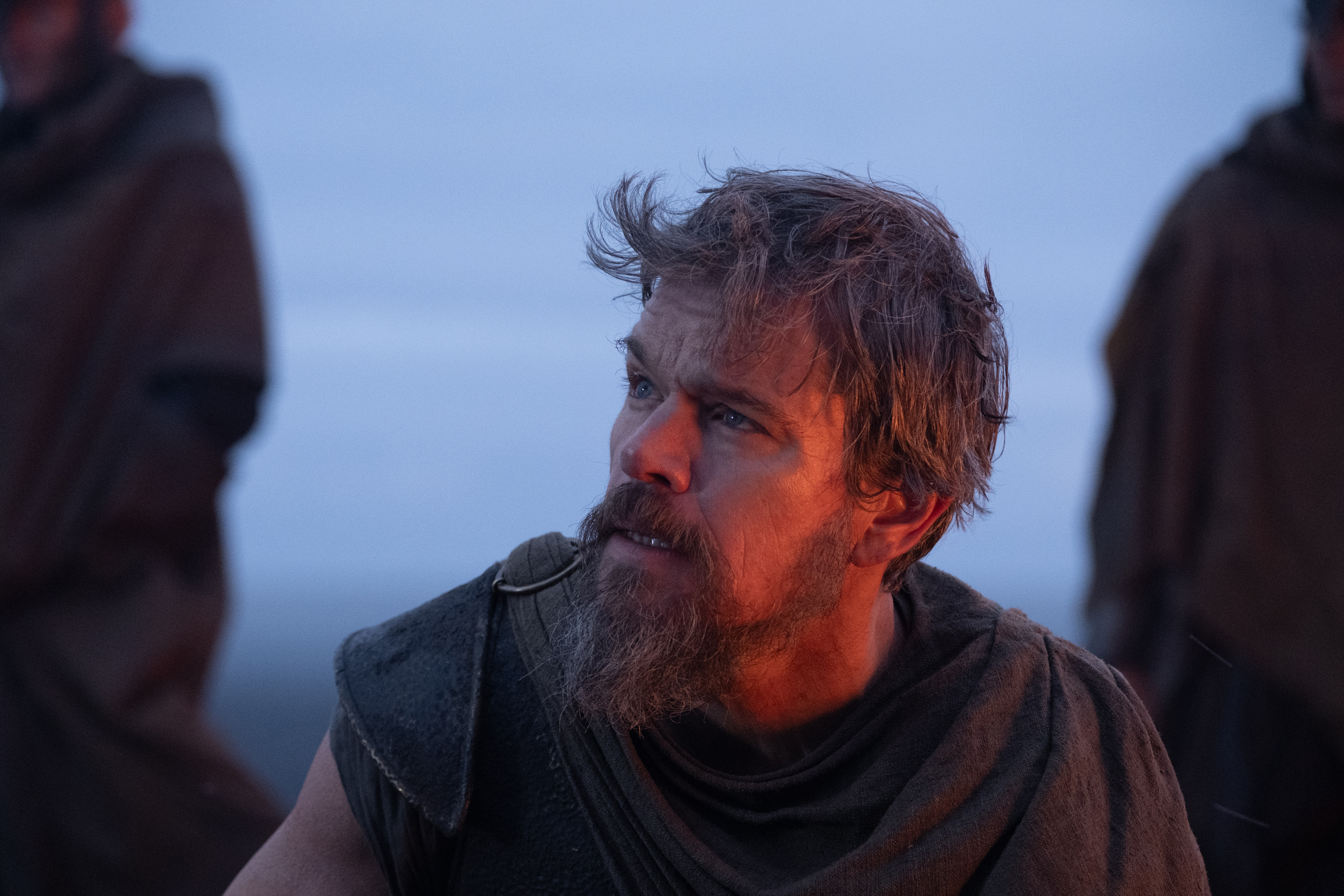


Over the eons we have gone from Homer’s epic poem to Operation Epic Fury, and today, as Christopher Nolan returns The Odyssey to the center of pop culture, we are currently living through another Greek tragedy.
As Imperial America remains locked in yet another seemingly endless war, that 3,000-ish year-old fabulous fable of Westerners facing off against Middle Easterners during the Trojan War is returning to our zeitgeist by way of the silver screen. According to our Ur-storyteller, the ancient city state of Troy was set near what today is Gallipoli (site of yet another momentous battle during WWI) in western Turkey, and it plays a pivotal role in the Homeric epics of The Iliad and The Odyssey. For it was, of course, the war between the invading Greeks and Trojans which drew Odysseus (aka Ulysses, played by Matt Damon) away from his home island of Ithaca, where he was king and happily married to Penelope (Anne Hathaway). After the fall of Troy (with a little help from history’s most infamous horse), Odysseus attempted to sail across the Aegean Sea back to his home, which he’d been absent from for a decade.
From Telemachus (Tom Holland) to television and beyond, Homer’s oft-filmed epic poem The Odyssey is not only among Western literature’s greatest adventure tales ever told, but also likely the West’s best-known saga about revenge (with the possible exception of Shakespeare’s Hamlet). The 24-book chronicle from the land considered to be the cradle of democracy is also a profound story about true love that features a father-son relationship for the ages, too. Previous screen versions starred Kirk Douglas and Anthony Quinn in the 1954 Italian co-production Ulysses and the 1997 TV mini-series The Odyssey with an all-star cast led by Armand Assante.
Christopher Nolan parlayed Oppenheimer’s unexpected critical and commercial success into an opportunity to film his pet project and to become the helmer of Homer. He did so using new IMAX technology, lensing the first feature ever shot entirely with IMAX film cameras, with Hoyte van Hoytema – fresh from his Academy Award for shooting 2023’s Oppenheimer – as director of photography. Previously, Nolan and van Hoytema had shot scenes of 2008’s The Dark Knight in the IMAX format, but utilizing the innovations of a bulky blimp dubbed “The Keighley” (named after David Keighley, the late chief quality officer at IMAX and his wife, Patricia) that encased the camera and muffled the sound empowered the filmmakers to shoot all scenes – including those that are dialogue heavy – with IMAX cameras.
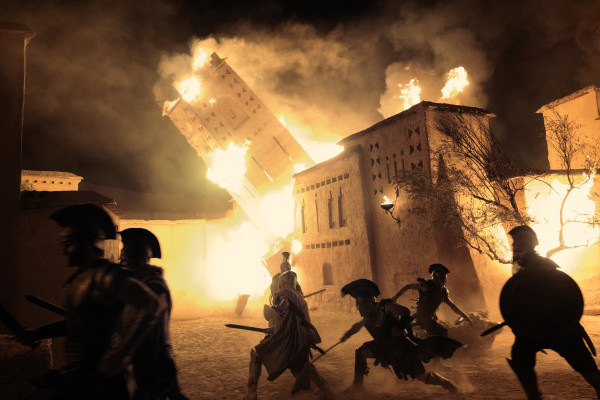
Thus, Homer’s epic was able to literally get the big picture treatment, and for about six grueling months Nolan’s production was filmed at “Morocco” (more on this below), Greece, Italy, Iceland, Scotland and the U.S. According to press notes, “What they could not accomplish on location they built and shot on California soundstages.” (But of course!)
Considering Nolan’s motion picture penchant for film form and big budgets, Homer’s somewhat disjointed, non-linear, sprawling yarn appealed to the man who, after all, inflicted 2010’s Inception and 2014’s Transcendence upon the moviegoing public. The story is not exactly told in chronological order; it moves back and forth in time, with flash forwards, flashbacks, special effects galore and lots of movie magic. But Nolan’s three-hour-long adaptation of Homer’s 12,109-line Odyssey has oddities, if not downright stupid cinematic lapses. Some of the two-time Oscar-winner’s head scratching screenwriting, directorial, location and casting choices include the following:
Still used today, the term “the Sirens’ song” is an expression derived from Homer’s hoary narrative. Indeed, in his The Odyssey: An Illustrated Guide (Adams Media), author Doug Metzger writes: “Odysseus’ short encounter with the Sirens in Book 12 might be the Odyssey’s most iconic episode.” After their excursion to Hades (which Nolan does not depict), Odysseus and his crew return to Circe’s (Samantha Morton) isle of Aeaea, where the witch warns Odysseus about the Sirens, who lure sailors to their island with enchanting music that beckons to them – however, those who join the seductive Sirens would never be able to leave their isle and go home, which is the entire raison d’être of their oceanic voyage.
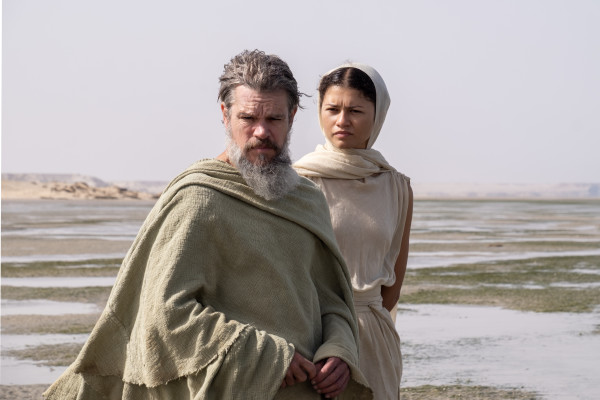 Matt Damon is Odysseus and Zendaya is Athena
Metzger, a PHD who hosts the Literature and History podcast, calls the Sirens’ sequence “a showstopping moment in ancient bardic performances of the Odyssey, as performers played and sang the song of the Sirens, dancers mimed out the events of the story, and listeners got the sense that they, like Odysseus, were enjoying something arcane and forbidden!” But despite the special FX and sound department at his disposal, what is the call of the Sirens that Nolan gives us? (NOTE: Plot spoiler alert:) Sheer silence, what the sailors with wax in their ears heard – or, rather, didn’t hear.
If Nolan fails audiences aurally, despite many truly eye-popping sequences throughout his film, in the denouement, when the returning, exultant Odysseus amazingly takes aim to shoot an arrow through an array of 12 arranged axes, the scene is ineptly filmed in a very perfunctory style, almost matter-of-factly. This is a sort of penultimate moment in the movie, but Nolan just blithely blows it off and tosses it away. I couldn’t help but wonder how a master of action pictures, such as John Wu or Sergei Eisenstein, would have filmed the arrow inexorably flying through all the axes, towards the bull’s eye? But what could have been a visual tour de force accentuating a momentous moment in The Odyssey with special effects, Nolan’s slipshod cinematic technique here lets this dramatic action slip through his filmic fingers.
In Book 5 of The Odyssey, seven of Odysseus’ ten years of trying to sail back home to Ithaca and Penelope were spent with the sensuous sea nymph Calypso on Ogygia Island, which Metzger drolly describes as “an outdoor sex dungeon.” Metzger lists Calypso’s “special powers [as] insatiable lust” and writes that she “dislikes dressing modestly,” although for some reason, Charlize Theron does not appear onscreen scantily clad at all. It’s true that before becoming an actress Theron was a model, and with her chiseled nose the blonde South African retains her photogenic looks, but she’s now more than half a century old. Odysseus’ idyll at Ogygia for seven years is strangely sexless – maybe Nolan bowdlerized Homer here with an eye on the box office, perhaps hoping not to turn children away from cinemas (despite heaps of violence). Although Oppenheimer had explicit sex scenes, I suspect that Nolan similarly avoided showing what the atomic bomb – that film’s raison d’être – did to the Japanese so as not to lose ticket buyers. In any case, opposite Assante, Vanessa Williams was a far sexier Calypso in the 1997 mini-series.
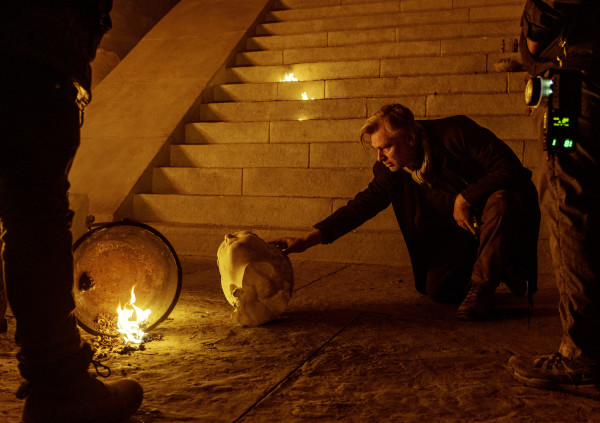 Director Christopher Nolan on the set of his film
Much has been made about Nolan’s casting, in particular his choice of Oscar winner Lupita Nyong’o, who is of Kenyan ancestry, as both Clytemnestra and her sister Helen of Troy, whose “face launched a thousand ships,” to start the Trojan War. Homer doesn’t describe Helen’s appearance in detail, although Metzger notes she was “The daughter of Zeus, and born into Spartan royalty with great beauty,” who “only makes a brief appearance in Homer’s Odyssey, and she’s also a fairly minor character in the Iliad.” Some film fans, in particular racist rightwingers like Elon Musk, have groused that Nyong’o doesn’t measure up as one of history’s most beautiful women, the daughter of Sparta’s queen, Leda, whom Zeus had raped while he was in the guise of a swan.
What’s likely most contentious of all, especially for those on the Left, is that part of Nolan’s Odyssey was shot on location in Africa’s last colony, Western Sahara, which is occupied by the Kingdom of Morocco. According to Eoghan Gilmartin in Jacobin, “Enjoying generous subsidies from the Moroccan state, they [the filmmakers] lent legitimacy to its illegal occupation regime. As Nolan and his crew filmed along the coast around the port city of Dakhla last summer, an open letter condemning the move was signed by prominent figures in world cinema, including Javier Bardem, Pedro Almodóvar, and [screenwriter] Paul Laverty.” I don’t believe any of Homer’s epic took place at Morocco or Western Sahara, and interestingly (if not deceptively), the movie’s press notes only refer to the former, never the latter.
Zendaya is charming as the goddess Athena who oversees Odysseus during his travails, while John Leguizamo is steadfast as the blind, loyal Eumaeus. I was dubious at first about Matt Damon playing the lead role, but he’s surprisingly good as the increasingly world-weary wanderer yearning to return to his wife and homeland. In the course of his 20 years away from Ithaca, ten of them spent at the frontlines in Troy where he craftily devised the Trojan Horse which empowered the gift-bearing Greeks to finally conquer Troy through trickery, Homer’s hero grows. Although it’s quite true that in Book 22 of The Odyssey Odysseus unleashes a terrible act of vengeance to purge Penelope’s palace of her would be wooers who have been taking advantage of the court’s generosity for years, the protagonist comes to rue violence and war.
Odysseus reflects on his wicked, wicked ways, which took him so far away and for so long from his beloved home, wife and the child she gave birth to while he was overseas and never met until he was nearly an adult. He regrets having lost 20 years of his life due to the Trojan War and that he had not fled Ithaca with (pregnant) Penelope when Agamemnon (Benny Safdie) had originally recruited him to fight, as Penelope had urged him to do.
According to the very end of The Odyssey in Book 24: “Then flashing-eyed Athena spoke to Odysseus saying: ‘Son of Laertes, sprung from Zeus, Odysseus of many devices, stay thy hand, and make the strife of equal war to cease…’” This renunciation of warfare is all the more relevant and resonant for modern moviegoers, as Trump fights yet another endless war of aggression in the Middle East against a country that borders Turkey, where Troy was located. We could do with some ceasing of the strife of war nowadays…
Nolan also alludes to class struggle by accentuating mistreatment of the poor, in particular when Odysseus disguises himself as a beggar and is abused by the scheming Antinous (Robert Pattinson), one of the suitors seeking to marry Penelope. Although he, along with the other wooers, are exploiting Penelope’s largesse, Antinous seeks to deny the man he believes to be a poverty-stricken beggar even his meager scraps to eat and kicks him.
As ICE slaughters innocent immigrants like deranged Laestrygones or Cyclopes in America’s streets, Nolan also slyly rebukes Trump’s anti-immigrant fanaticism. A recurring refrain throughout The Odyssey is Odysseus’ invoking of “Zeus’ Law,” which stresses a sacred obligation to extend hospitality to the strangers among us. According to Metzger, foremost of the things that the ancient gods disliked is “Hubris” – and it taxes the imagination to try to conjure up how rulers could have more overweening pride and be more arrogant than the warlike Trump regime, as its insane acolytes impose testosterone-testing on its troops.
Over the eons we have gone from Homer’s epic poem to Operation Epic Fury, and today, as Christopher Nolan returns The Odyssey to the center of pop culture, we are currently living through another Greek tragedy. Something a contemporary Cassandra might predict is that the inevitable, coming collapse of Trump will make Icarus’ fall from the sky for flying too close to the sun or the opening of Pandora’s box pale in comparison.
For info about the fourth book co-authored by Ed Rampell and Luis Reyes about filmmaking in Hawaii see here.
