


Unlike fiction, real life often can get out of the creator’s control and take us to places beyond our command.
LOS ANGELES ASIAN PACIFIC FILM FESTIVAL 2026: Film Review, Part II
The 42nd annual Los Angeles Asian Pacific Film Festival took place April 29-May 3 at a variety of LA venues. LAAPFF is arguably America’s main gateway for Asian, Asian American and Pacific Islander productions to gain access to the U.S. movie market and in particular, to LA, the world’s capital of cinema. The yearly filmfest is presented by Visual Communications, an LA-based media organization whose “mission is to develop and support the voices of Asian American & Pacific Islander filmmakers and media artists who empower communities and challenge perspectives. Founded in 1970 with the understanding that media and the arts are powerful forms of storytelling, Visual Communications creates cross cultural connections between peoples and generations.”
As a film historian/critic who has co-authored with Luis Reyes movie/TV history books, including our fourth, On Location in Hawaii, about South Seas Cinema – screen productions by and about the Indigenous peoples of Polynesia, Melanesia and Micronesia and their islands – my focus in covering LAAPFF is on the new works by Pacific Islanders. In Part I of my LAAPFF coverage I reviewed fiction shorts by and about Maoris, Hawaiians, Samoans, Micronesians, etc., and found that the South Seas screen image was making significant cinematic strides forward as Indigenous and local people increasingly got behind as well as in front of the camera to tell their own stories. After all, “self-determination” means that the “self” – not the “other,” not the “outsider,” not “Haole-wood” – determines how Natives are perceived and represented. I wish I could say the same re: the full-length documentaries screened this year at LAAPFF, but other than subject matter, they don’t advance the film form of Pasifika pictures like, say, Pacific Cinewaves’ I Am Not Your Dusky Maiden and The Return do. Both documentaries were screened at the Directors Guild of America’s theater on the Sunset Strip.
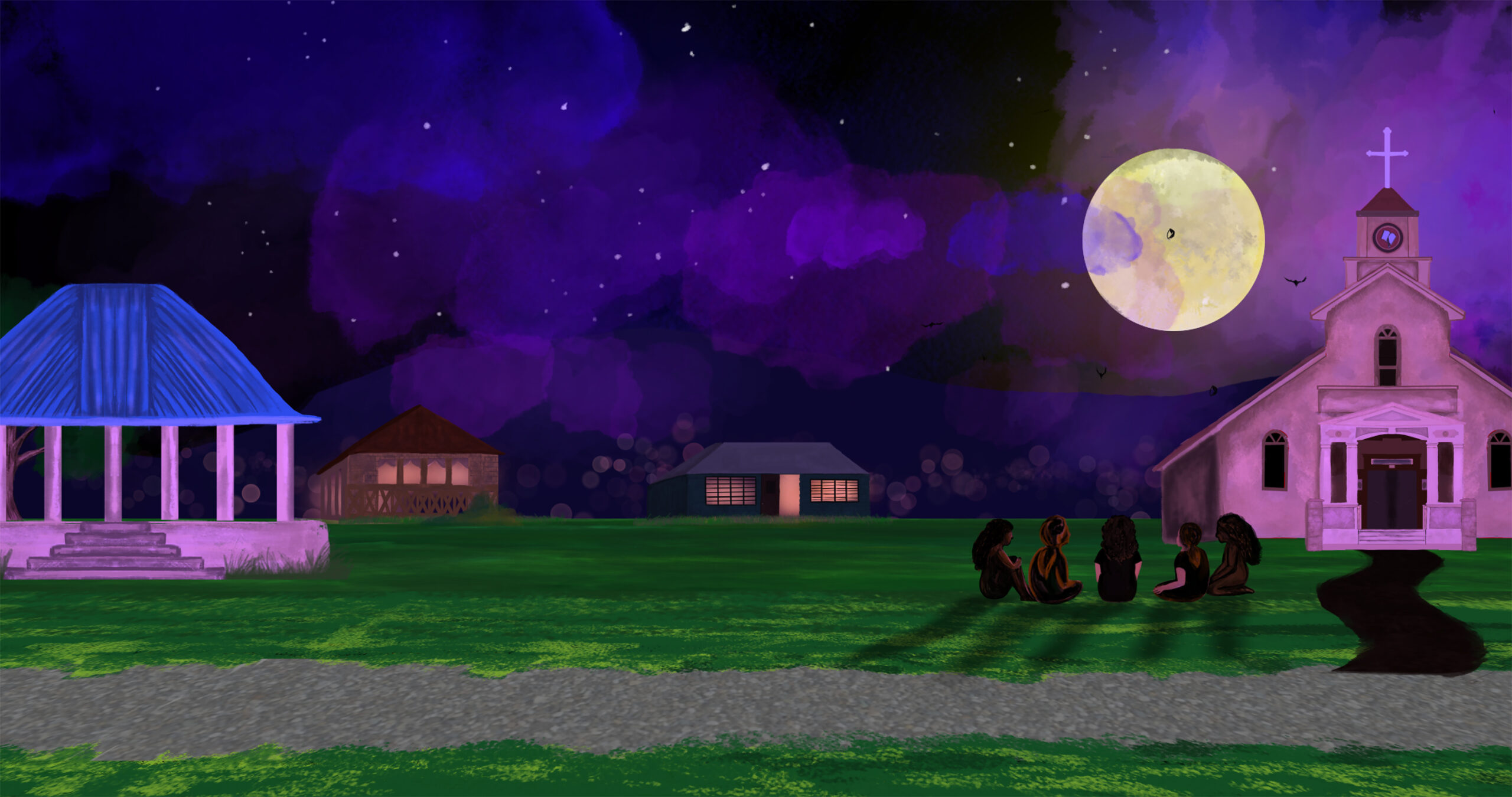
Coming of Rage in Samoa: Before the Moon Falls
I have to be honest with the reader: This may be the hardest documentary I’ve ever had to review. For one thing, I have to violate one of my guidelines as a critic, which is to not divulge plot spoilers, so be forewarned that because much of this sensational story has already been widely covered by the Pacific’s news media and beyond, including by the New York Post and CBS News, I am indeed going to reveal key plot points. So, having said that, here goes:
Imagine if, say, African American novelist Toni Morrison murdered, say, Black novelist Maya Angelou. And to compound matters, imagine if Angelou had been closely related to a member of the U.S. president’s cabinet.
In essence, within the context of the realm of Pacific Island letters, this is the tragic denouement of writer/director Kimberlee Bassford’s Before the Moon Falls. On May 25, 2024 57-year-old Samoan novelist Sia Figiel brutally murdered 78-year-old Samoan writer Caroline Sinaviana-Gabbard in Samoa.
My main problem writing about this documentary is that when I lived in Hawaii, I personally knew both Figiel and Caroline, so the reader is advised that this firsthand acquaintanceship with the protagonist and her homicide victim may affect my ability to write objectively and fairly about this film.
Bassford had begun her documentary about Figiel long before the Samoan scribe horrifically stabbed, hammered and beat her older friend to death, so of course, Kimberlee had no way of knowing what was going to happen when she started shooting. Figiel was a colorful figure who made a name for herself in Oceania (and to some extent beyond) in the 1990s when her first book of fiction, Where We Once Belonged, was published. However, over the decades it became increasingly clear that Figiel was battling mental illness, as well as diabetes. I believe that this is what drew Bassford to document Figiel, who literally walked across America in order to raise awareness about diabetes (and, arguably, to her eternally attention getting self).
But unlike fiction, real life often can get out of the creator’s control and take us to places beyond our command. At the LAAPFF screening, Bassford said she’d intended to end her documentary on a hopeful note of family reconciliation, to show that Figiel could survive despite her mental illness (coping with being bipolar, et al, if not overcoming it). Filmically, at first Before the Moon Falls shows promise and visual panache, creatively including imagination imagery such as animation.
But the bizarre murder committed by the main character of her film seems to throw Bassford completely off-balance, and extending her documentary to incorporate Figiel’s bloody homicide takes the film’s subject matter to a whole other dimension. It seemed to me that the contents of what unraveled exceeded her grasp as a filmmaker, and to be just, the protagonist’s cruel violent act likely would have thrown a topnotch documentarian like Errol Morris or Michael Moore for a loop.
With an entirely unforeseen ending forced upon it by circumstances beyond the director’s control, watching Before the Moon Falls becomes a dreadful, tedious experience. I remember Sia in her youth, and although she was oversized then and not especially attractive in the 1990s, let’s just say that she didn’t age well. With her close-cropped hair and morbidly obese physique, she’s the exact opposite of eye candy, and watching her for an hour and 41 minutes or so is difficult, if not unbearable. This is amplified by observing what an awful mother she often was to her two sons, who she abandons. When she notifies them she plans to return home to Samoa, the boys beg her not to return, but of course Figiel completely disregards their wishes. As for their dads, their biological fathers are never even mentioned in the film, they are not even afterthoughts. Except for a German boyfriend briefly glimpsed onscreen around the time the Berlin Wall came down, Figiel is never shown with someone identified as a romantic partner per se, and apparently not having a significant other(s) in her life complicated her mental health challenges.
On and off her meds, Figiel is extremely exasperating and wearisome to watch, especially knowing what she did to Caroline. At times the 101-minute film felt like it was a century-long and I couldn’t wait for it to be over – except, alas, I knew how it would end…
I have four or five distinct memories of Figiel from the 1990s, and all save one are negative. She was borderline cruel or abusive, very insensitive to others, and extremely self-indulgent at others’ expense (literally). Having said that, Sia was indeed a good writer and I remember giving Where We Once Belonged a positive review in the Honolulu Weekly.
For me, the best parts of Before the Moon Falls are when Pacific Islander authors, most of whom I’d met, appear onscreen and discuss Figiel’s literary contributions, most notably the great Albert Wendt, who I remember very fondly. When Caroline, the first Samoan to become a professor in the U.S., appeared I almost lost it, and gasped; “Poor Caroline!” I have only good memories of her as a good, kind, decent talent who in no way deserved what Figiel despicably did to her. Talofai nui!!!
Bassford never reveals that Caroline was the aunty of Tulsi Gabbard, Director of National Intelligence, which is a strange, glaring omission.
Bassford never reveals that Caroline was the aunty of Tulsi Gabbard, Director of National Intelligence, which is a strange, glaring omission. Nor does the film identify her brother, Mike Gabbard, a Hawaii state senator, a public figure known for his homophobic politics and background with a religious cult (now Tulsi’s in the Trump cult!). Another twist and turn in the twisted, tortured life of Figiel took place in January 2026. In a closing title Before the Moon Falls simply states that Figiel died in prison in Samoa. Like the curious non-mention of Caroline’s well-known niece, this may be an example of the filmmaker not wishing to upset the applecart, as there is dispute over whether or not Figiel killed herself, and reporting on her cause of death was banned by authorities (see here).
The writer/director does a good job explaining psychological factors that likely affected Figiel’s state of mind, such as the physical and sexual abuse she experienced as a child. But Bassford, who spent about six or so months of her life in Samoa, does not much delve into the possibility that Figiel was a dissident in Samoa, opposing a status quo that includes a heavy missionary influence, which arguably renders nominally independent Samoa a neo-colonial quasi-theocracy. A line from her writing is read aloud onscreen that suggests this: “We were taught to mimic Jesus Christ.” But the possibility that Figiel found herself to be in opposition to the prevailing powers-that-be in Samoa and how that, too, might have worn away at her soul, are not explored much. Plus, we only get brief glimpses of the theater that, to her credit, Sia created in her island, but little info about it.
Being abused may explain why one abuses others, but it certainly doesn’t rationalize or justify it. In the end, I reserved my pity for the victim, not the victimizer. I certainly hope somebody someday makes a film about Caroline Sinaviana-Gabbard, who is a far more deserving subject.
Culture Clash: Toitu: Visual Sovereignty
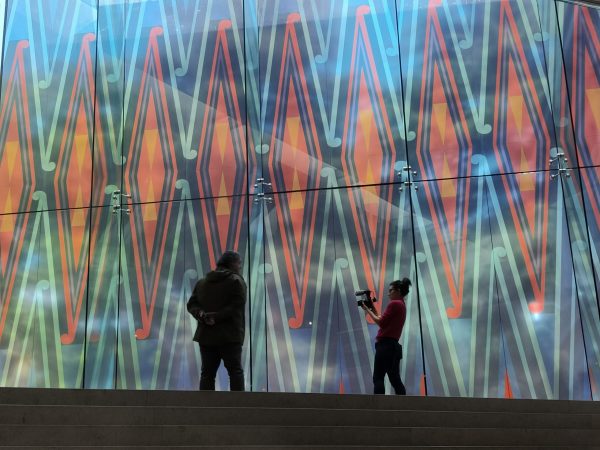
Oscar-nominated Maori director Chelsea Winstanley’s Toitu: Visual Sovereignty is about the behind-the-scenes culture clash that takes place when a major exhibition of contemporary Maori artists is held at a top national venue in Aotearoa/New Zealand. The film shows in painstaking details the power struggle between some of the Indigenous artists lead by the curator of the “Toi Tū Toi Ora: Contemporary Māori Art” 2020-2021 exhibit, Nigel Borell, against the Auckland Art Gallery’s establishment. Not only is it pakeha (Maori for Caucasian) dominated, but to make matters worse, the institution’s top official isn’t even a New Zealander – she’s an Australian who was imported to run the public gallery, which I believe is government-owned.
The didactic Toitu: Visual Sovereignty has tantalizing glimpses of Maori traditional and contemporary art at the Venice Biennale, Manhattan’s Metropolitan Museum in a great exhibit I covered in 1984, as well as at the Auckland Art Gallery. But this documentary seems far more interested in the faction fight at the latter than in the art per se, and this struggle to control representation takes center stage. The only thing more boring than long-winded Zoom business calls with multiple participants is having to sit through them interminably unfolding on a movie screen (in yet another overly long 101-minute doc).
I understood that one major concern of Nigel and the other Maori artists was that the gallery’s pakeha director was going to personally visit Indigenous creatives by herself, which sent the wrong signal re: representation. This was course corrected by having a Maori artist involved in the then-forthcoming exhibition accompany her. Fair enough.
But for the life of me, although this is what the film zooms in on (rather than the art per se), I really couldn’t understand other specific points of contention (although I did get the notion that, in general, the Maoris themselves should be in charge of and have final say over the exhibition of their artwork, which BTW I agree with) that led to splits, dissension, etc. Maybe this is because I’m an American white person, although my daughter grew up in NZ, which I visited several times.
I believe this is the full-length documentary debut of Ms. Winstanley, whose ex-husband, the great Taika Waititi, appears briefly in Toitu, and who directed 2019’s Jojo Rabbit, which was nommed for the Best Picture Academy Award, which Chelsea co-produced. To tell you the truth, although I think the struggle over who controls representation is extremely important, I would have preferred seeing more art and less bickering artists.
The fourth book co-authored by Ed Rampell with TCM guest host Luis Reyes about filmmaking in Hawaii is co-dedicated to LAAPFF and Pacific Islanders in Communications and includes Hawaiian films screened at the filmfest. The new drops in August: https://mutualpublishing.com/product/on-location-in-hawaii/.
