


Too big an ego was exactly Quisling’s problem. His tragic flaw (to use a Greek dramatist’s category) was that he lacked humility.
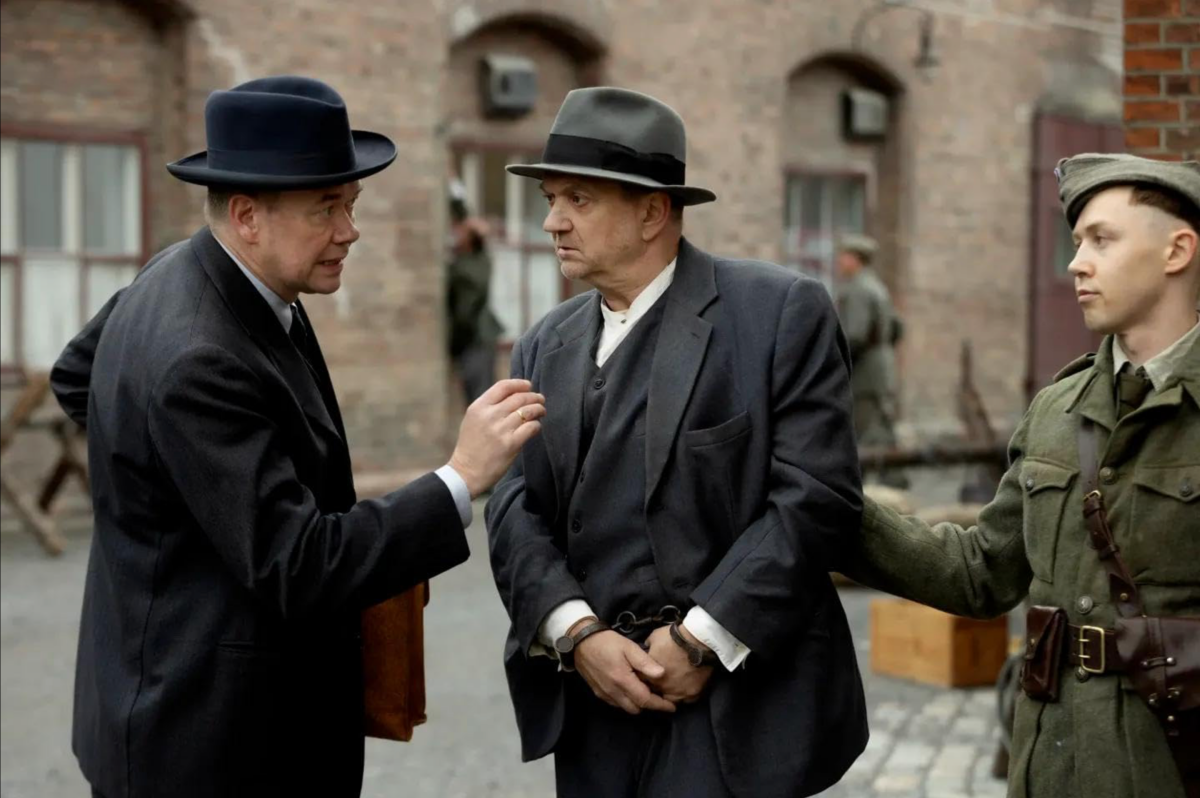
As the Norweigan film Quisling: The Final Days (2024, now on Amazon Prime) makes clear, Vidkun Quisling (1887-1945) was a smart man—as he brags in the film: “I also graduated with the best grades in school history” [the almost century old Norweigan Miliatry College]—but not a wise one. (Film quotes are taken from the filmscript, which approximates lines spoken in the movie, one that Variety labeled a “Superb Norwegian Historical Drama.”)
As psychologist Robert Sternberg wrote in his article “It's Not What You Know, but How You Use It: Teaching for Wisdom,” “People are wise to the extent that they use their intelligence to seek a common good. They do so by balancing, in their courses of action, their own interests with those of others and those of larger entities, like their school, their community, their country, even God. And they balance these interests over the long and the short terms. They adapt to existing environments, or shape those environments, or select new environments to achieve ends that include, but go well beyond, their own self-interest.”
Yet, Sternberg argued that “smart and well-educated people are particularly susceptible to four fallacies,” which he labeled the egocentrism, omniscience, omnipotence, and invulnerability fallacies. All four are tied up with too big an ego and with overestimating one’s own importance and powers.
And too big an ego was exactly Quisling’s problem. His tragic flaw (to use a Greek dramatist’s category) was that he lacked humility. Several times in the film, the clergyman assigned to advise him, Peder Olsen (Anders Danielsen Lie), makes reference to Luke 18:9-14. The passage reads as such:
To some who were confident of their own righteousness and looked down on everyone else, Jesus told this parable: “Two men went up to the temple to pray, one a Pharisee and the other a tax collector. The Pharisee stood by himself and prayed: ‘God, I thank you that I am not like other people—robbers, evildoers, adulterers—or even like this tax collector. I fast twice a week and give a tenth of all I get.’ But the tax collector stood at a distance. He would not even look up to heaven, but beat his breast and said, ‘God, have mercy on me, a sinner.’ I tell you that this man [the tax collector], rather than the other, went home justified before God. For all those who exalt themselves will be humbled, and those who humble themselves will be exalted.”
As psychologist Tom Lombardo writes, “A good dose of humility is an essential quality of wisdom.”
A recent pope, Francis, also indicated another flaw possessed by Quisling—his thinking was too constrained by ideology. In a 2013 sermon the pope warned against being ruled by ideology: “When a Christian becomes a disciple of the ideology, he has lost the faith...But it is a serious illness, this of ideological Christians....His attitude is: be rigid, moralistic, ethical, but without kindness.” He urged Christians “to remain humble, and so not to become closed.”
For Quisling the ideology that drove him to become a tool of Hitler was anti-communism. As he says in the film, “The only thing I wanted was to protect my people [Noweigans] from Bolshevism...It spread like a cancerous tumor. I saw it as my calling to stop it.” (Hitler also saw Nazism as a means of preventing the spread of Bolshevsim.)
Before going further, however, in analyzing Quisling’s WW II behavior, his prior activity, as well as a brief summary of Norway’s post-WWI politics, seems necessary.
Born the son of a distinguished Church-of-Norway (Lutheran) clergyman, after graduating from military college, Vidkum was soon afterward appointed to the Army general staff in 1911, and in early 1918—partly because of his knowledge of Russia—he was named an attaché to the Norwegian delegation in Petrograd. (After the delegation was recalled at the end of 1918, he was recognized as his country’s military expert on Russian affairs.)
During the 1920s, he spent considerable time in the emerging Soviet Union, especially in Ukraine and Armernia, and made important contributions to aiding victims of the 1922 Ukrainian famine. He also met and “married” two different women from Ukraine—in that he never obtained a proper divorce from his first wife, his second “marriage” to Maria Pasetchnikova (Lisa Carlehed) was legally tainted.
During the 1930s Quisling turned increasingly to Norweigan politics, and was Norway’s defense minister in Agrarian governments for a while in the early part of the decade. In 1933 he founded the Nasjonal Samling (National Unity), party, but four other parties—Conservative, Labour, Liberal, and Agrarian—remained more popular. As the 1930s continued, Quisling’s party was increasingly linked with Hitler’s Nazis in Germany, and in 1939 he sent Hitler a birthday greetingthanking him for “saving Europe from Bolshevism and Jewish domination.”
In his own mind Quisling, as he says in the film, had good intentions. The clergyman who often visits him in prison, Peder Olsen, says he thinks of “himself a Christian” and a “strong man who never doubts.”
Typical was his view of the Jews. During his trial the prosecution points out that “in speech and text” he has claimed “that Judaism is to blame for all evil.” And when asked about the Norweigan Jews’ fate during WW2, his reply is, “There was talk of sending them to Poland. That was all I knew.” He was reminded that in 1942 he visited Polish camps where Norweigan Jews had been sent, and he replied, ”Yes, they appeared as ordinary labour camps. Workplaces. There was nothing to complain about. There was nothing there that made an impression.” Despite this, a Jewish witness at the trial estimated that around 1,000 Norweigan Jews were sent to German camps, and only about 12 of them survived.
Quisling also states, “It's horrible...to accuse me of persecuting the Jews. I who have done such a great humanitarian effort! I would say that I am the one who has helped the most Jews in this country.” (His second wife, Maria, also told pastor Peder Olsen that he saved many Jewish lives in Ukraine’s 1922 famine. In March 1941, Quisling warned against exterminating Jews. Instead, he thought “their parasitic existence must be prevented by giving them, like the other peoples of the earth, their own land,” however not Palestine, which “has been the land of the Arabs for centuries.”)
In late 1939, after Germany’s invasion of Poland and the beginning of WW2 in Europe, Quisling twice met with Hitler. Following Germany’s invasion of Norway in the spring of 1940, the Norweigan king (with limited powers) and its sitting government refused to cede power; but Quisling, with Hitler’s backing, proclaimed a new government with himself as prime minister. Yet, since both the king and the pre-Quisling government refused to recognize Quisling, Hitler backed down and instead appointed a German Nazi, Josef Terboven, as Norweigan Reichskommissar. In turn, however, in February 1942, Terboven allowed the formation of a Norwegian puppet government under Quisling as minister-president. He retained that position until Germany was all but defeated and he was arrested in May 1945.
Quisling was indeed a complex man. And at one point Peder Olsen states, “The worst part is that I almost had started to like him. When he talks about something he cares about he seems to want to do good...You are drawn into his logic, until you think that he is right and you are wrong...but he completely lacks humility.” (Olsen thought that we all are sinners, including himself, and therefore we should all be humble.)
Part of the difficulty is that Quisling’s second wife, Maria , encourages his stubbornness and lack of humility. On a visit to his prison cell in 1945, she tells her husband, “You should not bow down to them. Don't let those barbarians break you. No one is stronger than you. I knew it the first time I saw you. ‘Now there's a man who would never let himself be broken!’”
In that Quisling really seems to love Maria, perhaps if she, like Olsen, had advised him to admit he had made mistakes, including his support for Hitler, he might have admitted he had sometimes gone astray. But even though he seems to waver a little near the end, his final words in 1945 were “I am innocent. You shoot an innocent man!”
Eight years ago in reviewing the 72 episodes and 18 shorter historical commentaries of the TV series “A French Village,” I wrote: “Although most people would like to think that they would resist the Nazi invaders and not cooperate with them in any way, the reality for occupied peoples—under the Germans and other occupiers—was usually much more varied...Some collaborated; some cooperated partly; only a small minority engaged in active resistance.”And I referred to Tony Judt’s chapter “Retribution” in Postwar: A History of Europe Since 1945 (2006).
I also contrasted the retribution (including execution) imposed on collaborators with the different approach taken in South Africa after the collapse of the evil of apartheid. (Starting in 1996 its Truth and Reconciliation Commission sought reconciliation and what is sometimes called restorative justice rather than the retributive justice sought at the end of WW2).
Watching Quisling be executed by a firing squad at the end of Quisling: The Final Days, reinforced my preference for the South African approach of Bishop Desmond Tutu and Nelson Mandela.
