



Besides seeking answers to life’s puzzling problems, there are other reasons people join religious movements, not the least is the social dimension it offers.
After watching “The Testament of Ann Lee,” the 2025 film now on Hulu about the Shakers’ late 18th century principal founder, my reaction was to recall the quote often mis-attributed (e.g., to Philo of Alexandria): “Be kind, for everyone you meet is fighting a hard battle.”
I have great respect for humble and loving religious believers, and for several years taught a college course on “Comparative Religions”—this was because of a departmental need and not because I had any specialized expertise in the field.
My belief is that on a global scale, many people turn to one religion or another because they are seeking some kind of answers to life’s puzzling meanings. As the quote suggests, they are “fighting a hard battle.” And so they turn to various faiths—not—note carefully—certainties. Therefore, we should also be humble. God or gods, the immensity of the universe, why good people suffer—who knows or understands the full complexity of our world?
About Asteroid City, a recent Wes Anderson film, one of the cast members commented, “The film is about. . . . existential angst . . . What are we doing
here? . . . Does anyone know what they’re doing?” The director himself said , “We
went into it with a sense of it being about how you face things beyond your control, and how you respond to a world that is so much bigger than you and is a mystery.
And grief was at the centre of it. Always. Death was at the centre of it.” In the 18th century, such uncertainty—though often not admitted—especially among illiterate people like Ann, was even more common.
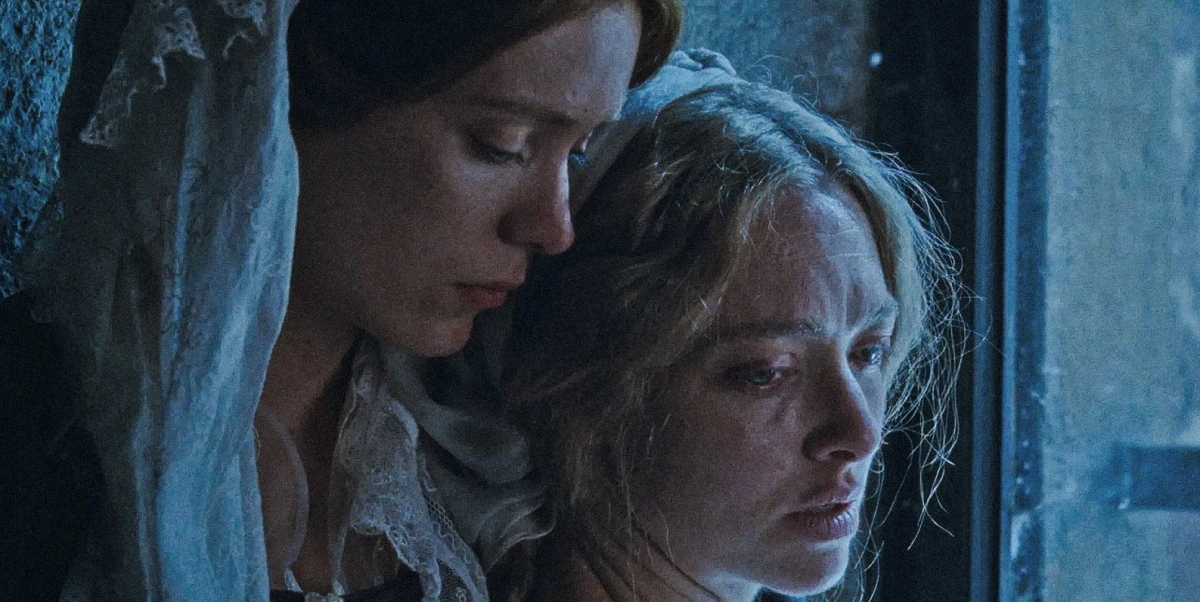
One of the songs Ann (an excellent Amanda Seyfried) sings while imprisoned in England, “Hunger and Thirst,” captures her longing beautifully:
I hunger and thirst
An ocean I see
Without bottom or shore
Feed me, I'm hungry
Enrich me, I'm poor
I cry unto God
I'll never cease
Till my soul's filled
with love
Love and sweet peace. (Film quotes are taken from the filmscript.)
Besides seeking answers to life’s puzzling problems, there are other reasons people join religious movements, not the least is the social dimension it offers. We humans are social beings, and worshiping with other humans provides many with a certain psychological satisfaction.
Which religion, if any, one adopts, depends on many factors. Geography is perhaps the most important. If one lives in Asia, adoption of Hinduism or Buddhism is more likely; if one resides in the Middle East or North Africa, Islam is more probable, although in Israel it would probably be Judaism. If one’s home is in the more secularized western world, the most likely choice would be some form of Christianity, though one also finds people of other faiths and an increasing number of individuals who profess no specific religion at all.

Regarding truth, it is difficult objectively to state that one belief system is better than others. The Shakers were generally pacifists and inclined to condemn slavery—there is a scene in the film where Ann and a small group of other newly-arrived-in-America immigrants yell “Shame! Shame!” at a slave auction—and though those inclinations appeal to me, many intelligent people are not complete pacifists.
The illiterate Ann Lee was born in 1736 in Manchester, England, where illiteracy, especially for girls, was more common than in Colonial America, where it was notably high, especially in New England. Her dad was a blacksmith, and she helped establish Shakerism around 1758, married in 1762, had four children—all of whom died in infancy—and emigrated to New York in 1774.
While still living in Manchester, but after the last of her children had passed away, she became convinced that it was because she had had sex with Abraham, her husband: “I have fallen under heavy trials and tribulations on account of lodging with my husband. It is sexual sin that has caused us to catastrophe. I know it.” As the Shaker religion developed, sexual relations even between spouses, was considered wrong. Therefore, to last more than one generation, the Shaker community had to adopt children and recruit converts. Those adopted were given a choice when they turned 21 to remain within the group or to leave.
Shakers were not alone in frowning upon sex, even among married couples. In imperial Russia during this same period, the Khlysty forbade sex even for married couples. And a late-eighteenth-century offshoot of that religious sect, the Skoptsy, went even further. They preached self-castration. Even some religious hierarchies, like 18th and 19th century Catholic priests, while permitting sex for married couples, forbade marriage—and sex—for themselves, thinking their self-abstinence reflected a “higher calling.”
Besides their pacifism, opposition to slavery and sexual activities, the Shakers emphasized the important role of women. They believed that when Jesus comes back, it will be as a woman. They also stressed personal revelations and, unlike many religions, had no priestly hierarchy.
“The Shakers” was not their official name, which was “The United Society of Believers in Christ’s Second Appearing.” But it was a common term for them because of their proclivity for ecstatic dancing, which involved “writhing and falling to the ground accompanied by wailing, grunting, and outbursts of . . . speaking in tongues.” The same source as the previous quote, indicates that the film’s depiction of their dancing—and there is much of it—was not exactly accurate but that it “involved a slow and laborious series of movements often incorporating rigid holding and sudden releases, designed to help the spiritual overcome the physical and promote discipline and union within the community.”
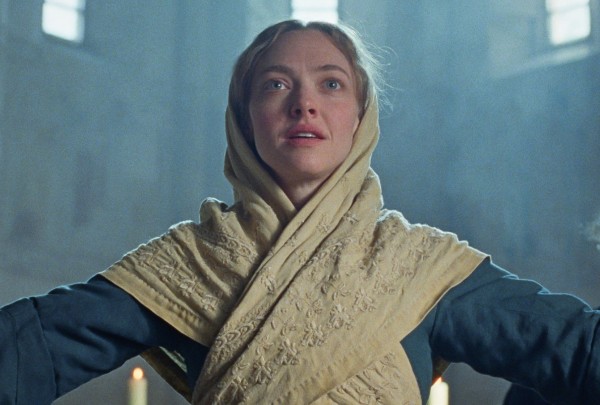
Although the movie takes some liberties with the Shakers’ dancing, in many ways it is quite accurate. Directed by Mona Fastvold, who co-wrote the screenplay with Brady Corbet, the couple turned to Daniel Blumberg to rework many of the Shaker hymns and compose a few new ones, which are sung (with great feeling) by Ann and some of the other Shakers.
Many of the other scenes in the film are also essentially accurate, including the Atlantic crossing of the small group from England to New York, Ann’s occasional jailings, the Shakers’ farming activities and proselytizing efforts, the distrust and occasional violence against her and other Shakers by distrustful neighbors, and their pacifistic stance against fighting the British during the American Revolution.
Ann was only 48 when she died in 1784, and some thought that her death and that of her brother William shortly before might have been at least partly due to the beatings hostile mobs inflicted upon them. And with her end, so too does the movie conclude, although Shaker growth continued thereafter. By the mid 19th century, there were 19 U. S. Shaker communities in the Northeast, Ohio, and Kentucky. Today, however, only a few Shakers remain.
Coming across a film that takes religious belief seriously and treats it with respect is somewhat unusual in our modern era, but The Testament of Ann Lee is such an example. And it also reflects a movement that came to full fruition after Ann’s death but before the Civil War—the Second Great Awakening. The mindset and emotions generated by that awakening are an important part of our history.
