



“The Best You Can” rings true about marriage and about the diminishment of Alzheimer’s. But it is also a well-acted and directed movie.
Toward the end of “The Best You Can” (now on Netflix), a divorced Stan (Kevin Bacon) tells a brief story to the recently widowed Cynthia (Bacon’s real-life wife, Kyra Sedgwick). He speaks about a time when he took his then-young daughter, Sammi (Brittany O’Grady), camping, and he messed up. But she said to him, “It’s okay, Dad. You’re doing the best you can.” Those last four words are, of course, the title of the film, and also the moral of the movie. (All film quotes are taken from the filmscript.)
Stan relates the camping story to Cynthia, who has just said to him: “I feel like I let him [her husband, Warren] down, Stan. . . . Would he say I was a good wife? Would he say I was there for him in the way he needed all these years? I don’t know. I-I truly do not know.” But to understand why she says these words, and why Stan tries to cheer her up with his you did “the-best-you-can” story, we need to explore Stan and Cythia’s backstory.
She was (until he died near the movie’s end) married to Warren (Jud Hirsch). As she explains at the start of the film: “At 57 [about the time she married him], he was in his absolute prime. He was handsome and vigorous and doing important things [helping oust President Nixon after Watergate] with the kind of wisdom and empathy you only acquire living in the world that long.” She, however, was only in her “30s at the time.” (The actual age differences of the three actors—Sedgwick, Bacon, and Hirsch—playing the three main characters approximate the differences in the film, with she being 60, Bacon 67, and Hirsch 91.)
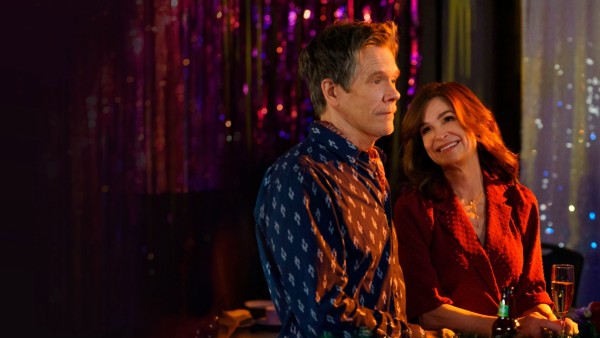
When Cynthia met Warren, she was already “a practicing physician” (a urologist) who owned her own condo. Now, however, decades later—he’s 83—Warren is displaying signs of dementia. At least so says Doug Finkelman (Ray Romano)—whom she describes as “expert of experts”—she prefers “mild cognitive decline.” But his grandson says Warren has “forgot how to play checkers.” And his daughter, Rosemary, adds that he “has slid so far since last time” and suggests perhaps moving him to a facility in Cleveland, where Rosemary and her family will soon be moving. Realizing that Cynthia works full time as a doctor, she says that as he “declines, he’ll need family around.” Cynthia, however, resists the idea; and, after visiting the Cleveland facility, disparages it as a place where the residents “connect-the-dots and [play] bingo”
Stan works for the Brooklyn private security patrol, and he checks out Cynthia and Warren’s house after a report of a home intrusion. Stan and Cynthia form a friendship; and because of an enlarged prostate and frequent urination, she begins to see him professionally.
As one might guess, the friendship soon develops into something more: she kisses Stan in an elevator, and they go to bed together. But she still loves Warren, diminished as he may be. And on Stan’s professional visit to her as a urologist, she tries to get him to switch his visits to another doctor. She apologizes to him, saying “We became friends. Close friends, and that was wonderful. But I let it get too far, and I take full responsibility.”
The dementia predicament of Warren and Cynthia resonates with me because for at least the last nine years of my wife, Nancy’s, life she had Alzheimer’s. Our situation was very different from that of Warren and Cynthia—we were both retired; there was no big age difference; etc.—but still I understand the pain of watching someone you love face diminishment.
I also think she was right to tell Stan, “I let it get too far.” Marriage vows today are often personalized, but a half-century ago words like these were fairly common: “I promise to have and to hold, from this day forward, for better, for worse, for richer, for poorer, in sickness and in health, until death do us part.”

In 2019, The Washington Post ran an article about a man whose wife suffered from Alzheimer’s, and he took up with another woman. I do not wish to judge that situation because every case is different, but in general I think Cynthia was right to break off her intimate relationship with Stan. (Warren soon died, leaving Cynthia free to resume her relationship with Stan, but the film ends soon after Warren’s death and before any further developments can occur.)
When Cynthia tells Stan she doesn’t know whether Warren would say she “was there for him in the way he needed all these years,” she also seems to be speaking the truth. And when he tries to cheer her up, suggesting she did the best she could, he also is close to the truth. Close, but not exactly. She could have refrained from kissing Stan in the elevator and from going to bed with him. But she is a human being. And, as the poet Alexander Pope wrote, “To err is human.” Thus, in a sense, in the sense she is a human being and therefore prone “to err,” she came close to doing the best she humanly could. But at least she had the sense to admit she “let it get too far.”
All readers might not agree with me. Some might think that given Warren’s condition, she was justified in having sex with Stan. But I agree with the words of U.S. neuropsychologist and Nobel laureate Roger Sperry: “Human value priorities . . . stand out as the most strategically powerful causal control now shaping world events. More than any other causal system with which science now concerns itself, it is variables in human value systems that will determine the future.” And I still believe the old wedding-vow words were appropriate—“to have and to hold, from this day forward, for better, for worse, for richer, for poorer, in sickness and in health, until death do us part.”
The sentiment they express reflects the primary value that should underlie a marriage—love. The words also seem to reflect those of St. Paul about love: “Love is patient, love is kind. It does not envy, it does not boast, it is not proud. It does not dishonor others, it is not self-seeking, it is not easily angered, it keeps no record of wrongs. Love does not delight in evil but rejoices with the truth. It always protects, always trusts, always hopes, always perseveres.”
Thus, in summary, “The Best You Can” rings true about marriage and about the diminishment of Alzheimer’s. But it is also a well-acted and directed movie.
