



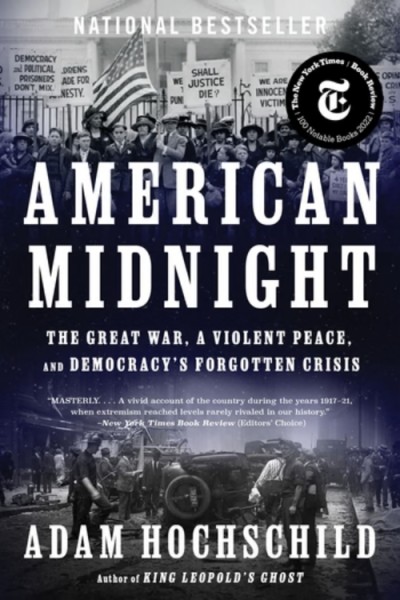
Adam Hochschild’s American Midnight reveals how quickly fear and demagoguery can turn democratic institutions against immigrants, minorities, and dissenters.
Adam Hochschild’s “American Midnight” (2022) reminds us of a period (1917-21) in which white nationalism, racism, anti-immigrant sentiment, and hostility to many foreign countries characterized our politics. Ironically enough, it was a time when a Democrat, some even considered him (Woodrow Wilson) a Progressive, was president. In the author’s words, “It is a story of how a war [WWI against Germany and its allies] supposedly fought to make the world safe for democracy became the excuse for a war against democracy at home.” In the midst of that war, in late 1917, the Communists in Russia seized power, and that also fed anti-foreign hysteria and fears.
As Hochschild quotes a source, “The years from 1917 to 1921 are probably unmatched in American history for popular hysteria, xenophobia, and paranoid suspicion. The Bolshevik seizure of power only intensified the crackdown on American dissent.”
Those reactions remind us of the present, roughly a century later, when “a war against democracy” is again being charged, this time against the Republican Trump administration.
Perhaps the least surprising was the hostility toward Germany and German immigrants once we entered the war in 1917. Hostility toward immigrants was not new to the USA. In the 1850s, there had been the Know Nothings (officially the “American Party”), who wanted to restrict immigration and exclude the foreign-born from holding public office or voting. In 1894 the Immigration Restriction League was founded by those "convinced that Anglo-Saxon traditions, peoples, and culture were being drowned in a flood of racially inferior foreigners from Southern and Eastern Europe.”https://www.harpercollins.com/products/american-midnight-adam-hochschild?variant=41003534123042
The anti-immigration people, however, remained a minority. By 1910 immigrants made up 14.7 percent of the U. S. population, those born in Germany providing the greatest number. Among them were my own maternal great-grandparents, some of whom settled in Cincinnati.
They lived in the Over-the-Rhine district of that city, and my mom attended the district’s Germanic public school. She was nine when the U. S. entered the war in 1917. According to Hochschild, “Pushes to eliminate German instruction was one victim of the ‘selective hysteria’ observed by Cincinnatians towards German culture as a result of the war, which caused the ban of German to escalate across Cincinnati public schools starting in February 1918. Additionally, most or all of the remaining Cincinnati-based private German-American schools closed during the war. By 1919, the Ake Law banned all German instruction below grade eight for the entire state of Ohio.”
One of the most influential anti-immigrants was the Republcan Rep. Albert Johnson of Washington State—according to Hochschild, “Johnson defined his political life by his hatred of immigrants.” But, Hochschild tells us, it was not until 1924, with Republican Calvin Coolidge as president and Johnson still in Congress, that his “decades-long crusade against immigrants climaxed...with the passage of the Johnson-Reed Act. Until it was abandoned more than 40 years later, the act placed the most severe restrictions on immigration in American history. It barred Asians from the country entirely, and it parceled out only a tiny quota of slots to other immigrants.”
Not surprisingly, racism—amply manifested by Johnson—was on full display during the 1917-21 period. Hochschild writes: “Despite all the other currents of violence in American life, nothing quite equaled the sadistic fury that met any hint of Black assertion. A man accused of something as mild as not yielding a sidewalk quickly enough to a white person faced the risk of lynching—often preceded by torture, mutilation, or castration...Mobs lynched thousands of Black men over the decades, never less than several dozen per year and often more than 100. Then in 1915 came the rebirth of the Ku Klux Klan [KKK], its flaming torches and burning crosses once again lighting the night sky.”
Another source indicates that in the 1919-1922 period at least 239 Black lynchings occurred. That same source indicates that the KKK also "used other terrorist methods against Black people, as they did in 1921 in the case of a Dallas, Texas bellhop named Alex Johnson, whom Klansmen accused of having sex with a white woman. They branded KKK onto his forehead, but, as usual, the Klansmen responsible were not prosecuted." The Klan reached its apex in the mid-1920s—in 1925 over a quarter of native-born, white Indiana males belonged to the Klan—only in the late 1920s did it begin to decline.
Hochschild ends his book with a warning:
Almost all the tensions that roiled the country during and after the First World War still linger today. It may be a sudden event that kindles them into flame, as did the nation’s entry into that war, followed by the Russian Revolution, or it may be gradually mounting pressures. Some of those pressures are already here, such as the increasing northward flow of refugees fleeing global warming. To keep these dark forces from overwhelming American society once again will require a lot from us. Knowledge of our history, for one thing, so we can better see the danger signals and the first drumbeats of demagoguery. Brave men and women both inside and outside the government, like those who spoke the truth and stuck to their principles more than a hundred years ago. A more equitable distribution of wealth, so that there will not be tens of millions of people economically losing ground and looking for scapegoats to blame. A mass media far less craven toward those in power than it was in 1917–21. And above all, a vigilant respect for civil rights and constitutional safeguards, to save ourselves from ever slipping back into the darkness again.
