

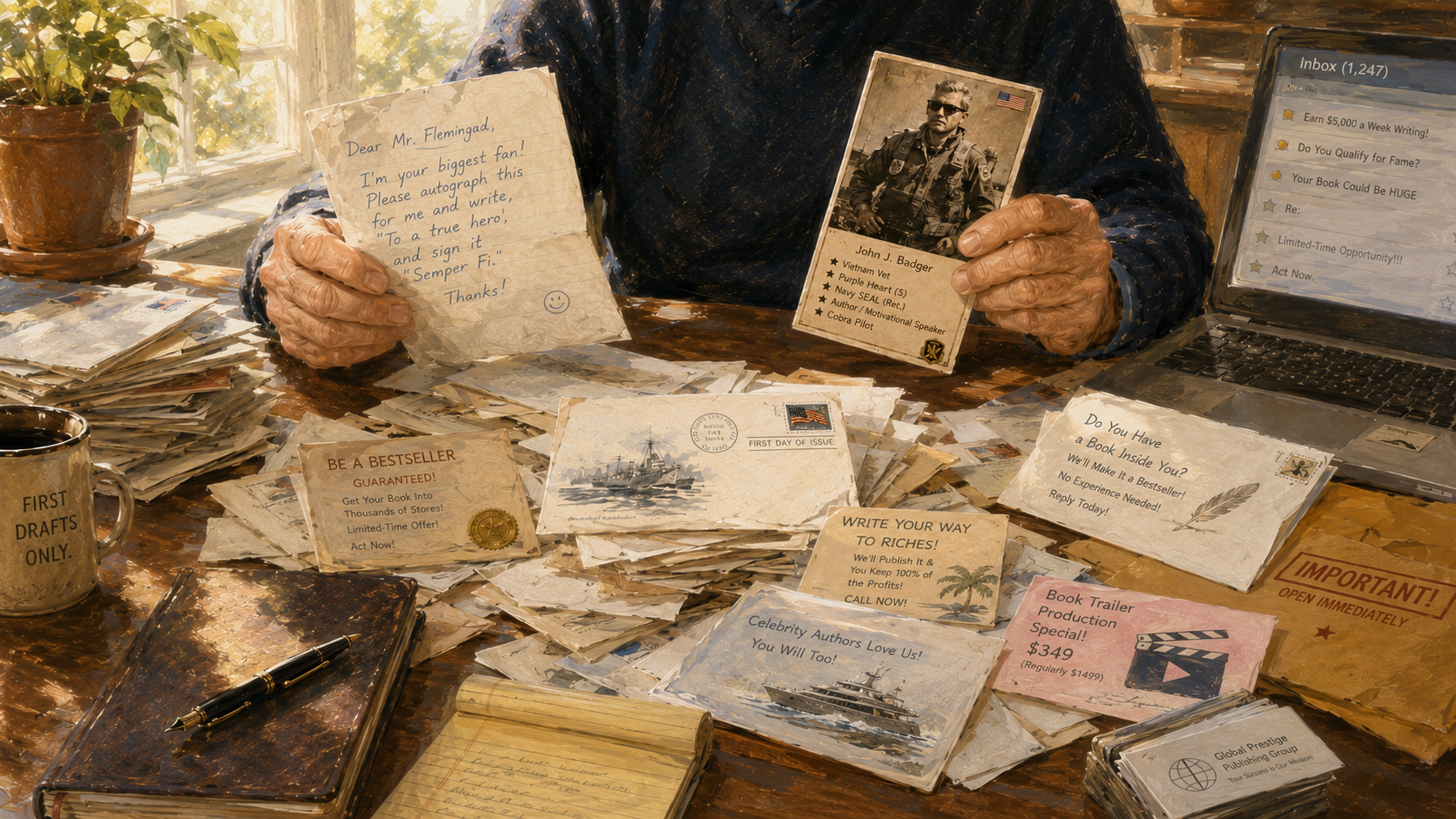
The Price of Fame?


From Bogus Book Clubs to Autograph Hunters, Writers Face a New Kind of Digital Hustle
About a year ago, I began receiving e-mail proposals from an assortment of people claiming, variously, to represent entities like the Western Australian Reading Society, the London Gay Book Club, the Chesapeake Readers Community, and the Washington Book Enthusiasts.
And over the course of the year, these have begun to arrive with ever greater frequency to the point that I am now receiving multiple solicitations each week, sometimes more than one a day.
Each one focuses on a single book of mine—usually, but not always—one that has just been published. Recent favorites are Getting Shot At: Essays on War, Conflict, and Culture Clash and the re-issue of Vietnam-Perkasie: A Combat Marine Memoir, both of which were released this year.
Some of these e-mails are quite extensive. With the re-issue of Vietnam-Perkasie, for instance, I’ve been told multiple times how valuable it is to have a memoir written from the point of view of the 18-year-old Marine rather than the hindsight of the much older and more mature writer. And how special it is to have 32 photographs I took in 1967 and 1968 included in the book.
The senders discuss the book as if they’ve actually read it when in fact, invariably, they are saying nothing that isn’t in the description of the book posted on the Amazon site itself. A description that I myself wrote and provided to my publisher, who passed it on to Amazon.
These pitches almost invariably come in one of two varieties. One involves my having been carefully selected, because of the quality of my work I am assured, to be a featured writer for the group. The other claims that my work is too good to languish in obscurity, and he or she can boost my visibility on Amazon, thereby giving me access to the audience—and the sales—my writing deserves.
And all I have to do to avail myself of these marvelous opportunities is make a modest payment for their services.
When I tell them to contact my publisher, I invariably never hear from them again. But that’s no matter because the supply of hopefuls is apparently endless. New e-mails just keep coming, week after week, even day after day.
Is this part of the electronic future, like SmartPhones and Zoom, Tik Tok and Facebook? Like eBooks and online publishing and Artificial Intelligence? Is this what a writer has to do to make it in today’s Techno-World?
Or are these people who keep contacting me just con artists and scammers who’ve found another way to make a buck off those sorry suckers who are born every minute?
I have no idea, and don’t really care. It is quite clear to me that, at the age of 78, and after half a century of writing and publishing, I am not suddenly going to become a bestselling author reveling in fame and attention and book sales, and rolling in $$$$$.
But even more recently, I seem to be famous enough that people want my autograph. This is really weird, but in just the past two weeks, I’ve gotten four letters from total strangers asking for my signature.
The first one came from what I took to be a young boy because the card was hand-written, block-printed actually, and had an assortment of stars and smiley face stickers. The note read:
“Thank you for Autographing my enclosed index card. Thank you for serving our nation during the Vietnam War. You were protecting my Freedom from the North Vietnamese Communists. ‘Nam’ was an hard fought war. May you have an great day! * May God bless you & America!!!” [errors in original]
But three more letters have arrived in the past few days, the last one just today. All are typed, all clearly come from adults, and each contains some sort of custom-made card I’m supposed to sign (a first-day-of-issue envelope, an index card with a photo of me taken off the internet, and a commercially-produced Vietnam War “fact card”).
One of the letters congratulates me on receiving the French Legion of Honor. Another says, “I am sorry you had to endure being a POW.” Neither of which is true.
Decades ago, when I was very young and relatively new to publishing, someone sent me a first-day-of-issue stamped envelope and asked me to sign it. I was flattered. The next thing I knew, it was for sale on some website. I may be slow, but I try to learn from my mistakes, and that’s a mistake that I’ve never made again.
Whatever. The fact is that I am not a famous person, yet I have ended up having to deal with these distractions and irritations on an increasingly regular basis. And I find myself wondering what people who are actually famous have to put up with. But they probably have administrative assistants and personal secretaries and gofers to keep it all at bay.
