

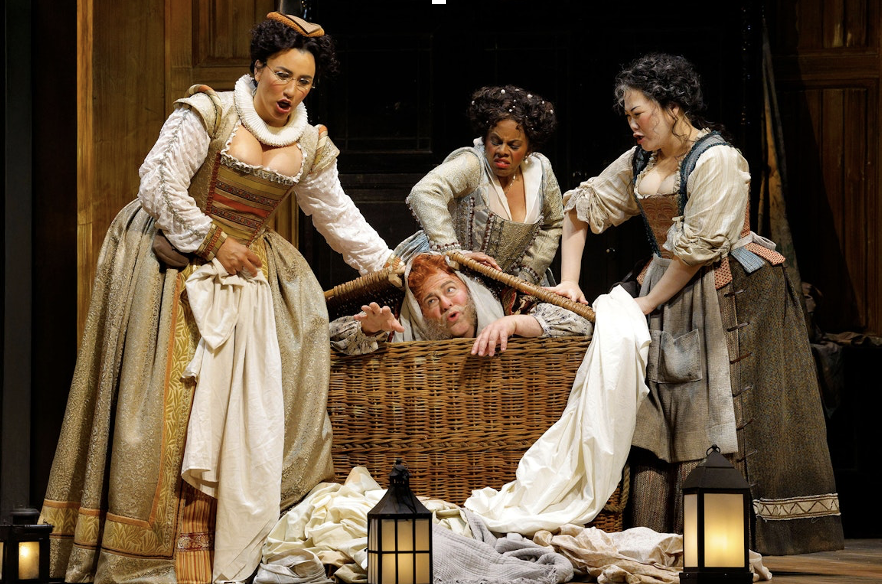


Verdi had adapted two other of Shakespeare’s plays, Macbeth and Othello, but chose in this one to focus not on the tragedy in overreaching but on the humor in it.
These reflections are occasioned by the LA Opera’s hugely enjoyable recent production of Verdi’s last opera, written when he was 80, his autumnal adaptation of Shakespeare’s Falstaff. Of course, there is no Shakespeare play titled Falstaff. Verdi adopted it mainly from the comedy The Merry Wives of Windsor with additional dialogue from Shakespeare’s history plays with a tragic sheen Henry the IV, Parts 1 and 2.
It's called a comic opera and that indeed is what it is. Comic is a funny word because in our modern world of sit coms we think that must mean belly laughs. Most often that is not the case in opera, but in this version, it is. Craig Colclough’s roly-poly Falstaff is, in his monumental and misplaced confidence and his indulgence in the lowest of misadventures, a buffoon who makes us all laugh and does so repeatedly.
The opening has the wonton Falstaff—Shakespeare’s name is itself a dirty joke since Sir John thinks he brandishes a “weapon” which intrigues but actually repels women, a false staff—wakes up drunk in a tavern low on money and planning ill thought-out knavery to seduce two noblewomen who control their husband’s purses. The story of the women’s revenge on their supposed seducer hangs on a misconception on the part of the protagonist. He doesn’t believe women talk to each other which proves utterly false as the two women both receive the same letter importuning them and that kicks off their revenge scheme.
Verdi had adapted two other of Shakespeare’s plays, Macbeth and Othello, but chose in this one to focus not on the tragedy in overreaching but on the humor in it, with his final word, in the last act, being that the story reduces to the need for laughter as healing and cleansing expressed in Falstaff’s final expression of good humor at his being bandied about: “All the world’s a jest.”
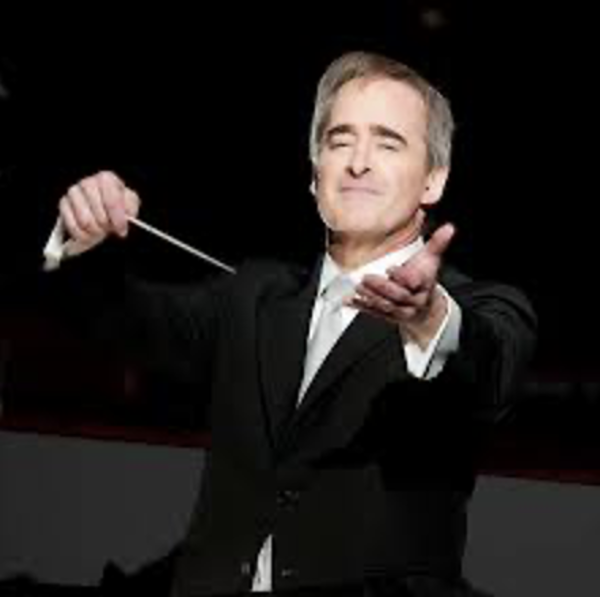
If this is Verdi’s final statement it is also a summing up of the retiring conductor James Conlon’s over 500 performances of Verdi’s operas, with the Sunday finale being his 60th performance of Falstaff surpassing all the others. Next up in this season of finales for the company is Gustavo Dudamel’s Ring Trilogy as he winds up his stay in LA and moves next season to New York.
Conlon is a master craftsman who understands the nuances of the Verdian melodies that flit in and out of the production adding to a light and gay air that is carried as much in the music and in the singers onstage.
The third act is a kind of repetition of the second, with Falstaff continuing to be justifiably bested by the two wives he sets out to seduce and cheat. Nicole Heaston is exceptional in the role of Alice Ford who, through her calculated exuberance, outwits Falstaff while teaching her jealous husband a lesson in trust.
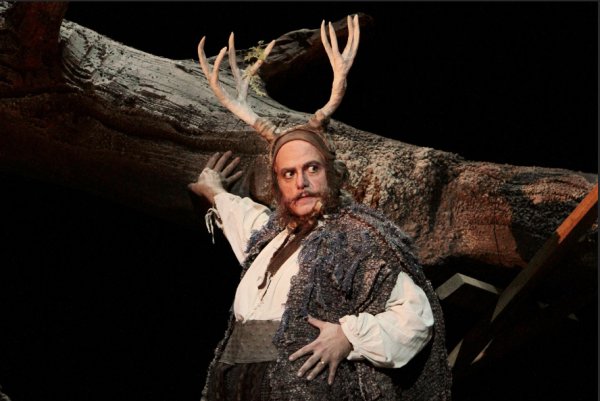
The staging of the third act, with the wives, their female allies and a host of children meeting the “stag” Falstaff, humiliated for wearing the horns he had hoped to imprint on the two husbands, is all awash in the woods with the deceivers clad as fairies, nymphs, goblins and other pagan creatures whose bawdiness contrasts with the upright moral mannerisms of the lords and ladies of the second act.
A quibble though is: Is “All the World’s a Jest” the ultimate wisdom? While Verdi’s conclusion is that Falstaff, through his arrogance, is ultimately only a comic figure, Shakespeare’s version, and particularly Orson Welles version Falstaff: Chimes at Midnight, emphasizes the tragedy of Sir John betrayed by his drinking and carousing buddy Henry who will now wear the mantle of king. The curtain before the 3rd act in this production contained the quote from Henry IV where he turns his back on his friend and choses blind power instead: I know thee not, old man. ..I have long dreamt of such a kind of man, So surfeit-swelled, so old, and so profane;But being awaked, I do despise my dream.” Shakespeare is a bit more ambiguous, about assuming the crown, but Welles presents the scene through Falstaff’s tear-filled eyes as he cannot believe this betrayal and utter lack of humanity, that which often accompanies the seizing of power.
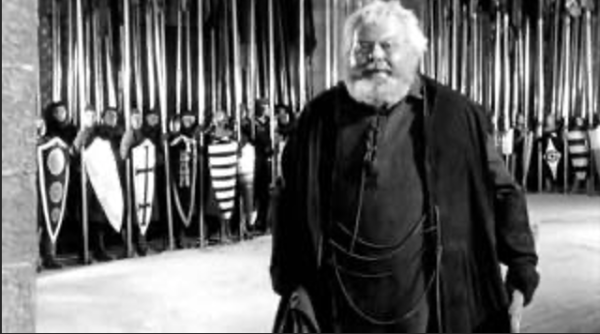
This Falstaff is absent from the opera, replaced by the time immemorial “All the World’s a Jest,” with this “entertainment maxim” becoming the rationale, well beyond Verdi’s time, for the entire Hollywood structure. Today though, with a Third World War at least on the horizon, if not already underway, with an economy in freefall except for the vaunted stock market, and with the treaties curtailing nuclear engagement all but broken, we have to wonder if jest is the ultimate answer and supreme wisdom, though that precept made for an eminently enjoyable night at the opera.
