



Removing the production barrier does nothing for a weak record. Music remains a taste business, and a beautifully rendered visual around a forgettable track is still a forgettable track.
An independent artist releasing a single has roughly six weeks of relevance and almost no visual budget. The release needs a video, a set of vertical clips, cover-adjacent artwork in motion, and enough variation to sustain a fortnight of posting without repeating the same eight seconds.
Traditionally, that meant one shoot day producing one video, sliced increasingly thin. The result is a release cycle where the audio is professional and the visual campaign runs out of material by day five. Generative video has been floated as the answer for a while, but only recently has it offered the one thing music visuals genuinely require: a look that holds.
A Release Is a Campaign, Not a Video
The industry framing hasn't caught up with how music is consumed. Labels still talk about "the video" as a singular deliverable, while discovery happens through dozens of short fragments distributed across platforms over weeks.
That means the real requirement is a coherent visual world producing many outputs, not one polished artefact. A single hero video is a poor fit for that job — it yields perhaps six usable clips before audiences recognise the repetition.
Artists who understand this build a visual identity for the release and then generate against it continuously. The obstacle has always been that generating against an identity required either a large shoot or an animator on retainer.
Consistency Is What Makes a Release Feel Considered
Anyone who has managed an independent release knows the compromise. Assets get made piecemeal — a photographer here, a friend with a camera there, an AI experiment in between — and the campaign ends up looking like four different projects sharing a name.
That incoherence reads to listeners as a lack of seriousness, fairly or otherwise. Major-label campaigns are recognisable precisely because every asset shares a palette and a treatment.
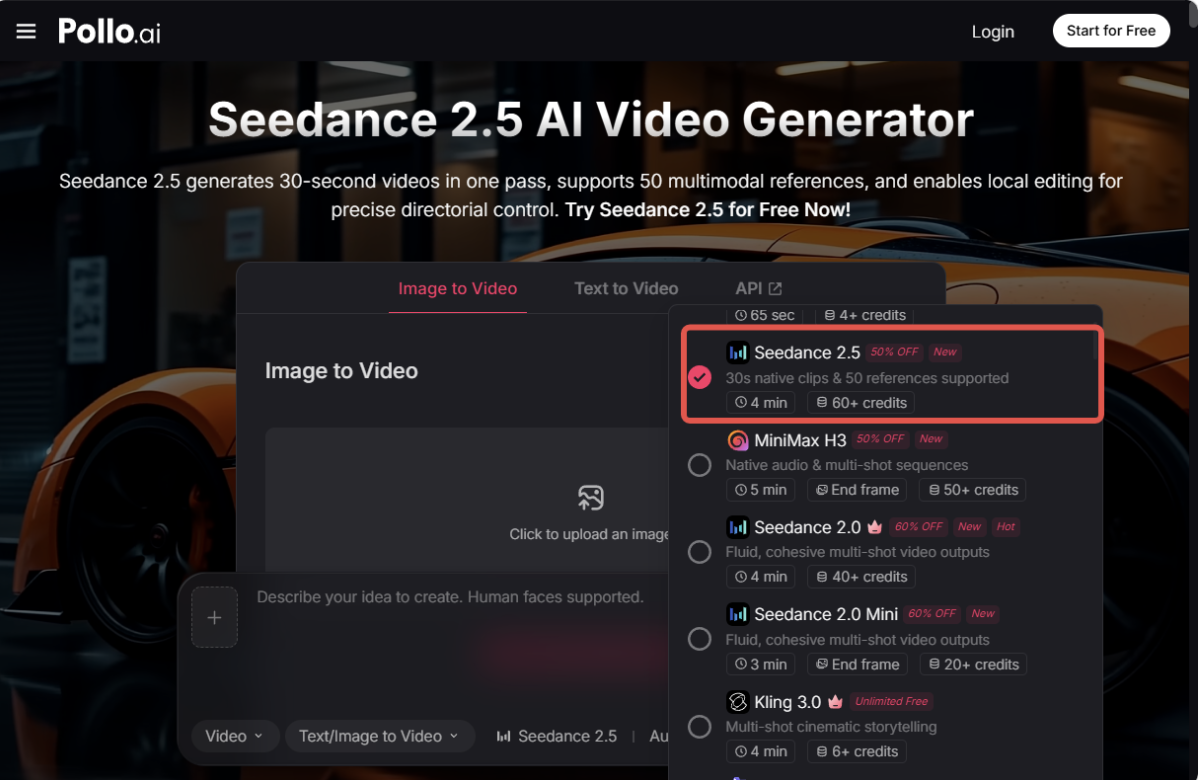
The technical basis for closing that gap now exists. Pollo AI's Seedance 2.5 AI Video Generator conditions on as many as fifty reference inputs simultaneously — press shots, artwork, texture samples, a clip demonstrating camera behaviour — so the artist's appearance, the campaign's colour treatment and the movement language stay locked across every asset produced. The identity is specified rather than described, which is the difference between a campaign and a collection.
Long Takes Serve Music Better Than Cuts
There's a craft point here that gets overlooked in discussions about generative tooling. A great deal of music video language relies on sustained shots — a slow orbit, a held close-up, a continuous drift through a space — because uninterrupted time lets the track carry the edit rather than the other way round.
Fragment-based generation forces constant cutting, which produces visuals that fight the music instead of supporting it. Thirty seconds generated natively in a single pass, with no stitched joins, covers a full chorus or verse and allows the shot to breathe.
Native 4K output matters more here than in most applications, because music visuals end up on festival screens, playlist canvases and press placements simultaneously. Producing once at high resolution and reformatting downward avoids the quality loss that follows from upscaling social-sized footage for a larger context. With the model presently listed at half price, building out a full release kit sits within reach of budgets that previously covered a single shoot day.
Iteration Fits How Releases Actually Behave
Music campaigns change mid-flight. A track gains traction on an unexpected platform, a lyric becomes the hook people repeat, a remix arrives, a sync opportunity appears with a two-day turnaround.
Under a shoot-based model none of that can be responded to visually — you have the footage you have. Under a generation model, producing a new asset in the established visual language takes an afternoon, which turns a campaign from a fixed plan into something responsive.
Localised editing supports the same behaviour at a finer grain. When the label wants a different garment, a changed background element or an adjusted colour cast for a particular market, the specific element is revised without regenerating the whole piece — so the approved look survives the amendment.
Where Corporate Video Tools Serve the Industry Side
The business layer around a release generates its own video requirements, and they're nothing like creative work: distributor onboarding, sync licensing explainers, artist-services education, multilingual press materials, internal briefings for regional teams.
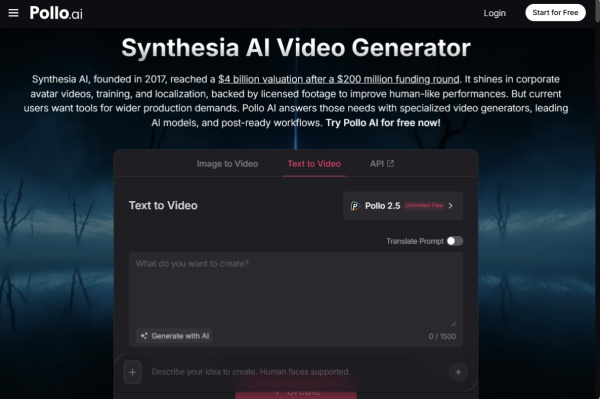
Synthesia AI Video Generator handles that workload and sits beside Pollo AI as a different instrument entirely. It centres on scripted presenter output — a catalogue exceeding a hundred and sixty avatars with natural movement and expression, delivery available in more than a hundred and forty languages, and an assistant that turns a document or a supplied link into a complete script with scene structure and generated supporting footage. Unified brand settings keep every output aligned, and its licensed media library removes clearance friction for teams publishing continuously.
For a distribution company explaining royalty splits to artists across nine territories, that's the right tool. It has no bearing on how a single looks, which is exactly the point of keeping the two workflows separate.
Building a Visual Kit for One Release
Define the Look From Assets You Already Own
Start with the artwork, the best two press shots, a colour reference and a texture that captures the record's mood. Add a short clip demonstrating the camera movement you associate with the track. This becomes the campaign's fixed condition set, and freezing it before producing anything prevents the drift that makes independent campaigns look assembled rather than designed.
Produce the Hook Section First
Identify the eight to twelve seconds of the track that people will actually repeat, and build the strongest visual for that segment before anything else. Within Pollo AI's Seedance 2.5 AI Video Generator, generating that section as one continuous take keeps the artist's appearance and the physical behaviour of the scene stable through the whole passage, which matters when the same clip will be watched dozens of times on loop. Everything else in the campaign should be designed to feel like it belongs to this piece.
Build Variation Through Single-Element Changes
Rather than creating unrelated new concepts for each post, hold the reference set constant and vary one thing — the setting, the time of day, a prop, the camera's distance. Because edits can be applied to individual elements without rebuilding the sequence, a fortnight of distinct posts can share a visual DNA that audiences recognise instantly. Novelty is far less valuable here than familiarity with variation.
Reformat Last, Never Reshoot
Generate at full resolution and full length, then derive the vertical, square and wide versions from that master. Frame with margin so cropping never clips the artist's head or a key visual element. Anything that is fundamentally an explanation rather than a performance — a campaign brief for regional partners, a licensing walkthrough — belongs with a platform such as Synthesia AI Video Generator instead.
The Constraint Has Moved
Removing the production barrier does nothing for a weak record. Music remains a taste business, and a beautifully rendered visual around a forgettable track is still a forgettable track.
What changes is who can sustain a visible campaign for the full six weeks that matter. That capability previously tracked budget almost exactly, which filtered out a great many artists whose music deserved better distribution than their visuals allowed.
Whether a team relies on Synthesia AI Video Generator for its industry-facing communications or on reference-conditioned generation for release visuals, the work that separates campaigns is now taste and consistency rather than access. Those were always the interesting variables. They were simply buried under production cost.
