

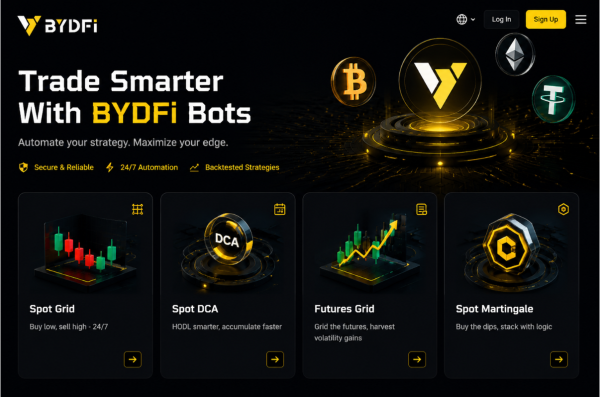


Trading bots do not predict markets — they structure reactions to them.
Do crypto trading bots actually help traders navigate volatile markets — or are they just another layer of complexity wrapped in automation?
The reality sits between hype and skepticism. BYDFi trading bots offer a practical lens to understand how automation works in real conditions. The platform, operated by BYDFi and now reporting over 1,000,000 registered users across 190+ countries, provides multiple bot types plus a Bot Marketplace designed for different trading styles and conditions. In practice, the effectiveness of automation depends less on the tool itself and more on how it is applied in volatile environments — especially when dealing with crypto trading bots for market swings.BYDFi Trading Bots: How Automation Helps Crypto Traders Manage Market Swings
Below are five common myths, and what actually matters in real trading environments.
Myth1: One Bot Works in Every Market Condition
Crypto markets constantly shift between sideways ranges, sharp corrections, and trending phases. No single automation strategy performs well across all regimes.BYDFi offers multiple bot types designed for different environments:
Spot Grid bots are particularly effective in volatile sideways markets, capturing repeated price oscillations that manual trading often misses.
Myth2: You Need Advanced Quant Skills to Use Bots
Modern trading bots are increasingly designed for accessibility.BYDFi provides AI-assisted parameter suggestions for Spot Grid strategies based on historical data. In many cases, users can deploy a bot in under a minute by selecting a trading pair and confirming recommended settings.Spot DCA bots are even simpler: choose an asset, set an amount, define frequency, an
d automation handles execution.The platform also supports copy trading and a demo environment funded with virtual balance, allowing users to experiment before committing real capital.
Myth3: All Bots Carry the Same Level of Risk
Automation does not standardize risk — strategy design does.Spot-based bots (Grid, DCA, Martingale) operate within available balances, meaning there is no liquidation risk. Losses are limited to asset depreciation.
Futures Grid bots, however, introduce leverage. This amplifies both gains and risks, including liquidation under extreme price movement.Understanding this distinction is essential when deploying crypto trading bots, because volatility affects spot and leveraged systems very differently.
Myth4: Bot Trading Always Comes with Hidden Extra Fees
Another misconception is that automation layers additional costs on top of trading fees.On BYDFi, standard spot trading fees apply (0.1% buy / 0.1% sell), whether trades are executed manually or through bots. There is no separate automation surcharge for using trading bots.This means cost efficiency remains consistent even when bots execute multiple trades during volatile periods.
FAQ: What types of trading bots are available?
Spot Grid, Spot DCA, Spot Martingale, and Futures Grid, plus an upcoming Bot Marketplace for strategy sharing.Can beginners use trading bots easily?
Yes. Pre-set parameters, AI suggestions, and demo trading reduce complexity significantly.Are there extra fees for bots?
No additional bot fees. Standard trading fees apply to all bot activity.The Real Insight: Automation Is About Structure, Not PredictionSpot Grid, Spot DCA, Spot Martingale, and Futures Grid, plus an upcoming Bot Marketplace for strategy sharing.
Can beginners use trading bots easily?
Yes. Pre-set parameters, AI suggestions, and demo trading reduce complexity significantly.Are there extra fees for bots?
No additional bot fees. Standard trading fees apply to all bot activity.The Real Insight: Automation Is About Structure, Not PredictionTrading bots do not predict markets — they structure reactions to them. Their real strength lies in executing disciplined strategies during volatility, especially when markets move unpredictably.In this sense, trading bots are not tools that remove uncertainty. They are tools that systematize how traders respond to it — consistently, continuously, and without emotional interference.
