


Another problem, with both the book and the film is that neither medium offers a clear answer as to why the goshawk’s killing of other animals, like rabbits, is necessary.
In 2023 I wrote that “increasing our human contacts is one way to overcome loneliness”—which some experts believed was becoming epidemic in the USA. But another way was “for us to realize our oneness with other forms of life—the non-human ones found in nature, whether they be in the animal or non-animal world.” In that writing I highlighted the poetry of Mary Oliver, but I’ve just discovered another writer, the British Helen Macdonald, who shares that perspective.
In her 2020 Vesper Flights—a book of essays—Macdonald writes that her writing reflects “most specifically love for the glittering world of non-human life around us.” And she adds that we should “understand that your way of looking at the world is not the only one,” that we should “think what it might mean to love those that are not like you.” We should “rejoice in the complexity of things. Science encourages us to reflect upon the size of our lives in relation to the vastness of the universe.” (Good advice to counter the Trumpian attacks on Diversity, Equality, and Inclusion—DEI.)
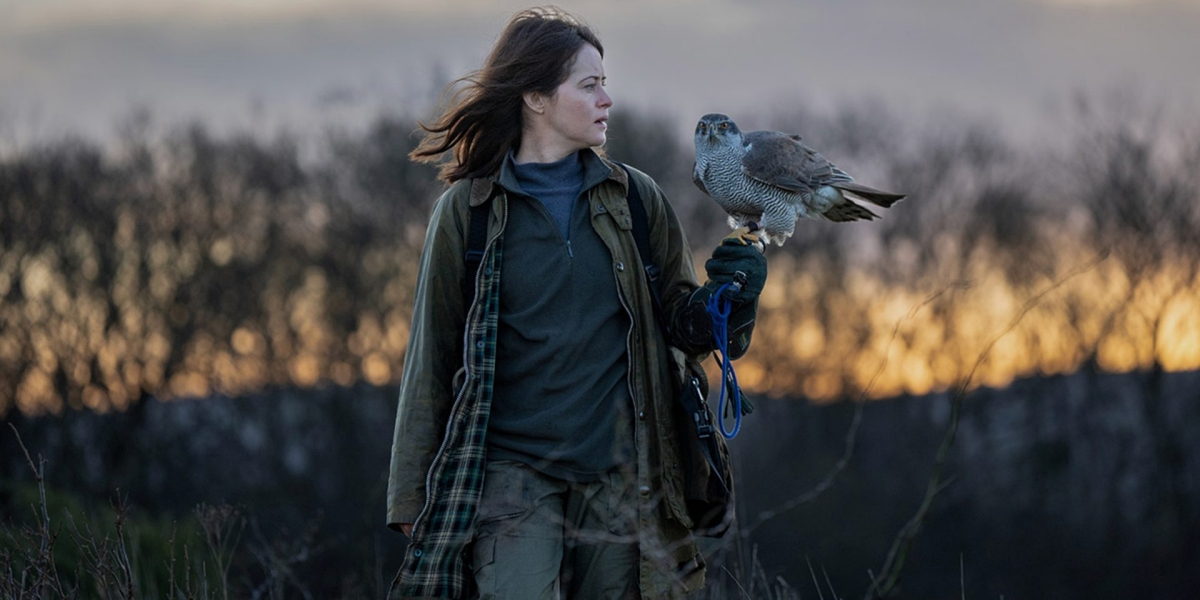
My discovery of Macdonald, however, came not through one of her books, but a recent (2026) film, “H Is for Hawk,” based on the same-named 2014 memoir of hers. It deals with her attempt to cope with the death of her father (played by Brendan Gleason). And Macdonald herself is portrayed by another excellent actor, Claire Foy, who won awards for her portrayal of a young Queen Elizabeth II in the Netflix series The Crown. (Others in the cast, such as Lindsay Duncan as Helen’s mother and Denise Gough as her friend Christina, contribute to the outstanding acting featured in this movie.)
Macdonald’s way of coping with the loss of her father, however, drives her to swerve too far from human contacts, and the film—unlike her memoir, which explains how she regained her balance—insufficiently provides an answer. One film reviewer perceptively wrote that audiences unfamiliar with the book “may have their work cut out in joining up these final dots.”
Another problem, with both the book and the film—and given the limited knowledge of humans, perhaps we have no answer—is that neither medium offers a clear answer as to why the goshawk’s killing of other animals, like rabbits, is necessary.
In a previous essay I explored the question of the suffering of innocent children, a problem that writers like Dostoevsky and Camus struggled with and Jewish rabbi Harold Kushner later addressed in his book When Bad Things Happen to Good People. In the film based on Macdonald’s memoir, Helen tries to explain why killing is necessary in nature.
After one of her listeners asks, “Couldn't you feed her [her pet bird] bird seed?” Helen
answers, “No, she's a carnivore. And you see her talons. You see her hooked beak for rending flesh. . . . I have a responsibility to let her be a Goshawk. To raise a hawk and not let it hunt would be like . . . not letting a child play.” (Quotes from the film are taken from the filmscript, which adheres closely to film dialogue.)
Her listener then objects, “All you're really doing is bringing death.” To which she then responds, “Well, . . . death's already there. You know, death's everywhere. But we're just . . . we're constantly protecting ourselves from it. . . . We want to keep death hidden well away, but . . . hunting with Mabel, it's . . . an honest encounter with death.”
The only problem with Helen’s answer is it still does not answer why if an all-loving and perfect God exists, the suffering and death of victims, like the rabbit, are necessary.
Perhaps our only answer is that suggested by perhaps the most famous U. S. Protestant theologian of the 20th century, Reinhold Niebuhr. He stressed humility linked with humor. Here is what he stated:
People with a sense of humor do not take themselves too seriously. They are able to ‘stand off’ from themselves, see themselves in perspective, and recognize the ludicrous and absurd aspects of their pretensions. All of us ought to be ready to laugh at ourselves because all of us are a little funny in our foibles, conceits and pretensions. What is funny about us is precisely that we take ourselves too seriously. We are rather insignificant little bundles of energy and vitality in a vast organization of life. But we pretend that we are the very center of this organization. This pretension is ludicrous; and its absurdity increases with our lack of awareness of it.
“Insignificant little bundles of vitality and energy in a vast organization of life.” We may not like to look at ourselves that way, but perhaps that’s as close as we can get to the truth.
