

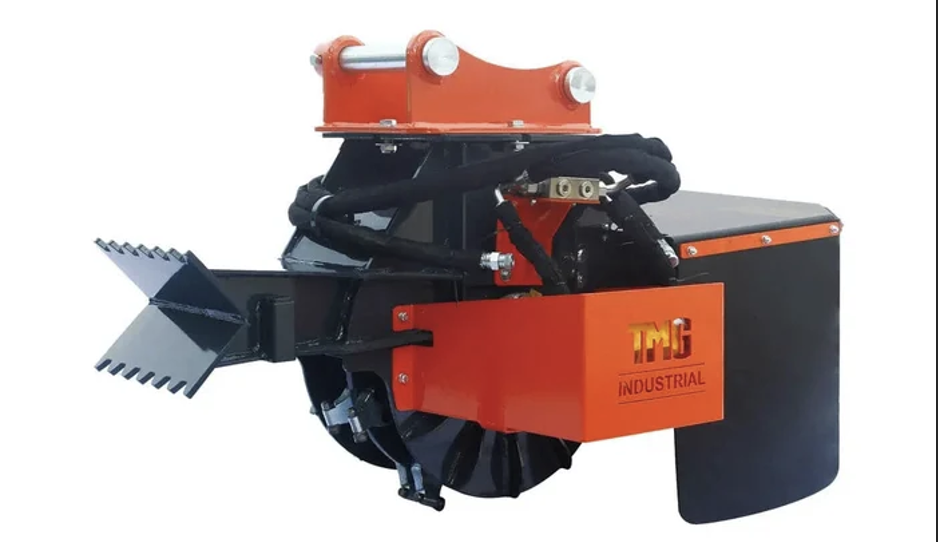


Bolting the grinding wheel to an excavator arm, rather than a set of wheels, changes which stumps are even reachable.
Summer clearing turns up stumps in places a machine cannot stand
Across an American summer of land clearing, the stumps that hold up a job are rarely the easy ones on open ground, but the ones on a bank, tight to a wall, or across a ditch, and the tool that reaches them is an excavator stump grinder.
Bolting the grinding wheel to an excavator arm, rather than a set of wheels, changes which stumps are even reachable.
The arm is the whole reason this version exists
A walk-behind grinder has to be stood over its stump on ground firm enough to hold it.
An excavator stump grinder is carried out on the boom, so it works stumps the operator could never safely stand beside.
Reach and slew place the wheel without moving the machine
The boom extends and the house slews, so the wheel sweeps across a stump while the carrier sits still on stable ground.
That reach lets one setup clear several stumps in an arc, and it keeps the machine back from a soft edge or a slope it should not climb.
Hydraulic oil from the carrier, not an onboard engine, spins the wheel
The attachment has no motor of its own; it runs on hydraulic flow piped out from the excavator.
A hydraulic drive motor on the head turns that flow into wheel torque, which is why a stump grinder of this kind carries no engine to service.
The match to the carrier decides whether it works at all
The attachment is built for three to seven ton machines, and the carrier has to supply the flow and pressure the head was designed around.
Too little flow and the wheel stalls in the cut; too small a machine and the reach that makes it useful also makes it tippy.
Grinding below grade takes the boom, not more downforce
A stump has to come out below the surface so a new lawn or a footing can go over it, and the boom presses the wheel to that depth in place of an operator leaning on a machine.
The excavator holds the head under grade steadily, so the stump grinder cleans out the root crown rather than just skimming the top.
Distance is a safety margin as much as a reach
Because the wheel works out on the boom, the cab and the operator sit well back from the flying chips and the stump itself.
That gap is worth as much on a steep bank as the reach is, since the machine never has to climb the ground it is clearing.
Where oil meets the motor is what gets checked
With no engine to service, the care goes to the hydraulic couplers, the hoses, and the drive motor, where a leak quietly steals the flow the wheel needs.
A quick look for weeping fittings before a long day keeps a stump grinder cutting at full torque instead of fading in the cut.
Clearing tight to a wall is where the reach earns out
Stumps left beside a fence, a foundation, or a septic field are the ones a drive-up machine cannot safely approach.
Slewing the head in from a safe distance lets a crew take those out without risking the structure or the machine.
Feeding the wheel is a slow sweep, not a hard push
The operator eases the wheel through the stump in thin passes, letting the hydraulics carry a steady bite rather than forcing the boom down.
A crew clearing a fence line outside Nashville worked each stump in shallow sweeps and never once stalled the head against the wood.
A boom-mounted cutter throws chips with real reach behind it
The wheel slings chips and grit well out from the cut, so the cab stays glazed shut and nobody stands within the arc of the head.
On a slope the carrier is set level and stable first, since a machine reaching downhill with a spinning head has the least margin for a slip.
Grinders divide by how they are carried to the stump
• Walk-behind: its own engine, firm flat ground
• Excavator attachment: boom reach, carrier hydraulics
• Skid steer mount: drive-up power on open sites
Where the excavator version wins and where it does not
• Strength: reaches banks, ditches, and wall lines
• Strength: no engine of its own to maintain
• Limit: only as able as the carrier hydraulics
• Limit: needs a stable machine for the reach
Weighed against a walk-behind, it gives up drive-up simplicity to reach the stumps that stopped every other tool.
Clearing crews increasingly want one carrier to do more jobs
As operators run more attachments off a single excavator, a grinding head that shares the machine already on site earns its place over a separate engine.
That move toward one versatile carrier is why the land clearing equipment that TMG Industrial builds hangs real grinding power off the arm a crew already brought.
