




The danger of early success gambling is that it creates a powerful memory that your brain will chase for months or even years after the fact.
You have probably heard that losing is dangerous for gamblers, but the truth is far more surprising and counterintuitive than most people realize. A single win, especially an early one, can cause more long term damage to your bankroll than a dozen losses stacked together. Why winning is more dangerous than losing comes down to how your brain chemistry changes after a victory, making you overconfident and reckless. Let me explain why that twenty dollar win at the slot machine might be the worst thing that ever happened to your gambling budget.
Think of a small win as a tiny taste of a drug that you did not even know you wanted before that moment. The danger of early success gambling is that it creates a powerful memory that your brain will chase for months or even years after the fact. A loss teaches you nothing except that gambling has risks, which you already knew before you started playing. A win teaches you that winning is possible, that you can beat the system, and that you have some special talent for gambling. This lesson is completely wrong, but your brain believes it absolutely because the dopamine feels so good.
The Chemical Trap That Rewires Your Brain
First win trap psychology begins in your brain’s reward center, where dopamine creates intense feelings of pleasure after any success. When you win, your brain releases a powerful chemical rush that feels rewarding regardless of whether the result came from skill or pure luck. This reaction encourages you to repeat the same behavior again and again because the brain only remembers how good the moment felt. Similar psychological systems are heavily used across online gambling environments, where platforms like 7Gear combine games, bonuses, and fast paced interaction to keep players emotionally engaged for longer periods.
After a win, dopamine surges strengthen the connection between gambling and pleasure while memory centers store the event as something emotionally important. Stress levels temporarily drop, confidence rises, and previous losses become easier to ignore completely. This is why many beginners continue gambling far beyond their original limits, increasing bets and taking bigger risks while chasing the feeling of that first emotional high again.
How Your Behavior Changes After a Win
Winning once leads to bigger losses because your behavior changes in predictable and dangerous ways after any victory. You start betting larger amounts because the win made you feel confident, lucky, and somehow invincible against the odds. You play longer sessions because the win made you feel like you are on a hot streak that cannot end. You take more risks because the win makes you feel like you have special insight that other gamblers lack. Each of these changes increases your exposure to the house edge, guaranteeing bigger losses over time.
Here is a table showing how your betting behavior changes after a win:
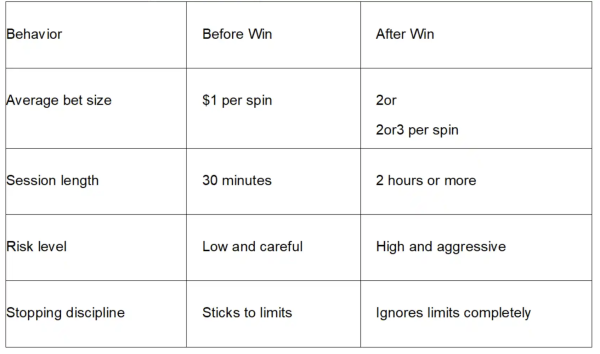
Danger of early success gambling is that these behavioral changes happen without you even noticing them in the moment. You do not decide to increase your bets, you just feel like betting more is the right move somehow. You do not plan to play longer, you just lose track of time because you are having too much fun. The casino knows this pattern better than you do, and it designs its games to encourage it. Your small win is not a gift from a generous casino, it is an investment the casino makes in your future losses.
The False Skill Attribution That Traps You
Why beginners win then lose everything is often explained by something psychologists call false skill attribution, which affects every gambler. When you win, your brain naturally assumes that you won because of something you did right in the moment. You picked the right machine, you stopped the reels at the perfect moment, or you had a lucky feeling about that number. In reality, you won because of random chance, not because of any skill or insight you possessed. Your brain refuses to accept this explanation because it desperately wants to feel competent and in control.Here is what false skill attribution looks like in practice at the casino:
- You remember the win as proof of your gambling ability
- You forget that the loss before the win was also completely random
- You develop elaborate theories about why your system works
- You share your "winning strategy" with other gamblers
- You ignore mathematical evidence that randomness rules everything
Overconfidence after winning grows with every win, whether those wins are lucky or come from genuine skill. A player who wins five times in a row genuinely believes they have figured something out about the game. The casino does not need to convince you of this false belief, your brain does it automatically without any help. Each win reinforces the false belief that you have skill, control, and special insight into randomness. This false belief is what keeps you playing long after the math says you should stop.
The Casino Knows What You Will Do
Casinos have studied winning behavior for decades, and they know exactly what you will do next after any win. Danger of early success gambling is so predictable that casinos factor it directly into their business models and profit projections. A small win is called a "loss leader" in the industry, which means an investment in your future losses. The casino is genuinely happy to give you fifty dollars today because you will give back five hundred tomorrow. This is not a conspiracy theory, it is simple math based on decades of real player data.Here is how casinos use your wins against you without you noticing:
- They celebrate your win with loud music and flashing lights
- They offer you free drinks to lower your inhibitions
- They remove clocks and windows so you lose track of time
- They make it easy to keep playing with one click
- They track your winning behavior to target future offers
Why beginners win then lose everything is not bad luck or a personal failing, it is a predictable outcome of casino design. The small win is the bait, and your brain's dopamine response is the hook that keeps you playing. The casino does not need to trick you with fancy illusions, your own brain does the work for them. Understanding this pattern is the first step to breaking it, but awareness alone is not always enough.
Protecting Yourself from the First Win Trap
The only way to avoid the danger of winning is to have a plan before you ever place your first bet of the session. Danger of early success gambling can be managed with pre-commitment strategies that actually work if you follow them. Decide how much money you are willing to lose before you start playing any game at all. Decide how much time you will spend before you sit down at a machine or table. Stick to these limits no matter what happens, whether you are winning or losing during the session.
Here are practical steps to protect yourself from the first win trap:
- Set a win limit and stop playing when you reach it
- Set a loss limit and stop playing when you reach it
- Take your winnings out of your gambling bankroll immediately
- Do not increase your bet size after a win, no matter what
- Leave the casino or close the app after any significant win
Why beginners win then lose everything stops happening when you follow these simple rules without making exceptions. A win is only dangerous if you keep playing after it happens, chasing that good feeling. Walking away with your winnings turns a potential trap into an actual victory that you can enjoy. The casino wants you to keep playing, but you know better now that you understand the trap. Take the win, say thank you to the casino, and leave before the math catches up with you.
FAQ
1. Why is winning once more dangerous than losing many times?
A single win changes your brain chemistry and behavior in ways that multiple losses cannot match at all. Losses make you cautious and likely to stop playing, which actually protects your bankroll. Wins make you overconfident, increase your bets, and extend your playing sessions significantly. This dangerous combination of behavioral changes leads to much larger losses after a win than after a loss.
2. What happens to my brain when I win at gambling?
Your brain releases a powerful flood of dopamine, the same chemical released during drug use. This dopamine spike creates a strong pleasure response and reinforces gambling behavior significantly. Your brain remembers the win as a significant event worth repeating many times. Stress hormones decrease, making you feel relaxed and somehow invincible.
