



When the Soviets tried to shame America with a film about Black life.
In the depths of the Great Depression, thousands of Black Americans joined the Communist Party USA. Not because they had memorized Marx. Not because Moscow beckoned. But because the Party was one of the only political organizations in the country confronting racial terror and economic exploitation at the same time.
Much like today, neither major political party was doing it. And while institutions like the NAACP were fighting crucial legal battles, they were not organizing unemployed Black workers, defending the Scottsboro Boys in the streets, or openly challenging the racial caste system embedded in American capitalism.
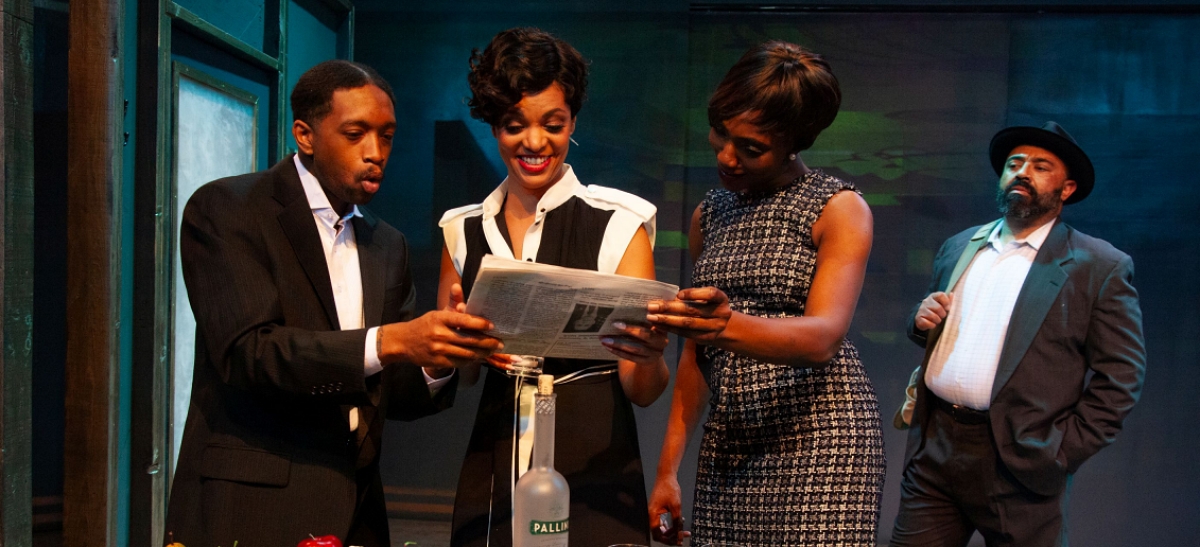
That combustible historical moment is the beating heart of playwright Kimba Henderson’s powerful new drama, Red Harlem.
Luis Kelly-Duarte and Rama Orleans-Lindsay • Claudio Parrone Jr. and Fana Minea Tesfagiorgis
The Film That Never Was
In 1932, as the Depression crushed working people nationwide—and devastated Black communities disproportionately—the CPUSA and Soviet officials conceived a bold propaganda project: a feature film exposing the brutality of Black life in America.
Titled Black and White, the script was written by none other than famed poet Langston Hughes, among others. The film was intended to contrast lynchings, labor exploitation, and segregation in the American South with the Soviet Union’s proclaimed racial egalitarianism. The message was blunt: capitalism breeds racism; socialism abolishes it.
The film would be shot in Moscow. Black American performers would star in it. And the world would watch.
Except the world never did.
Harlem to Moscow
As Red Harlem opens, historical figure James W. Ford (Micah Johnson)—the CPUSA’s vice-presidential candidate—auditions talent from Harlem’s glittering nightclub scene alongside fictional Soviet delegate Misha (Claudio Parrone Jr.).
They select a dazzling trio: Selena and Will (Fana Minea Tesfagiorgis, Ahei Togun), a charismatic song-and-dance duo, and Lenore (Rama Orleans-Lindsay), a statuesque singer whose presence commands the stage. Slipping into the mix is appropriately named Shifty (Luis Kelly-Duarte), a hustler who somehow manages to secure passage with the troupe.
For these performers, the opportunity is intoxicating. In America, doors are closed. In Moscow, they are promised stardom. They travel first class across the Atlantic, treated royally and greeted as honored guests. For a moment, it feels like history has opened.
And then history closes its fist.
Romance complicates everything—Selena and Will’s bond strains under ambition, while unexpected interracial dynamics unfold between Selena and Misha, and Lenore and David (Christopher Cassarino), a white businessman they meet at a stop in ominously unstable Berlin. The play does not shy away from tensions around interracial desire, ideological seduction, and even colorism within the Black community itself.
Henderson understands that politics without intimacy is flat. She gives us both.
Playwright Kimba Henderson • Director Bernadette Speakes
The Collapse of a Dream
If you’ve never heard of Black and White, there’s a reason. The project collapsed. Soviet priorities shifted. Bureaucracy intervened, much thanks to American plutocrat Hugh Cooper (Daniel Gerstein). Political winds changed. The performers’ dreams dissolved in the machinery of state power.
The film meant to expose American hypocrisy became instead a lesson in Soviet manipulation.
Neither superpower could fully confront its own failures.
America could not deal honestly with racial apartheid. The Soviet Union could not tolerate narrative control slipping from its grasp.
What makes Red Harlem sting is how contemporary it feels. The authoritarian drift. The propaganda wars. The way artists are courted, used, then discarded by political movements. The seduction of “elsewhere” when home feels unlivable.
History does not repeat, but it rhymes loudly here.
Why It Matters
Director Bernadette Speakes draws strikingly human performances from her marvelously talented cast. The emotional core lands because this is not simply a political drama; it is a story about longing—for dignity, for recognition, for opportunity, for love.
The performers aren’t naïve. They are ambitious. They want what America has always promised them but systematically denied them. That hunger makes them vulnerable—not just to capitalism, but to any system promising liberation.
That’s the sharpest insight of the play: exploitation does not belong exclusively to one ideology.
See it.
And then sit with it.
Red Harlem director Bernadette Speakes and cast members Claudio Parton and Akei Togun
Red Harlem opened February 14th and runs through March 15th Company of Angeles, 1350 San Pablo St., Los Angeles 90033. Performances Fridays and Saturday at 8 p.m.; Sundays at 3 p.m. Tickets: $10–$30 are available at 323.270.6325 and Company of Angels.
Photos by Raphael Cardenas