

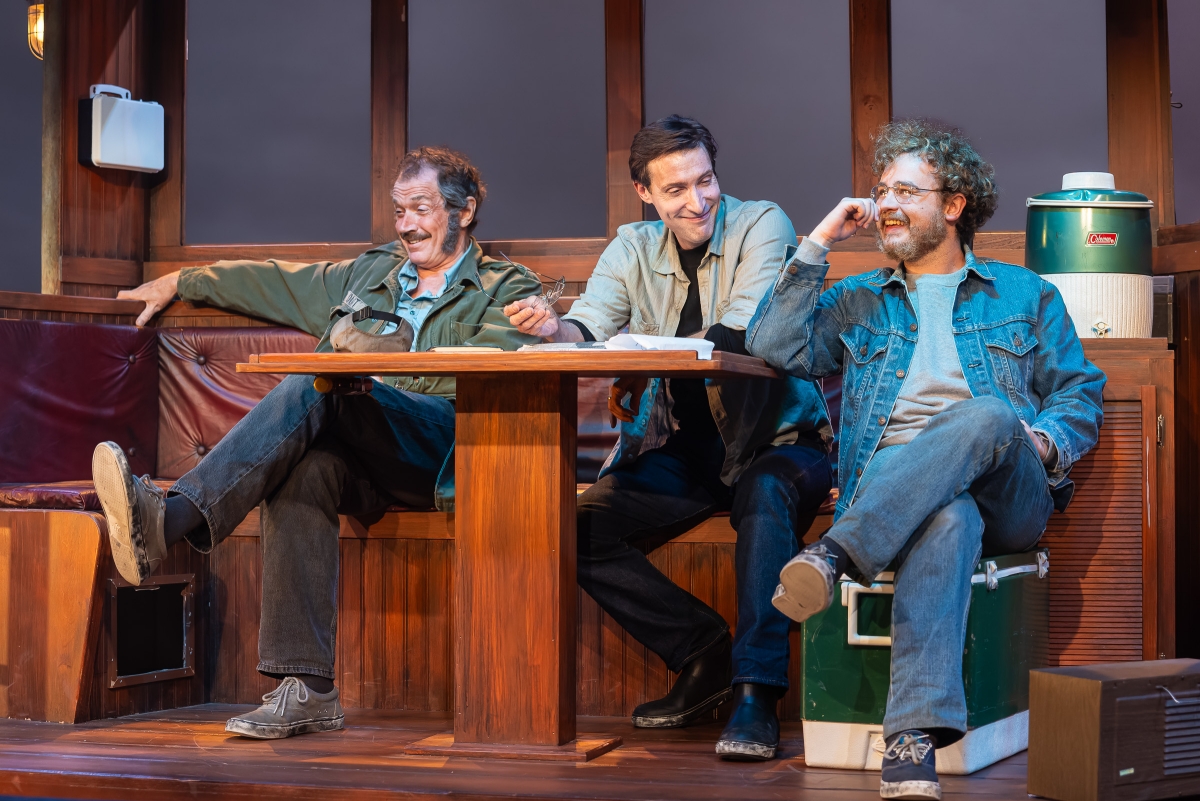

Now I’ve experienced what may be the best play about the making of a real-life movie, Ian Shaw and Joseph Nixon’s The Shark is Broken.
THE SHARK IS BROKEN: Theater Review
A few months ago, I had the immense pleasure of seeing the best feature ever made in motion picture history about the making of an actual movie, Richard Linklater’s Nouvelle Vague, which dramatizes the shooting of Jean-Luc Godard’s groundbreaking 1960 Breathless. Now I’ve experienced what may be the best play about the making of a real-life movie, Ian Shaw and Joseph Nixon’s The Shark is Broken. While Philip W. Chung’s 2024 Unbroken Blossoms may actually be a better play, that complex two-act drama deals with much more than just D.W. Griffith’s shooting of 1919’s Broken Blossoms, including celluloid stereotypes and the dynamics of racial politics.
On the other hand, The Shark Is Broken takes place entirely during the troubled production of Steven Spielberg’s 1975 blockbuster Jaws. The making of that hit was plagued by unpredictable weather – to enhance Jaws’ realism it was largely shot out on the ocean near Martha’s Vineyard, rather than in a studio water tank at some Tinseltown backlot. As the play’s title indicates, the shooting’s turbulence was intensified by the frequent breakdowns of the mechanized great white shark(s) contrived to “play” the role of Jaws’ eponymous character, which repeatedly delayed the filmmaking process.
However, the biggest source of conflict in The Shark Is Broken is the clash of personalities between Jaws’ three co-stars. The movie based on Peter Benchley’s novel may have been set at the fictitious Amity Island, but during much of this one-act play there isn’t much amity between the not-so-amiable leading men. A solid Hollywood supporting and sometimes lead actor, Roy Scheider (Adam Poole), who was the co-star of pictures such as William Friedkin’s 1971 The French Connection (and of a Jaws sequel, which the attuned listener will hear a good jibe about in Broken), portrayed Martin Brody, the police chief of the New England town with the shark-infested waters.
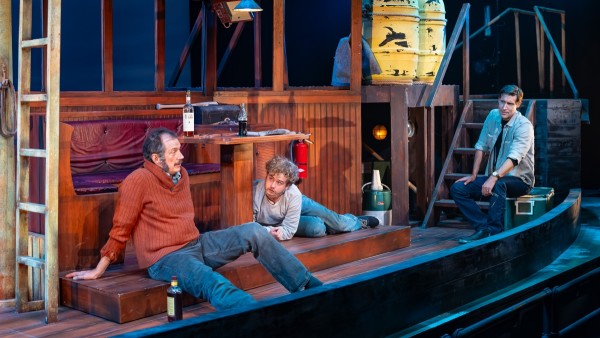 Gildart Jackson, Will Block, Adam Poole
Richard Dreyfuss (Will Block), who co-starred in George Lucas’ 1973 American Graffiti and delivered a powerhouse of a performance in 1974’s superb The Apprenticeship of Duddy Kravitz, may be considered to be representative of “New Hollywood.” In Jaws he played marine biologist Matt Hooper, and having crossed paths with Dreyfuss twice, I believe Block’s depiction of him as a jumpy bundle of neuroses consumed by nervous energy is accurate. Dreyfuss appeared in a production I co-presented in 2017, but I first encountered him when Dreyfuss portrayed Iago in Shakespeare in the Park’s 1979 production of Othello, which is ironic because in The Shark is Broken he muses about acting onstage and doing Shakespeare.Gildart Jackson, Will Block, and Adam Poole
Dreyfuss ruminates about this with Broken’s third main character, and its most enigmatic, the renowned British thespian Robert Shaw (Gildart Jackson), who had a rarefied Shakespearean background, which included training at London’s Royal Academy of Dramatic Arts, treading the boards at Stratford-on-Avon (where he was directed by John Gielgud) and at the Old Vic, etc., collaborated with playwright Harold Pinter, and went on to go from the stage to the screen, in English cinema before “going Hollywood,” including 1973’s The Sting. Endowed with an imposing physique, Shaw rather memorably played the Bond villain Red Grant, who has a battle royale with Sean Connery’s 007 aboard a train in 1963’s From Russia with Love. In Jaws, Shaw depicted the Captain Ahab-like Quint, the professional shark hunter with a fascinating backstory that Shaw unforgettably brings to life – as both thesp and scribe – as a centerpiece of Broken. (As the play notes, John Milius contributed to this harrowing speech which Shaw reworked and immortalized.)
Shaw shines in this drama with some comedic touches, not only because in 1975 he was then the most accomplished actor and biggest star of the trio, but also because The Shark Is Broken is co-written by his son, Ian Shaw (with Joseph Nixon), whose mother was the wonderful actress Mary Ure (1959’s screen adaptation of John Osborne’s Look Back in Anger). While Ian visited the set of Jaws as a child, his account of the sparring between its stars is not primarily based on his own memories, because he was only eight-years-old when his father, an alcoholic (which is a big part of Broken), died in 1978. Rather, according to Rolling Stone, Ian did extensive research, including perusing his sister’s extensive scrapbooks, plus reading print and watching televised interviews with his dad. In addition, Ian drew upon Jaws screenwriter Carl Gottlieb’s nonfiction book The Jaws Log.
Ian, who is also an actor, actually depicted his father in the original production at 2019’s Edinburgh Fringe Festival, then at London’s West End and in the Broadway version of The Shark Is Broken. Considering that the play deals with father-son issues – especially Robert’s vis-à-vis his alcoholic father, who committed suicide – this is a fascinating aspect that casts a shadow over Broken.
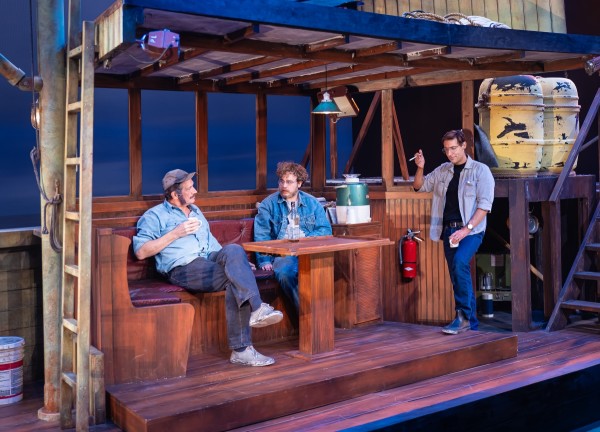 Gildart Jackson, Will Block, Adam Poole
Having said that, the English actor Gildart Jackson acquits himself well in the role of his troubled countryman essaying the part of the quirky Quint. Director Pesha Rudnick likewise elicits excellent portraits from Shaw’s true-life co-stars, Block as Dreyfuss and Poole as Scheider, who is the most even keeled of the characters, who consistently seeks to defuse the tensions between the other two – although as theatergoers will see, Poole’s Scheider has his quirks, too. For some strange reason, the most famous talent associated with Jaws, director Steven Spielberg, is an offstage presence in this play (like Langston Hughes, the most famous yet alas, unseen, character in Red Harlem, another stage production about a real-life proposed film that was, alas, never made). Although Elijah Frankle provides projections, “Bruce” – the eponymous mechanical shark – doesn’t set foot – or fin – onstage in Broken.
It can be argued that scenic designer Fred Kinney’s set, cleverly composed of the boat that the monomaniacal Quint and his cohorts track the killer shark down in, is a co-star in this play that is a film historian’s dream come true. Although Broken seems to run out of steam about two thirds the way through the 95-or-so-minute production, Jackson as Shaw as Quint redeems the drama when he harpoons the great white whale of what made Quint tick with a tour-de-force monologue for the ages. (What an irony of history that the servicemen who delivered the atomic bomb to be dropped on Hiroshima to Tinian in the Northern Marianas would meet such grisly fates…)
As a film historian, I’ll close by pointing something out that’s overlooked in Broken: Jaws, was the big budget blockbuster that broke the New Hollywood trend of ’60s/’70s character-driven films with personal visions that was then-prevalent in American movies. As Morgan Neville argues in his new documentary Breakdown: 1975, this was an unprecedented time in US filmmaking, producing classics such as One Flew Over the Cuckoo’s Nest, Dog Day Afternoon, Nashville, etc. Jaws came out that same year, but was followed by commercially-driven, mindless entertainment such Star Wars and other movie franchises like Indiana Jones, et al. After their boffo box office, Tinseltown studios were mostly too afraid to go back into the water of indie films. Nevertheless, The Shark Is Broken is a riveting, highly entertaining cinematic slice of film history that I thoroughly enjoyed and recommend.
Laguna Playhouse presents The Shark is Broken through March 22 on Wednesdays at 7:30 p.m.; Thursdays at 2:00 p.m. & 7:30 p.m.; Fridays at 7:30 p.m.; Saturdays at 2:00 p.m. & 7:30 p.m.; Sundays at 1:00 p.m. & 5:30 p.m., with no performance Sunday, March 22 at 5:30 p.m., at Laguna Playhouse, 606 Laguna Canyon Rd., Laguna Beach, CA, 92651. Tickets: Laguna Playhouse; or 949.497.2787 (ext. 229).
