

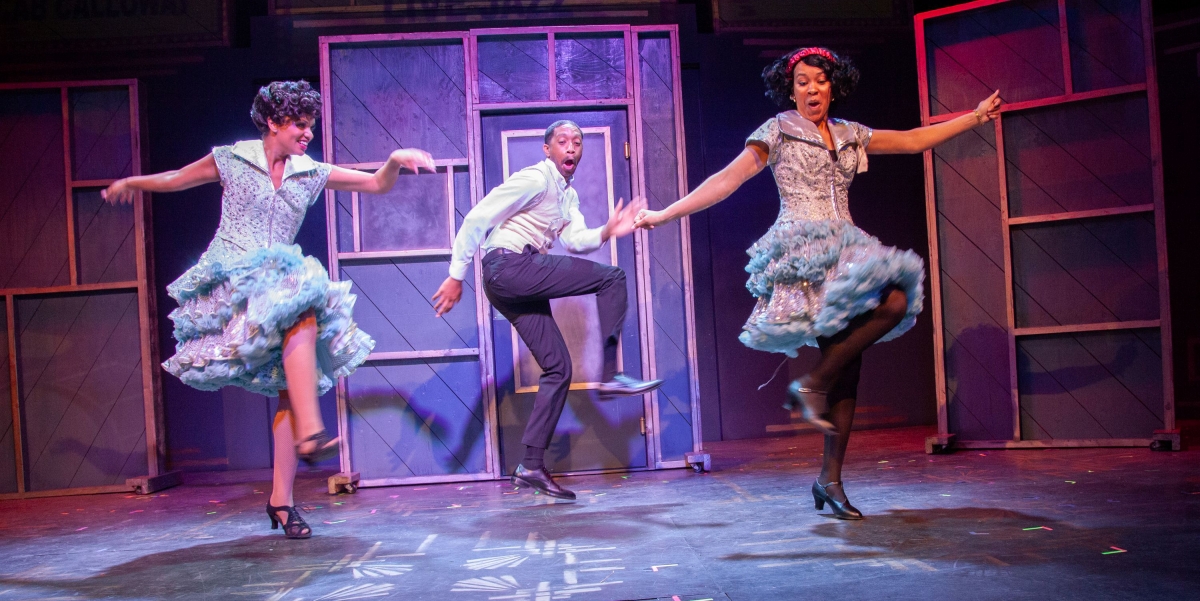


A highly political play, Red Harlem and its message about Blacks and communism are bound to be in the eyes of the beholder.
RED HARLEM: Theater Review
I have to take my hat off to playwright Kimba Henderson, whose drama Red Harlem uncovers and dramatizes a cinematic slice of film history that had previously escaped the notice of this film historian, who has a special interest in early Soviet cinema. According to Henderson’s play, the Communist Party USA recruited African Americans in Harlem to travel to the Soviet Union circa 1932 in order to act in a movie produced by the CPUSA and financed by Moscow about racism in America to be entitled Black and White. Langston Hughes, poet and leading light of the Harlem Renaissance, was commissioned to rewrite the cliché-ridden screenplay that Soviet screenwriters unfamiliar with African American culture had, from afar, written. James Ford (Micah Johnson), the three-time vice presidential candidate of the USA who first ran in 1932, was involved in this undertaking, which is also assisted in New York by a Soviet functionary, Misha (Claudio Parrone Jr.).
I, the author of Progressive Hollywood, A People’s Film History of the United States, had never heard of this endeavor before. For instance, it does not seem to be mentioned in key sources such as Jay Leyda’s book Kino, A History of the Russian and Soviet Film, a definitive account up to around 1960 by a former student of the USSR’s movie maestro Sergei Eisenstein at the State Film Institute in Moscow. Did the playwright merely conjure this tale up out of thin air, or did it really happen? Is it is, or is it ain’t? Of course, Hughes was a real person, as was Ford, who was the running mate of William Z. Foster and then Earl Browder on the CPUSA ticket during the 1932, 1936 and 1940 presidential races. (Subsequent Black CPUSA V.P. candidates included Angela Davis and Jarvis Tyner.)
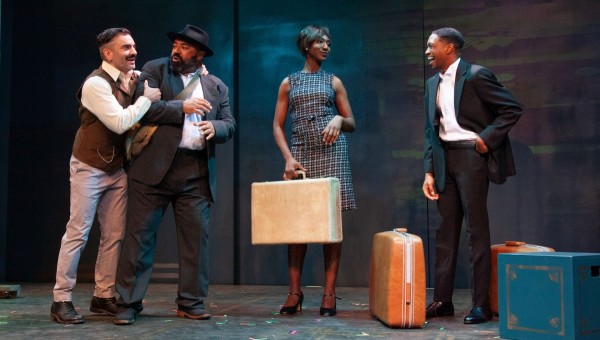 Claudio Parrone, Luis Kelly-Duarte, Rama Orleans-Lindsay, and Ahkei Togun
Fascinated, I researched the matter to verify whether or not the contention in the playbill that Red Harlem was “based on true events” was accurate, and it turns out that at least in its broad outlines, Henderson was indeed inspired by actual historic events. According to a press release, Henderson fortuitously stumbled upon the subject:
“After one of my play performances, I was approached by an elderly gentleman in the audience who said it was imperative he speak with me. One never knows how such an interaction will go, but after he casually mentioned he used to be the manager for Sly & the Family Stone, I was all in. ‘Did you know in 1932, the Communist Party was courting African Americans, so the Party’s Black US Vice Presidential candidate convinced Joseph Stalin to bring a group of Harlemites to the Soviet Union to make a propaganda film written by Langston Hughes?,’ he asked. After all that swirled around my head, the obvious answer was, ‘No,’ but I was deeply intrigued. I found glimpses of this event in literature about Hughes, the V.P. candidate, Ford, the Communist Party, 1930s filmmaking, and the African American presence in Russia. As a lover of historical fiction, there was just enough information about this event that I knew it had happened, but not so much that it was too well known.”
As the vivacious Black organizer Lenore (Rama Orleans-Lindsay), an ardent CPer who enthusiastically hawks copies of the party’s newspaper The Daily Worker on Harlem’s streets points out, the Communists were at the forefront of the struggle to free the Scottsboro Boys, surpassing the NAACP’s support given to the young Black men falsely charged with raping Southern white women. I think it’s simply a matter of historical record that from the time of its founding shortly after the Russian Revolution until 1960 or so, the Communist Party advocated and fought for Black rights and equality more than any other majority white organization in the USA. As Paul Robeson (who is mentioned several times during Red Harlem but never appears onstage as a character) defiantly replied when asked “Are you now a member of the Communist Party?” by the not-so-grand inquisitors of the House Un-American Activities Committee during the singer/actor’s June 12, 1956 testimony:
“What do you mean by the Communist Party? As far as I know it is a legal party like the Republican Party and the Democratic Party. Do you mean a party of people who have sacrificed for my people, and for all Americans and workers, that they can live in dignity? Do you mean that party?” (See the full HUAC testimony here.)
 Claudio Parrone, Jr. and Dennis Gersten
In fact, the CPUSA agitated so militantly for Black self-determination and Civil Rights, that I assumed Red Harlem would be about the Party’s recruiting and organizing in America’s most prominent African American community during the Depression (in fact the title refers to something totally different which I am dubious actually existed). However, only about the first 10 or so minutes of Act I depicts CP activity in Upper Manhattan, and the quartet enlisted to act in the proposed agitprop film are quickly off on the road to the USSR to shoot Black and White.
In addition to Lenore, Cotton Club hoofer Selena (Fana Minea Tesfagiorgis from Madison, Wisconsin, whose hoofing credits include the Alvin Ailey American Dance Theatre), and Will (Ahkei Togun) have dancing backgrounds. They zestfully, skillfully perform Kenya Clay’s choreography, which are highlights of this show, although, alas, their scintillating oscillations are set to taped music instead of live jazz in this well-acted play deftly directed by Bernadette Speakes, with projections by video designer Emmanuel Munda that enhance the period flavor.
I have no idea if the above characters are fact-based on real historical personages, but I have serious doubts that the quartet’s fourth member Shifty (Luis Kelly-Duarte) is. Shifty is a sort of petty criminal, a bootlegger with absolutely no show biz resume, and I seriously doubt CP leader Ford and Soviet agent Misha (who may be a fictitious character) would select him to act in a film for which he has no apparent aptitude. So, while Red Harlem may have been based on events that really happened, this work of historical fiction likely includes some characters who appear to be made up out of whole cloth or are composites. This, of course, is the bard’s prerogative, although the play’s basic premise per se turns out to be factual.
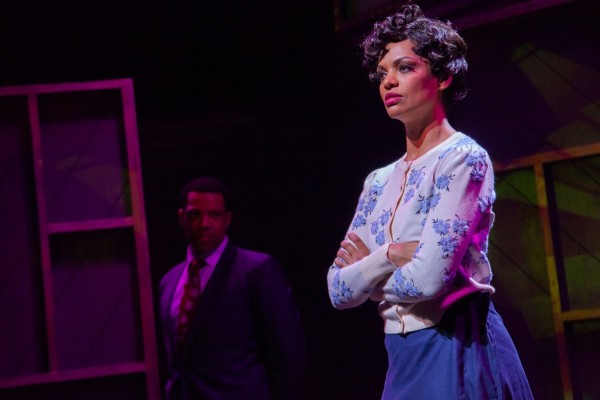 Micah Johnson and Fana Minea Tesfagiorgis
In any case, the two-act play’s treatment of this long lost true episode from film history is subject to interpretation, especially as this is such a politically charged production. In Red Harlem the quartet sail to the USSR along with Langston Hughes, who unfortunately is an offstage presence. Supposedly, the ink-stained wretch is ensconced in his cabin, rewriting Black and White to try to make the script by Russians more culturally authentic and relevant. (Is this the origin of “Black Russians”?) Although Ralph Bunche (performing double duty, the dexterous Micah Johnson also depicts the first African American to win the Nobel Peace Prize) appears as a passenger aboard the ship during the trans-Atlantic voyage.
What do the African American cast members of Black and White encounter when they finally arrive in the Soviet Union, where General Secretary Joseph Stalin has recently consolidated power? Beyond the Communist Party propaganda that Lenore in particular has bought into, the quartet are confronted by two major flaws in the workers’ paradise. Your plot spoiler averse critic will reveal only one of them here, as it ties into why he never heard of Black and White before seeing Red Harlem. And that is because unlike Hughes’ 1939 Way Down South, which Langston co-wrote with co-star Clarence Muse and was co-directed by Bernard Vorhaus (who subsequently fell victim to the Hollywood Blacklist), Black and White was never made. According to the play, American civil engineer Hugh Cooper (another actual historical personage, portrayed by Dennis Gersten), who is building a major hydroelectric power plant in the underdeveloped USSR, gets his mitts on the “anti-American script” and lobbies Stalin to kill the film.
However, according to Black Past:
“It was initially claimed that the cancellation of the movie was due to a lacking script; however, Hughes later confirmed that the real reason for the cancellation was the unexpected recognition of the USSR by the Franklin Roosevelt administration. Before this, the United States refused to acknowledge the existence of a Soviet state, prompting the USSR to continuously harass and berate the American government. When the US finally agreed to recognition, one of the conditions was that the USSR must cease all propaganda directed specifically towards African Americans. Thus, the movie project was dropped."
Either way, this seems like a case of censorship. That, plus another dire plot point in the play I won’t divulge here, leads to a Richard Wright-like, “the god that failed” disillusionment with the USSR. In an unsolicited letter emailed to me about the play, a Red Diaper Baby who was raised in L.A. by white and Black Communist Party members, criticized Red Harlem for its
“distinct sheen of anti-communism and anti-sovietism… essentially from the beginning to the end… anyone viewing the play [would] come away with the impression that although the CPUSA might be taking positions in support of Black people in the US, it was only because the Soviets wanted it that way, but Black people were merely dispensable pawns and they all ended up unhappy and disillusioned with communism, socialism and the Soviet Union. Whether intended or not, the play essentially carries the same anti-communist message carried by the mass media since the ’50s, only with a focus on why Black folks are or should be anti-communist.”
The letter writer went on to contend:
“This perspective is at odds with the experience of many actual Black actors and others in relationship to the CPUSA/communism, socialism and the Soviet Union. Two prime examples were actress Frances Williams and Paul Robeson. Robeson’s story is well known. Williams was one of those Black actors who went to the Soviet Union in 1935, acted, got training and returned to the US essentially a fan of the Soviet Union and of the CPUSA, and she pretty much remained so throughout her life.”
In her Depression era play, Henderson seems to be holding up FDR’s New Deal as preferable to the Soviet way. The play argues that President Roosevelt’s programs such as the Works Progress Administration and social security are socialistic in nature. And in the finale Orson Welles and the Federal Theatre Project, which was launched by the New Deal, is lauded as an alternative to the USSR’s state-run film industry. A highly political play, Red Harlem and its message about Blacks and communism are bound to be in the eyes of the beholder.
Company of Angels is presenting Red Harlem Fridays and Saturdays at 8:00 p.m.; Sundays at 3:00 p.m., through March 15 at 1350 San Pablo St, Los Angeles, CA 90033. Company of Angels is located in Boyle Heights at the Legacy L.A. Campus with free ample parking. For Tickets and information; Email: info@companyofangels.org ;
Phone: 323.270.6325.
