

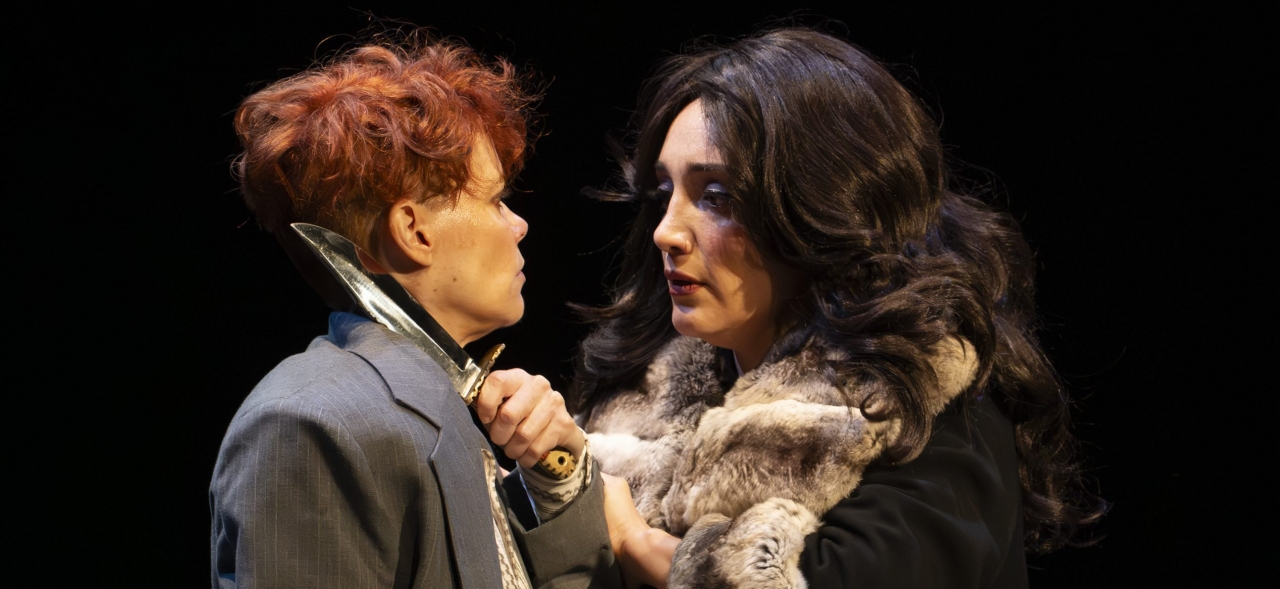

The tip off that this gripping ANW show dynamically directed by director Guillermo Cienfuegos with a tour de force performance by Ann Noble refers to current events is that instead of medieval garb, the cast is clad in modern dress.
RICHARD III: Theater Review
Although Shakespeare wrote Richard III circa 1592, about a century after the events it depicts transpired, A Noise Within’s high-voltage production bursts upon the scene at a most propitious moment. Richard III dramatizes the title character’s shocking murder spree in his relentless rise to power and to retain the blood-drenched throne he ruled from, 1483-1485. Richard III’s infamous reign of terror included the pitiless slaughter of men, women and children during what his character famously calls “the winter of our discontent.” As Richmond (Wes Guimarães) puts it, the War of the Roses, which pitted one faction of the royal family against another to rule the realm, “ma[d]e poor England weep in streams of blood.”
The tip off that this gripping ANW show dynamically directed by Guillermo Cienfuegos with a tour de force performance by Ann Noble refers to current events is that instead of medieval garb, the cast is clad in modern dress (by costume designer Christine Cover Ferro). Just as Orson Welles’ renowned 1937 modern dress adaptation of Julius Caesar was a nod to fascist Italy and Nazi Germany, ANW’s all-too-relevant Richard III arises at a disconcerting time. About the same minute the proverbial curtain dropped on ANW’s skin-crawling production the night I saw it, a shotgun- and gas can-wielding apparent assassin was shot dead by Secret Service agents inside Mar-a-Loco, apparently the third assassination attempt (that we know of) since 2024 against America’s wannabe mad king.
Ann Noble • Ann Noble and Tom Pasqualini.
More to the point, the succession struggles portrayed in Richard III are mirrored now in the turmoil roiling the UK’s royal family. Andrew, the alleged pedophile formerly known as “Prince,” has been stripped of his titles, and for the first time since 1647, when Oliver Cromwell arrested King Charles I, a British royal has been busted. Now, moves are afoot for Andrew to be removed from the line of succession to the throne. If the Bard of Stratford-upon-Avon who penned Richard III was writing the script determining what would happen next in that “sceptred isle,” to avoid imprisonment and regain his title, before Andrew could be removed from the line of succession he’d murder the seven royal family heirs ahead of him in order to usurp the throne, crown himself king, and pardon himself of his alleged Epstein-related crimes.
But I digress. As the play’s eponymous monarch, much to her credit Ann Noble imperceptibly crosses genders to play the king. It’s not that her Richard III is trans or that Noble is “mannish” (as that old chestnut would put it), but that as the incomparable thesp she is, Ann fully inhabits and convincingly plays the role of the man who would be king and remain monarch, slashing his bloodstained path to the crown, come hell or high water.
What made Richard run? He has, rightly or wrongly, been portrayed as misshapen, sometimes as a hunchback. This purported disability, which is noted in Shakespeare’s dialogue, may have spurred him on to embark on his murderous trek towards the throne. Perhaps to seek vengeance against those who have mocked his physical imperfections – or revenge against nature itself for having giving birth to his “defective” self. In any case, Noble depicts Richard III as having a mangled right arm and perhaps I spied a tad of padding behind her right shoulder, which helps explain why the dejected, rejected royal felt compelled to fight the War of the “Neu-roses.”
In doing so, Noble proves she can superbly play a character suffering from physical disfigurement, just as she brilliantly portrayed a character suffering from disfigurement of the soul, as she did with her unparalleled depiction of Hitler’s favorite filmmaker, Leni Riefenstahl, in playwright Tom Jacobson’s top notch Crevasse. Unlike Richard III, Riefenstahl was athletic, known for her dancing and painstakingly acting in mountaineering movies excruciatingly shot on location in the Alps – but she was crippled inside her malignant self. One suspects that Riefenstahl heard many rather loud noises within. The stellar Noble has, with both tyrannical characters, indelibly painted portraits of despotism, one from the 15th century, the other from the 20th (although, alas, the song remains the same, as certain British musicians may muse).
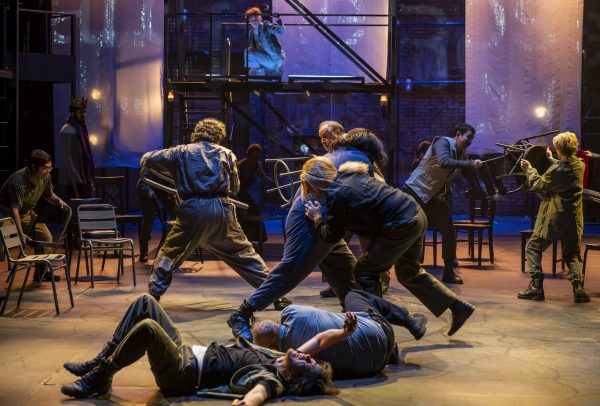
Like Welles’ 1937 Caesar for the Mercury Theatre, Cienfuegos’ energetic Richard III is performed with great panache on a bare stage, with minimalist to none sets and props. The mercurial, highly stylized staging is not naturalistic and burns with the intensity of, well, 100 fires. At a loss for the proper words, I asked the helmer himself to describe the production’s startling mise-en-scène and the innovative Cienfuegos replied:
“The opening prologue is definitely Brechtian. I didn’t start out with that intention – my main approach was to make the movement and narrative as cinematic as possible and to add chyrons and subtitles like you would with a fiction film based on a true story. To orient the audience to all this history and all these characters. But when I came up with the idea of the chairs and the paper, I maintained the high velocity propulsive action film attack, but embraced that theatricalizing that would be more like Brecht’s approach,” according to the veteran metteur en scène, who has outdone himself here in what is the best work I’ve ever seen him direct.
The way Cienfuegos visualizes the War of the Roses in the grand finale’s Battle of Bosworth has the elegance of simplicity. However, your plot spoiler averse reviewer won’t ruin the surprise for you; to find out how the play graphically expresses the War of the Roses, you’ll just have to see it yourself, Dear Reader. Which I advise all lovers of the live stage – in this case, very alive! – to do. While the action-packed Richard III is definitely not for children per se, I happened to attend on “Teen Nite,” wherein ANW reached out to nearby high schools to see the show. As far as I could tell, the students paid rapt attention to the drama and were model theatergoers.
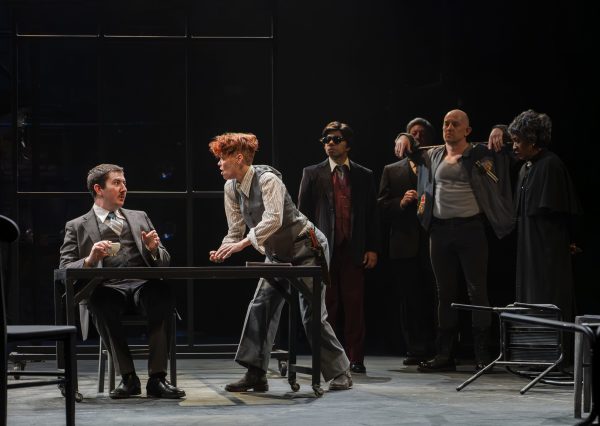 Samuel Garnett, Ann Noble and Ensemble Photo by Craig Schwartz
In the opening of Richard III Bard purists may think Cienfuegos plays a bit fast and loose, cribbing quotes from other Shakespeare plays, although it worked for me to bring us up to date on the War of the Roses. Be that as it may, Cienfuegos tautly helms his dramatis personae, who all deliver performances that pack a wallop, with themes that remain relevant more than four centuries after Shakespeare set them down on parchment by daylight and candlelight with quill and ink (I’m an expert on Will’s creative process because I saw Hamnet). As ANW’s website states: “Our 2025–26 season, Songs from the Volcano, bursts with timeless stories of upheaval, transformation, and the embers that push us to grow. These plays blend laughter, heartbreak, and self–discovery, reminding us that even in chaos, humanity finds a way to rise.”
To wit, Richard III concludes the way Hamlet and many of the Bard’s other histories end, with the bad king being replaced by a more benevolent, capable ruler. When I remarked upon this after the curtain to my companion, a theatergoer overheard me and plaintively asked: “Where is our ‘good king?’” I don’t know the answer to that, but I’m certain that the final curtain for the malevolent mentally ill imbecile currently usurping the White “Castle” will be quite Shakespearean.
I also know that Ann Noble is not just the king or queen of Los Angeles theater, she is indeed the veritable empress of the stage in the City of the Angels. And long may our greatest treader of the boards reign! Hip hip hooray!
A Noise Within presents Richard III on Thursdays, Fridays and Saturdays at 7:30 p.m., with 2:00 p.m. matinees on Saturdays and Sundays through March 8. Post-performance conversations with the artists will take place every Friday. ANW is at 3352 E. Foothill Blvd., Pasadena, CA 91107. For info and tickets: www.anoisewithin.org; (626)356-3100. Free parking is in an adjacent garage. Arthur Miller’s Death of a Salesman opens March 28 at ANW.
ALOHA OE (Farewell to Thee), Robert Duvall, the lover of the smell of napalm in the morning…
