

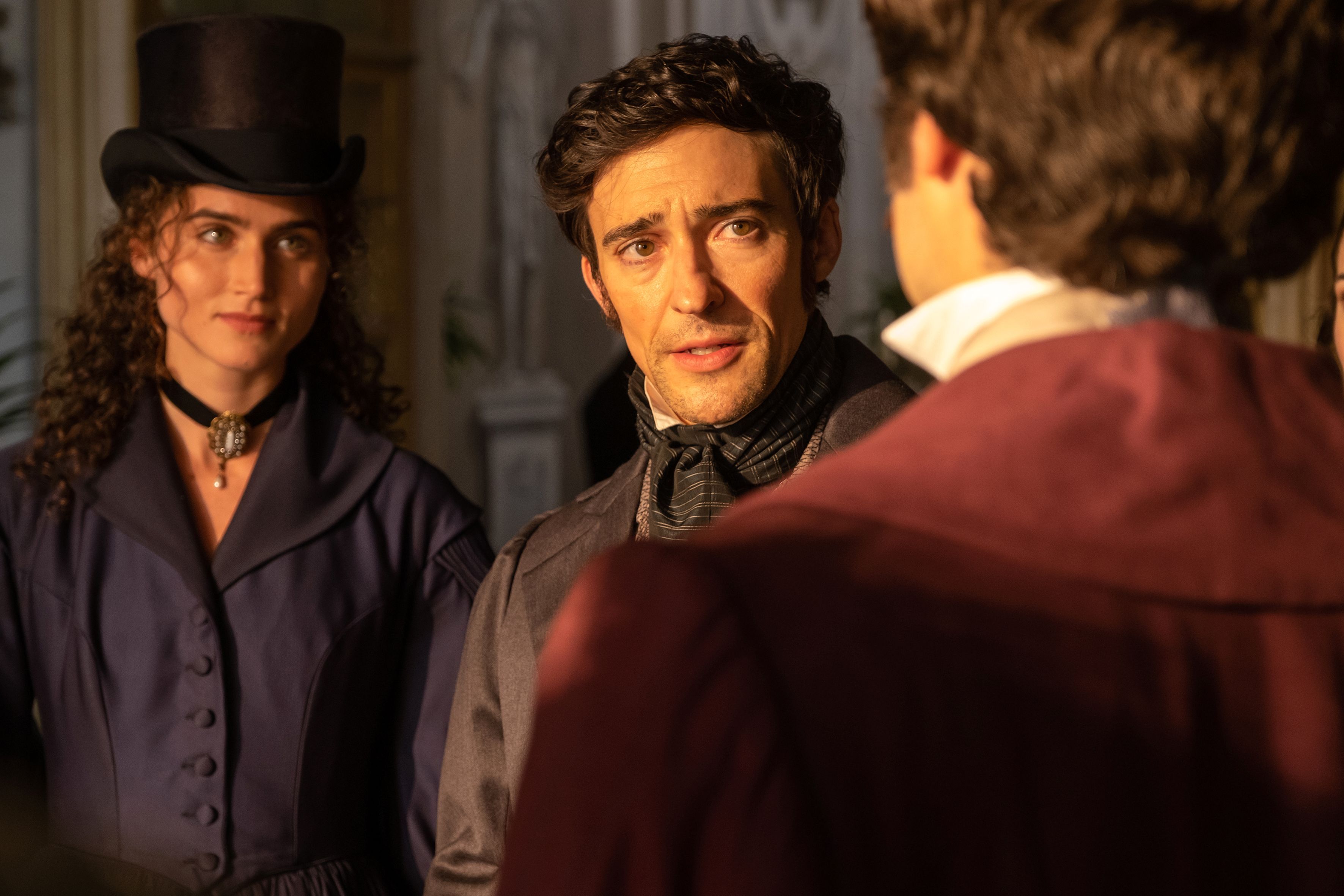


The series has much to recommend it: excellent acting and directing; insightful depiction of early 19th century France; and enough plot twists and turns to keep viewers hooked.
Now available on many PBS stations are one or more of the eight episodes (each 50 some minutes) of The Count of Monte Cristo, based on Alexandre Dumas’ famous (and long, 117 chapters in the free Gutenberg edition) novel. A book that has continued its global popularity, often in translation, ever since its mid-nineteenth-century serialized publication.For those who contribute a modest donation to PBS—now more helpful than ever since the Trump administration ended partial funding of PBS—they may stream all eight segments on PBS Passport.
The whole plot in both the novel and series hinges on the revenge of the count (Edmund Dantes is his name, and he is played by Sam Claflin) for being unjustly imprisoned in an island fortress about a mile from Marseilles for almost a decade and a half. (Unjust, excessively long or death-row, imprisonment remains a major problem today, especially in the USA.)
Since the revenge and its preparation stretch out for most of the series (Episodes 3-8) and I do not wish to spoil the suspense for most potential viewers, I’ll be guarded in what I reveal. Suffice it to say that it is primarily against three men. Also, about half way through Episode 3 a priest tells Dantes that “you must forgive my son, for without forgiveness, you will not find love again.” And later on Dantes states that the priest he encountered was “a wise old man” and “he was right.” And the love of Dantes’ life—the woman, Mercédès (Ana Girardot) to whom he says, “Thinking of you is what kept me alive in there” [the prison, where he spent 14 years]—tells him “love can heal.” (Although some artistic licence is taken in the PBS series—partly necessary because of the book’s great length and complexity—it is reasonably faithful to the novel. Film quotes are taken from the series transcripts, all eight of which can be found here.)

But whether or not Dantes completes his revenge-seeking against the men who unjustly imprisoned him, or pulls back, I’ll not reveal.
Dumas (1802-1870) himself, was a fascinating man. The son of Thomas-Alexandre Dumas, who was the child of a black Haitian and a French aristocrat, Thomas-Alexandre became a French general under Napoleon, but was unjustly imprisoned for almost two years—a probable influence on his son’s “Monte Cristo” novel. One essay about son Alexandrestates that he started out as a writer of plays, and “only in the 1840s did he begin publishing fiction...[and one] edition of his complete works comprises three hundred volumes, most of them novels about France’s past.” But he “also managed to publish much besides historical fiction: travel books (about Switzerland, Russia, Spain), tales of the supernatural (The Wolf-Leader, Castle Eppstein, The Corsican Brothers), a garrulous, immensely long memoir of his youth, serious works of history and biography, and, posthumously, a huge dictionary of gastronomy.”
Like many French intellectuals born in the early 19th century Romantic period—and like many Masons of the same period—Alexandre Dumas could not be classified as a Christian, but more as a Providential Deist, who sees God as a “source of human flourishing” and progress. He was a Mason, and like Tolstoy’s fictional Pierre in War and Peace, he believed that “Freemasonry is the teaching of Christianity freed from the bonds of State and Church, a teaching of equality, brotherhood, and love.” And also like Pierre and many Masons, he thought that the universe was “created by a supreme intelligence, but one who does not interfere with the world.” Like Ben Franklin, another Mason, he thought that “the most acceptable service to God is doing good to man.’”
Doing “good to man” brings us back to the main series plot—revenge—and the count’s second thoughts about it—and Mercédès’s final words, “love can heal.” Partly because of the French Catholic higher clergy’s political involvement, Dumas was critical of it, yet his opinion on the importance of love was close to that expressed by our most recent deceased pope, Francis. In October 2024, his Encyclical Letter on Love appeared, and it stated that love is the only “reality that can unify all the others.” Furthermore, “In loving, we sense that we come to know the purpose and goal of our existence in this world. Everything comes together in a state of coherence and harmony.”
In addition to the count’s revenge-seeking and then his doubts about seeking such a path, the series has much to recommend it: excellent acting and directing; insightful depiction of early 19th century France, including the role of law versus government corruption; and enough plot twists and turns to keep viewers hooked in a state of animated puzzlement until the series’ end.
