

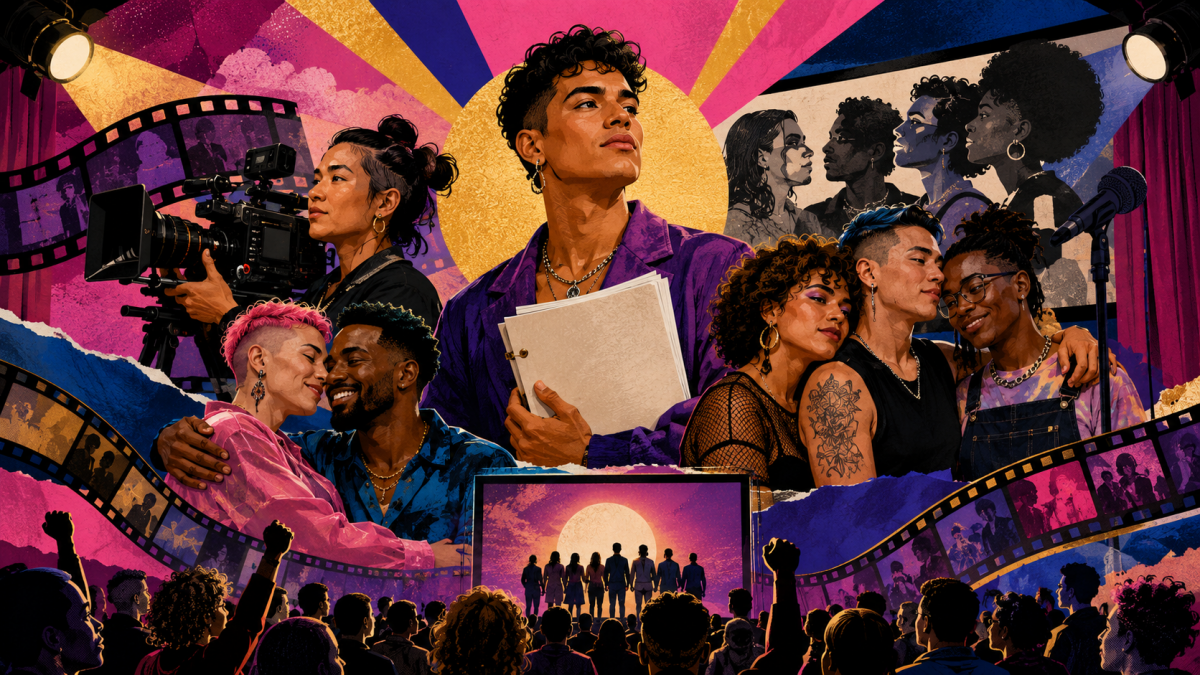

For decades, bisexual characters have been cast as cheaters, villains and sex objects. A growing movement is demanding something different: complex stories in which bi+ and polyamorous people get to be fully human.
For decades, film and television have told familiar stories about love and belonging.
The hero–who is often a man–gets the girl. The couple rides into the sunset. Love is neatly packaged into straight pairs, and most everyone else is relegated to the sidelines–or worse, turned into a cautionary tale.
The stories we tell influence whose lives are seen as worthy of love, dignity, and opportunity. That is why expanding who gets to be at the center of our stories is not simply an artistic concern; it is a social one. And a growing movement of writers, actors, artists, and advocates is pushing for stories that reflect the full spectrum of how people love, build family, and find belonging.
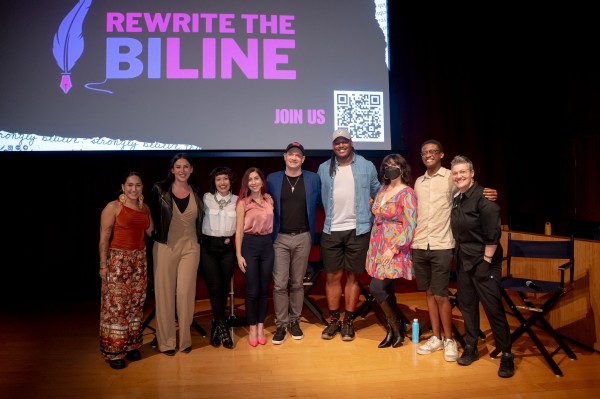
On September 19, Rewrite the BiLine will host the Write Us In Summit in West Hollywood, bringing together creators, actors, artists, and advocates to celebrate bi+ and polyamorous stories in film, television, music, and the arts.
“I've waited my entire life to see myself in a character on screen,” said Aaron Hammersley, a writer and producer who co-authored the first industry guide on bi+ representation on screen for Rewrite the BiLine. “Bi+ stories deserve the same opportunity, expansion and attention as any others.”
Historically, the bi+ character was the cheater, the sex object, the villain, the punchline. And if a character happened to be in a non-monogamous relationship, the story often treated them as reckless, dysfunctional, or destined for disaster.
These portrayals are so common that many audiences barely notice them anymore, but their consequences are impossible to ignore. Bi+ people are paid less and are more likely to live below the federal poverty level than gay, lesbian, and straight people. In fact, nearly 1 in 3 cisgender bi+ women and trans people fall below the federal poverty threshold. These disparities are compounded by other intersecting identities with research showing that polyamorous individuals are more likely than those in monogamous relationships to have annual incomes below $40,000.
Co-sponsored by the City of West Hollywood with support from The Polyamory Foundation, the Write Us In Summit is both a challenge and an invitation to the film and entertainment industry.
- Write us into the writers' rooms.
- Write us into the casting decisions.
- Write us into news coverage.
- Write us into the cultural imagination.
- Write us into your budget lines.
The stories that receive investment become the stories that shape culture. The stories that shape culture influence which communities receive resources, legal protections, and opportunities to thrive.
At a moment when LGBTQ+ communities face escalating political attacks and growing attempts to censor our stories, the need for authentic representation is especially urgent. Audiences are hungry for narratives that reflect the complexity of life today. They are ready for more stories about bi+ people who are heroes, parents, leaders, artists, and dreamers. They are ready for more stories about polyamorous families that are neither sensationalized nor ridiculed.
When bi+ young people see themselves as heroes rather than side characters, it expands their sense of what is possible. When audiences encounter polyamorous families portrayed with the same depth, complexity, and humanity afforded to couples, it challenges assumptions and broadens understanding.
Representation alone cannot solve inequality, but it can help create the cultural conditions for greater belonging, empathy, and opportunity.
