

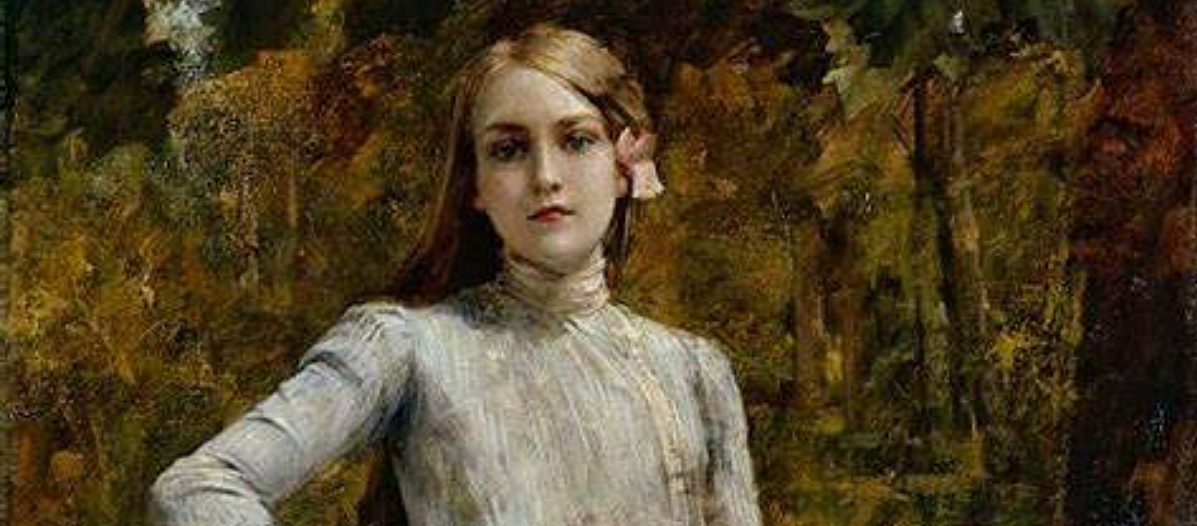
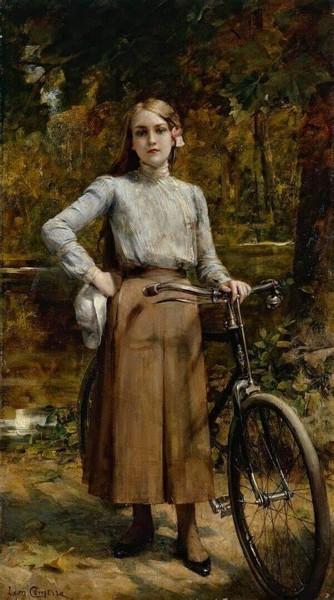
Cycling at Vesinet


A bicycle could be had by anyone but the poorest of the poor since you didn’t have to stable it or feed it or acquire and maintain riding tack.
In the process of researching Marshall “Major” Taylor, the African American world champion bicycle racer of the late 19th and early 20th centuries (see Hollywood Progressive), I happened upon a reference to a painter and a 1903 painting I had never heard of before: Cycling at Vesinet by Leon Comerre. This piqued my curiosity.
By the time of this painting, cycling had become extremely popular, especially once the original challenging and rather dangerous high-wheeled design was abandoned in favor of our modern design with two wheels of equal and reasonable dimension. The automobile was still in its infancy, but the bicycle was seen as a great leap forward in personal freedom.
The automobile was still in its infancy, but the bicycle was seen as a great leap forward in personal freedom.
It freed a person from dependence on public conveyances like horse-drawn or steam-powered public transportation in urban areas. You could come and go on your own schedule, and once you owned a bike, there was little further expense involved. And a bicycle could be had by anyone but the poorest of the poor since you didn’t have to stable it or feed it or acquire and maintain riding tack.
But the rise of the popularity of bicycles was not without controversy, especially for women. Frances Willard, president of the Women’s Christian Temperance Union, enthusiastically supported bicycles for women, arguing that they gave women freedom from dependence on men. Susan B. Anthony thought it did more than anything else in the world to emancipate women. “I stand and rejoice,” she said, “every time I see a woman ride by on a wheel. It gives a woman a feeling of freedom and self-reliance.”
But Charlotte M. Smith, president of the Women’s Rescue League, thought bicycle riding would lead women into temptation, arguing that “it has a tendency to lure young girls into paths that lead directly to sin.” Fashions themselves became controversial. Like “bloomers” before them, culottes were designed to allow women freedom of movement, eliminating the need, for instance, to ride a horse side-saddle, and this applied equally well to riding a bicycle. Many women—and men—welcomed this new freedom. Others thought it scandalous.
But back to Monsieur Comerre’s painting. I looked it up, and was quite taken with it. So much so that it inspired me to write this:
Cycling at Vesinet
after Leon Francois Comerre,1903
The woman is French, young, attractive.
She wears a white blouse and tan culottes,
the liberating, often controversial
fashion that allows her to sit astride
the bike she holds upright in her left hand.
Her right hand, perched jauntily on her
right hip, holds a white soft-brimmed cloth
cap. Her long hair, the color of her pants,
falls down her back. She has what appears
to be a flower tucked behind her left ear.
She looks directly at the artist,
neither smiling nor sad, but pensive,
as if to say, “This is who I am. I enjoy
riding my bicycle. I enjoy riding
alone, by myself. I don’t need you,
though I might deign to let you ride
beside me for awhile if you keep in mind
that I want nothing from you. Nothing.
I have my bike. That’s all I need.”
I wonder if she were selected by the artist as a model, or was just someone he encountered one day. She looks self-possessed and confident. She does not look like someone who is on the path to sin. She does not look like someone to be trifled with. In her own way, she reminds me of Eduard Charlemont’s The Moorish Chief. I would like to have known her. I hope she had a good life.
