

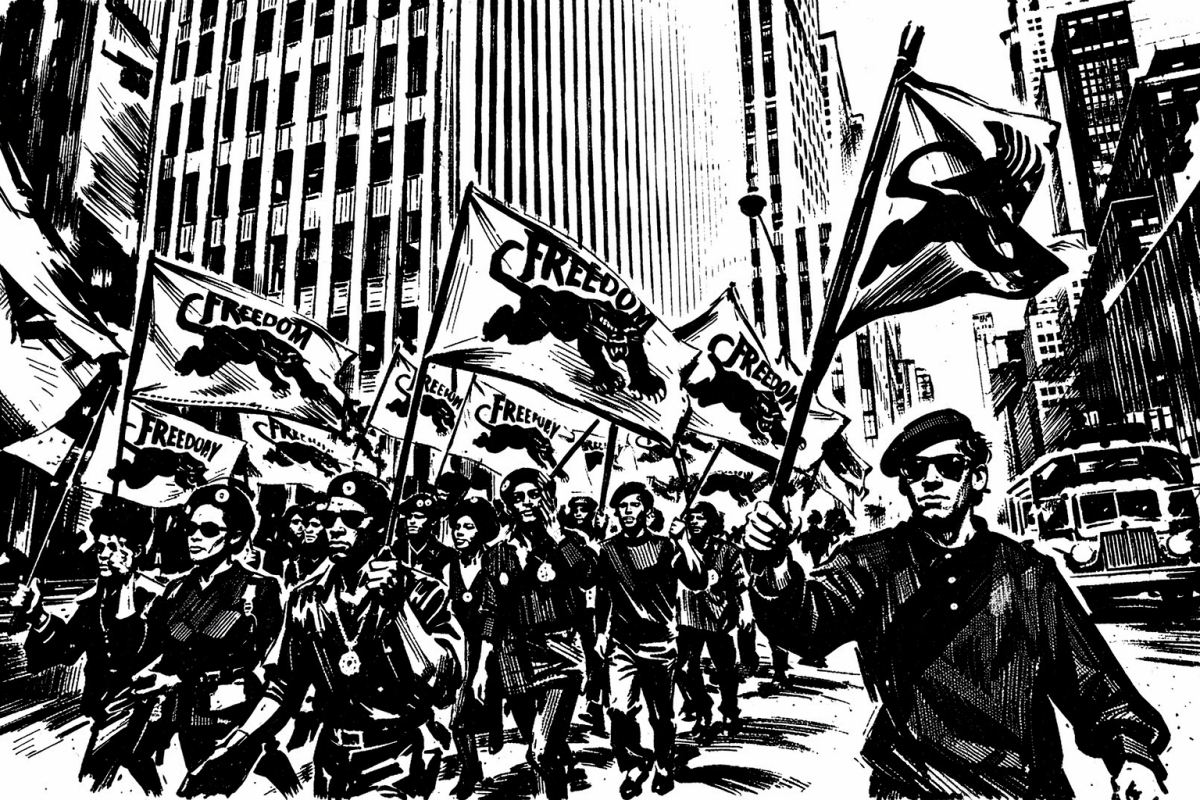


The resurgence of Panther imagery reflects a hunger for clarity, courage, and confrontation. But the Panthers were not a symbol. They were a strategy.
In moments of political crisis, history has a way of resurfacing—not as nostalgia, but as unfinished business. The renewed visibility of groups calling themselves “Black Panthers” in recent years has sparked confusion, curiosity, and no small amount of debate, particularly among white progressive circles asking a familiar question: Can white people join the Black Panthers?
It’s a question that misunderstands both history and power.
To answer it honestly requires going back to the origins of the Black Panther Party, understanding why it emerged, what it represented, and why contemporary efforts to revive the name reflect radically different political realities.
Why the Black Panther Party Was Formed
The Black Panther Party was founded in 1966 in Oakland, California, by Huey P. Newton and Bobby Seale. It arose in response to conditions that were not abstract but brutally concrete: police violence, economic exploitation, segregated housing, failing schools, and the systematic exclusion of Black Americans from political power.
The Panthers did not emerge as a cultural organization or an identity-based club. They were a revolutionary political party, rooted in Black self-determination and community defense.
Equally important were the Panthers’ survival programs: free breakfast for children, community health clinics, sickle cell anemia testing, liberation schools, and food distribution. These programs embodied a central Panther principle: the state had failed Black communities, so the community would meet its own needs while organizing for systemic change. These commitments forever changed the country in the best of all possible ways.
The State’s Response: Repression and Destruction
Through COINTELPRO, the FBI systematically targeted the Black Panther Party for surveillance, infiltration, disinformation, arrests, and assassination. Leaders were jailed or killed. Fred Hampton was assassinated in his bed by Chicago police in a raid coordinated with the FBI.
By the early 1970s, the party had been effectively dismantled—not because it failed politically, but because it was destroyed by the state.
Who Is Still Alive—and Are They Involved Today?
Some original members of the Black Panther Party are still alive, including Bobby Seale and Elaine Brown. However, they are not involved in contemporary organizations using the Panther name, nor do they endorse most of them.
The New Black Panther Party—and the Confusion It Creates
The New Black Panther Party, founded in 1989, is not the same organization as the original Black Panther Party. It has been widely criticized for promoting racial separatism, misogyny, antisemitism, and authoritarian leadership structures.
So Why Are the Panthers “Back”?
They are “back” in the sense that the conditions that produced them never disappeared. Police violence continues. Economic inequality has deepened. Schools remain segregated in practice. Housing is increasingly unaffordable. Oppression against non-whites remains.
Can White People Join the Panthers?
The original Black Panther Party was explicitly a Black organization. White people did not join the Panthers. That does not mean the Panthers rejected solidarity. They worked with allied organizations such as the Young Lords and the Young Patriots Organization.
White allies were expected to organize their own communities, confront white supremacy where it lived, and follow Black leadership in shared struggles.
What Solidarity Actually Requires Today
If white progressives are serious about honoring the legacy of the Black Panthers, the work is not to ask for inclusion in Black-led organizations. The work is to challenge police violence, organize against racialized economic policies, confront white supremacy, and support Black-led movements materially and politically.
History as Warning, Not Fantasy
The resurgence of Panther imagery reflects a hunger for clarity, courage, and confrontation. But the Panthers were not a symbol. They were a strategy.
If you are white this group may interest you. Showing Up for Racial Justice (SURJ) is a national organization that brings hundreds of thousands of white people into fights for racial and economic justice.
For too long, the Right has hoarded wealth and power by using strategic racism to convince white people that we have more in common with billionaires and corporate elites than with the people of color in our communities. At SURJ, they bring our folks in by offering a better alternative: a just, vibrant future where people of all races work together to win what we need. We do this work by building people power in multi-racial communities across our network — through campaigns, 200 chapters across the country, and deep local organizing projects. So if you want to join the battle, sign up.
