

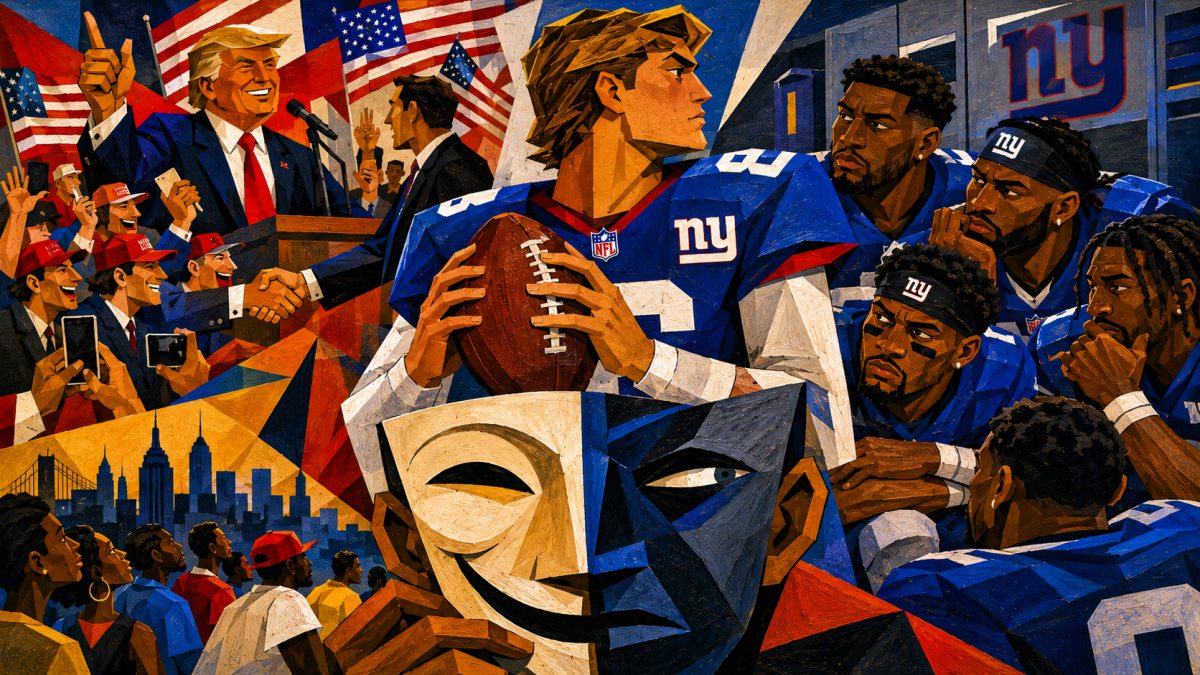

A quarterback's public alliances force a conversation about race, power, and whether football's celebrated "brotherhood" can survive America's widening political divide.
Smiling faces sometimes pretend to be your friend.
The Undisputed Truth did not just give us an R&B classic. They handed America a warning label with a bassline. Because human beings, in our endless little talent show of deception, fabrication, manipulation, and drama, have always known how to smile ear-to-ear while hiding the switchblade, bear hug while smuggling the message, and shake hands while burying the confession in the palm. A smile can be a mask. A handshake can be theater. A hug can be a whole political statement, wearing perfume, flashing teeth, and pretending it only stopped by to check on you.
And now here comes Jaxson Dart, the New York City Giants quarterback and the NFL’s latest carefully polished Great White Hope, straight-outta’ the Land of Cotton by way of Ole Miss, that grand old Southern football cathedral where mythology, masculinity, and selective memory still Waltz under the old oak trees like history never sent the bill. It was revealing enough that Dart reportedly mourned Charlie Kirk in glowing terms. People are entitled to grieve whomever they wish. That is their right. But public mourning has meaning. Political company has meaning. Symbolism has meaning. And when a man starts wrapping himself around figures and movements tied to the ugliest corners of America’s racial past and present, nobody should insult grown people’s intelligence by pretending we are simply discussing a harmless photo-op at the county pancake breakfast.
Smiling faces, indeed.
Because the danger hardly ever strolls in wearing a white hood anymore. It walks in grinning. It calls you a teammate. It calls you “bruh.” It says all the politically correct things under blazing stadium lights, then shows you where its soul lives when the cameras turn toward politics, economics, power, and nostalgia dressed up as patriotism. That is when the smirk stops being adorable and harmless, and starts looking like evidence with dimples and a Mullet.
When someone tells you who they are, give it credence and accept it as the ice-cold truth. When they show you who they are, document it. And when they keep showing you, stop pretending you need a doctoral thesis, five eyewitnesses, a notarized confession, and a burning cross on the front yard before forming an opinion.
Geez, the backbones of Gumby and Pokey.
Jaxson Dart appears to be planting his flag firmly in the Make America Great/White Again section of the arena. That is his choice. His intrinsic, inherent, innate right. His prerogative. This is America, after all, Land of the Free, where a man can stand wherever he wants politically, even if he chooses to stand so close to reactionary nonsensical bullshit that the fumes start curling his eyebrows.
But rights come with reverberations. Choices come with backlashes. Public associations are not internal private thoughts. They are billboards. And Dart did not whisper his politics into a pillow. He stepped into the spotlight, introduced Donald Trump at a political rally, and then looked shocked, or at least conveniently innocent, when the room started smelling like smoke. According to reports, Giants teammate Abdul Carter reacted publicly with disbelief before later saying he and Dart were “good” after a private conversation. Translation from NFL Damage Control to plain English: somebody saw the fire spreading toward the curtains and decided to grab a bucket before the whole locker room looked like a log cabin on fire.
That is the part that “outs” the whole system.
Because Carter’s first reaction mattered, the cleanup mattered too, but the first reaction was the truth slipping out before the PR janitors arrived with mops, Febreze, and that tired old “we’re focused on football” nonsense. Black teammates are not blind. They are not deaf. They are not decorative action figures strategically placed around the “field general” to make the NFL brochure look diverse. It’s honestly the other way around in many aspects.
The Locker Room Heard Him Loud and Clear
Most Black players know exactly what time it is. They know what Trump represents to millions of people. They know what Ole Miss represents historically. They know what MAGA has become in the American bloodstream. And they know when a teammate’s public choices start sounding less like “personal politics” and more like a locker-room weather report: storm clouds forming, trust levels dropping, visibility poor.
Perhaps Dart’s Black teammates in Ol' Miss were less enlightened, more tolerant, more dumb downed, more spineless than those he’ll encounter in the diversity of the NFL?
In this fractured, boiling, mosaic mess of a country, one would think a young NFL quarterback might pause for half a second before embracing people and movements widely viewed as racist, sexist, elitist, neo-Confederate, and allergic to anything that looks like a multiracial democracy. One might think he would weigh the pros and cons before stepping onto a political stage with Donald Trump, especially while preparing to lead a locker room filled with Black teammates, Black coaches, and Black fans whose talent, labor, loyalty, and bodies help make this billion-dollar football carnival run.
But, apparently, that is asking too much. Perhaps the calculator broke somewhere between Oxford, Mississippi and the campaign podium.
Maybe Jaxson Dart, the team's signal caller and Golden boy, is genuinely surprised that some Black teammates, coaches, and fans are looking at him sideways. Maybe he expected everyone to shrug, lace up, and follow him into battle like he didn’t embrace who he did. Maybe he believes touchdowns wash away politics, that a clean spiral can disinfect a dirty association, and that Black men are supposed to block, catch, tackle, cheer, forgive, forget, and keep the machine humming while the quarterback plays footsie with the people who would rather see them silent, grateful, and permanently in their assigned seat.
That is not leadership. That is either disconnected from reality, dumbass jock ignorance, or young good ol’ boy arrogance in the smallest shoulder pads on the field..
And let us not miss the silence from the other side of the locker room. Where were the other white Giants players rushing forward, standing shoulder to shoulder, declaring that this was all some beautiful festival of unity? Where were the firm public defenses, the brave little speeches, the “Jaxson speaks for all of us” chorus? Funny how the silence got really athletic all of a sudden. It ran a 4.3 forty and hid behind the equipment cart.
That silence says plenty.
The team's head coach, John Harbaugh, and his brother, San Diego Chargers’ head coach, Jim Harbaugh, have both gone to the White House and kissed the Great Orange ass…
It suggests the divide is not imaginary. It suggests players and coaches across the NFL know these political fault lines are running right through locker rooms, meeting rooms, group chats, and dinner tables. The league can paint “End Racism” in the end zone until the turf needs therapy, but everybody knows the NFL is still a place where Black bodies carry the entertainment, white ownership controls the plantation ledger, and political discomfort gets stuffed under the rug like a hotel crime scene before kickoff.
The Giants may not be unique. They may just be the team whose tension spilled into daylight this week. Around the league, there are almost certainly players who understand exactly what Dart’s Black teammates understand: that “brotherhood” gets real complicated when one brother is cheering for forces that another brother believes are working against his rights, his family, his community, and his dignity.
Football people love to talk about chemistry, culture, trust, brotherhood, sacrifice, and “the locker room.” They sell those words like holy Sunday scripture. But trust is not built in press conferences. Brotherhood is not born in slogans. Culture is not something a coach tapes above a doorway. It lives in what players believe about each other when the cameras are gone. It lives in who feel respected. It lives in who feel exposed. It lives in whether a Black left tackle believes the white quarterback behind him sees him as a full human being or just another moving part in the Sunday machine.
History is full of good ol’ boy captains who assumed the men under them would follow orders simply because rank said they should. Vietnam taught this country, among many other brutal lessons, that men do not automatically follow leaders they do not trust. A uniform does not create loyalty. A title does not manufacture respect. And a quarterback cannot expect a locker room to rally behind him while his public choices tell half that locker room, “I see you, but I ride with them.”
Sure, Carter later said he and Dart were good. Perhaps they are. Perhaps they talked. Maybe Dart explained himself. Maybe Carter accepted it. Maybe the Giants will all smile for the cameras, dap each other up, repeat the usual sacred football gobbledygook, and pretend the whole thing was just a misunderstanding with cleats on. That is how professional sports work. Conflict gets folded, pressed, and tucked into a team-issued polo before anyone from management starts sweating through the quarterly revenue projections.
But “we’re good” does not always mean “nothing happened.”
Sometimes “we’re good” means, “I still have to work with this man.” Sometimes it means, “I’m not letting the media turn this into a circus.” Sometimes it means, “I handled it privately because I’m a professional.” And sometimes it means, “I saw what I saw, heard what I heard, and filed it away.”
Black folks are world-class file clerks when it comes to this kind of nonsense. We may grin. We may nod. We may well say, “We’re good.” But the folder has been created, labeled, alphabetized, and placed exactly where it belongs.
Everybody knows who everybody is...
And if Jaxson Dart wants Black teammates to protect him, Black receivers to fight for him, Black linemen to take punishment for him, and Black fans to cheer for him, then he may want to consider the radical idea that those same people are watching who he hugs, who he praises, who he mourns, and whose politics he helps legitimize.
Because smiling faces sometimes pretend to be your friend.
And sometimes the mask slips just enough for everyone to see what was smiling underneath.
