

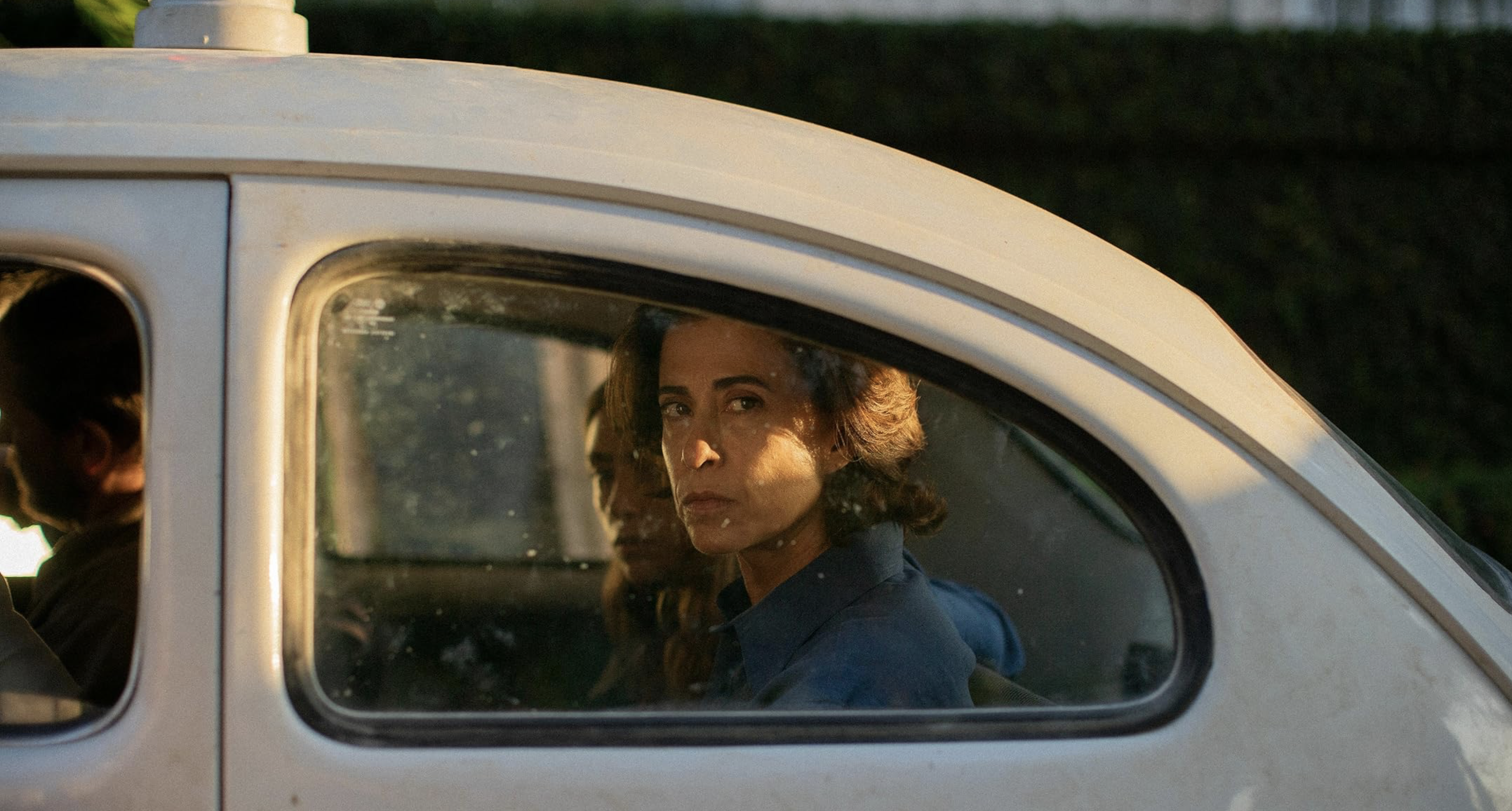

The family’s “nightmare” involves it not knowing exactly what happens to Rubens after security forces take him away—but increasingly suspecting that he has been killed.
As we look around us now in the spring of 2025 and see all the needless suffering going on in the world, we ask ourselves “Why?” Why are all the Ukrainians (and many Russian soldiers attacking them) dying? Why are all the people, many being innocent civilians—including women and children—being killed or being deprived of food in Gaza? Why did hunger in Sudan reach “catastrophic levels...with famine confirmed in 10 areas and 17 more at risk”? Why, despite a judge’s order, were over 200 Venezuelans residing in the USA sent to a brutal prison in El Salvador by the Trump administration? (Earlier we could have asked the same why question about all the suffering caused by wars or leaders like Hitler, Stalin, or Mao).
The Brazilian film “I’m Still Here” (2024) raises the same why question. It is directed by one of Brazil’s leading directors, Walter Salles, and is based on the 2015 memoir by Marcelo Paiva—see below. Besides Salles’ excellent directing, the acting is also first rate, especially that of Brazilian actress Fernanda Torres, who plays wife Eunice, and won a Golden Globes award for Best Actress.
At the opening of the movie the screen tells us the scene is 1970 in Rio de Janeiro, and the country is under a military dictatorship. The facts are these: In 1964 a military coup overthrew an elected, reformist government headed by a President Goulart, who was supported by many workers, peasants, and students. He and his supporters were opposed not only by high-ranking military personnel, but also by many of Brazil’s wealthiest and the hierarchy of the Catholic Church. The U. S. government also backed the military coup. Among other complaints, Goulart was accused of cooperating with communists and terrorists. Military rule continued in Brazil until 1985.

The movie’s central focus is the Paiva family—husband Rubens and wife Eunice (both age 40), four daughters, Veroca, Eliana, Nalu, and Babiu (ages 17, 15, 13, and 8 respectively), and a son, Marcelo (age 9, but later author of the memoir on which the film is based). Dad Rubens is an engineer and a former member (before the coup) of Congress. They all seem like a happy and fairly affluent family—having a female servant, Maria José (age 30)—and they have many friends.
But then Brazilian security forces come to the family’s home in Rio and take husband Rubens away. And the nightmare begins. Later in the movie, it’s revealed that after the coup in 1964, husband (and congressman) Rubens went into exile. After he came back, he was apparently involved in some minor forms of dissent. A family friend later tells wife Eunice that “we can’t just do nothing. There's no way to just stand by...We all [including Rubens] do what we can. One talks to the foreign press, another one provides shelter to people on the run, [another] deliver [s] letters to families with no news.” (Quotes are taken from the filmscript, which recounts the film’s dialogue.)
The family’s “nightmare” involves it not knowing exactly what happens to Rubens after security forces take him away—but increasingly suspecting that he has been killed. (A Brazilian truth commission in 2014 “reported that at least 434 people were killed and more than 100 disappeared completely during the country's military dictatorship.”)

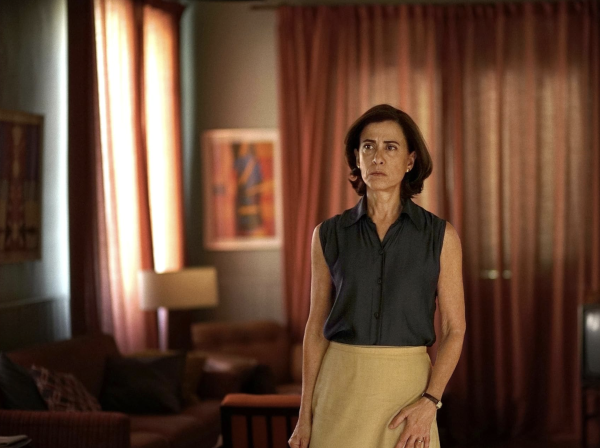
After he was seized, Eunice says to a journalist, “I really don't understand, how in a country with an allegedly functioning justice system, someone can break into your house, take a father away, throw him in jail, and then simply say ‘he's gone.’ And there's not a thing you can do? Every single stage of the legal process was flouted, and after three months, the nature of the crime my husband allegedly committed remains a mystery, as do his whereabouts...This is unacceptable behavior by the State, which is protected by a system of false news designed to cover up the unlawful acts committed by its own agents.”
Less than 10 minutes screen time after this scene—and with only about one-half hour left in this two-hour-plus movie—words tell us that it’s “25 years later” (thus, 1996) and the family is now in Sao Paulo, where it moved to after Rubens was seized.
Eunice and two of her now-grown children arrive at a courthouse and manage to obtain Rubens’ death certificate.
She tells reporters, “It's odd, you know, to feel relief with a death certificate.” To the question, “How did you deal with the void left by your husband?” she answers, “Forced disappearances were one of the regime's cruelest acts. You kill one person, but condemn all the rest to eternal psychological torture.” When another reporter asks her “doesn't the [now civilian] government have more urgent issues than fixing the past? She replies, “No. I think it's absolutely necessary to compensate the families and do the most important thing, clarify and judge all crimes committed during the dictatorship. Otherwise, they will continue to be committed with impunity.”
Immediately after the courthouse scene and her exchange with reporters, we see her at home with pictures and a projector as she views older depictions of her family when Rubens was still live. The filmscript reads, “She turns on the projector. Eunice's eyes shine damply.” And indeed we, watching the movie, might also experience damp eyes. Damp eyes because of the sadness of life, for some—like those under authoritarian regimes, or in present-day Ukraine, Gaza, or Sudan—sadder than others.
But Eunice didn’t succumb to grief and wallow in her misery. Near the very end the screen posts the following words: “Eunice Paiva got her law degree at the age of 48 and dedicated her career to the defense of human rights. She became one of the few experts in indigenous rights and a consultant for the Brazilian federal government, the World Bank and the UN. Eunice died in 2018, at the age of 89, in São Paulo.”
But back to the question posed at the beginning of this review essay—Why the needless suffering, suffering caused largely by misguided leaders and regimes, whether of the Left (like that of Mao) or Right (like Hitler)?
One answer is ideology. As Pope Francis said about “ideological Christianity”: “It is a serious illness, this of ideological Christians.” It is “rigid, moralistic, ethical, but without kindness.” Another reason is the demonization of enemies. In Brazil those who opposed the military coup leaders were often branded terrorists or communists, as Mussolini and Hitler often called their enemies. (See also The Guardian article of September 2024, entitled “The US right keeps accusing Democrats of ‘communism.’”) As Francis also stated, love—not demonization—is the only “reality that can unify all the others.”
In Chapter 1, “A Century of Violence,” of my An Age of Progress? Clashing Twentieth-Century Global Forces (2008), I attempted to explain how societies could violently break apart. I quoted Nobel-Prize winning economist Amartya Sen, who wrote of “the illusion of a unique and choiceless identity,” for example, that of nationality, race, or class. He added that “the art of constructing hatred takes the form of invoking the magical power of some allegedly predominant identity that drowns other affiliations and in a conveniently bellicose form can also overpower any human sympathy or natural kindness that we may normally have.”
I have also often written about values and quoted U. S. neuropsychologist and Nobel laureate Roger Sperry, who once stated: “Human value priorities ...stand out as the most strategically powerful causal control now shaping world events. More than any other causal system with which science now concerns itself, it is variables in human value systems that will determine the future.”
As long as fear, suspicion, and even hatred outweigh, love, empathy, humility, and tolerance we are going to continue to witness needless suffering. We have enough of it going on around us without increasing it by multiplying it by the evils we do to others.
Toward the end of the film, we see son Marcelo, in a wheel chair—we learn from other sources that at age 20 he fractured his spine and became paraplegic from jumping into a shallow lake.(After physiotherapy he regained some arm and hand movement.) Words on the screen at the end also reveal that his mother, Eunice, lived the last 15 years of her life afflicted with Alzheimer’s.
Accidents and sickness, as experienced by Marcelo and Eunice, can occur in any family. (A boy down the street from me also became a paraplegic from jumping into a shallow lake, and my wife, Nancy, spent the last decade of her life with Alzheimer’s.) Such fates are just part of the twists and turns that are part of human experience. But the Hitlers, Stalins, and Maos of this world—and one could add the names of many other leaders—immeasurably add to the suffering of peoples.
In the spring of 2025 we continue to see this. And in the decades after Hitler, Stalin, and Mao we saw it. In Brazil the rule of Jair Bolsonaro (2019-22), who defended the country's military dictatorship, delayed the reckoning with the past evils of the generals’ rule. In “I’m Still Here” the tragedy of Eunice and her family reminds us that, like her, we should keep fighting to end the misery of needless suffering.
