



One of the important reasons for watching 53 Sundays is that it once again demonstrates how fruitless life can be if we emphasize the wrong values.
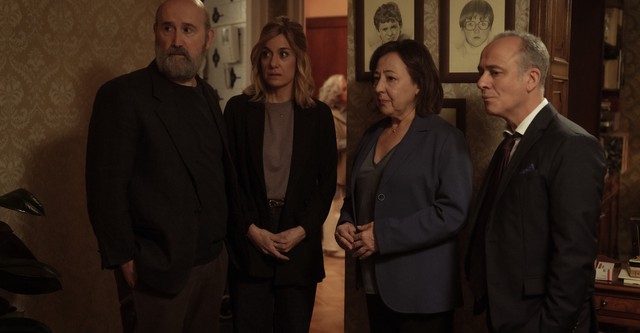
53 Sundays (2026) is a Spanish-language film that is both amusing and thought- provoking. It is based on the same named play of director Cesc Gay and stars four actors: the three siblings, Julian (Javier Camara); his older brother, Victor (Javier Gutierrez); and his older sister, Natalia (Carmen Machi), plus Julian’s wife, Carol (Alexandra Jimenez). Often mentioned but never seen is their 89-year-old widowed father, who lives alone in an apartment.
Being widowed, living alone (except for my dog), in my late 8os, and having two middle-aged sons and a daughter, I felt a certain affinity for their father. Plus, Natalia is a professor, as I was for four decades. One major difference—I certainly hope—is that I am in better shape than their father is—but then again he’s 89 and I’m not quite there yet. And my children are not as narcissistic as his are.
As described in the movie—and the filmscript from which all the film quotes are taken—their dad is “no longer able to live alone. . .[is] getting lost more and more often now, and recently, he's had this bad habit of showing the neighbors his p*nis.” According to Natalia, he also “doesn't know how to use the hearing aid properly,” and the three children “need to hurry up and make a decision before things get out of control and something really serious happens.”
Even though I hope my kids are not as worried about me, I know of similar people my age who pose residency problems for their children. Should their parent (often now widowed) continue to live alone, come live with one of them, or transition to some sort of assisted living facility? There is often no easy answer, and until we ourselves are old—or we have to face the question with our own parents—we probably don’t even give the question much thought. (When I was much younger, the powerful movie I Never Sang for My Father briefly focused my attention on the problem, but not for long.)
But I wrote that the film is “thought-provoking.” Yet, it is not so just because of this central problem, but also because of the narcissism of the three middle-aged children. What is the cause of such behavior? When all major religions—and many other belief systems—each the central importance of love (see, e.g.,"Pope Francis’ 2024 Encyclical on Love”), why does that virtue not display itself more?

But before taking a stab at answering such questions, let me provide a few examples of the egotism of the three middle-aged children—Julian’s wife, Carol, who narrates part of the story, appears more loving than any of the trio. Perhaps because he has more screen time than his two siblings, Julian seems the worst. But all three seem petty when it comes to going over to their dad’s apartment and changing an overhead flickering light bulb for him—an act that might have prevented a serious accident.
Julian especially resents that Victor won’t do it, saying to Natalia, “Victor is far too refined to change dad's light bulb. People of his rank don't do manual labor.” (Victor had married into a well-to-do family.) And, Julian adds, “he thinks I'm the family's janitor and the butler and the little caddie.” And Victor does have a superior attitude. He says to Julian about his sister, “Do it [change the light bulb] soon before she loses it completely. Lately, she's been so annoying.” Victor also puts his brother down for doing a commercial, telling him that “it breaks my heart” that he has taken a job playing a tomato.
And Natalia, a professor who “has two university degrees, and . . . speaks and reads in four languages,” can also be petty. She refuses to change the light bulb because her psychologist told her not to do it. When her brothers tell her that it is an insufficient reason, she responds that “for the first time in my life, I've found someone who understands me perfectly. He's helping me so much. . . . .[to] discover the woman I actually am,” which means she has “to confront my cheating husband and kick him out of the house for all the misery he's caused me. Then, lastly become a lesbian.”
She also tells Victor—though perhaps he deserves it—“I'm tired of the way you treat me. This superior attitude you have towards me, especially since I'm the only one who seems to worry about things around here.”
The main problem with all three middle-aged children is that they lack wisdom. They do not act upon psychologist Robert Sternberg words: “People are wise to the extent that they use their intelligence to seek a common good.” About a half-century ago, economist and environmentalist E. F. Schumacher observed that modern education completely failed to answer a key question for us, “What should I do” with my life.
More recently, author Patrick Radden Keefe talked about modern Western culture as one “that venerates wealth above all and venerates hustle, even when the hustle is illegal potentially and immoral and could end in catastrophe.”
Sternberg, Schumacher, and Keefe are correct. As Sternberg has pointed out, our Western cultures do not emphasize the gaining of wisdom, but other attributes such as gaining money or fame. It all goes back to values, which ones we were taught and which ones we hold. As U. S. neuropsychologist and Nobel laureate Roger Sperry once stated: “Human value priorities . . . stand out as the most strategically powerful causal control now shaping world events. More than any other causal system with which science now concerns itself, it is variables in human value systems that will determine the future.”
One of the important reasons for watching 53 Sundays is that it once again demonstrates how fruitless life can be if we emphasize the wrong values.
