




The values reflected in Anora reflect a money-first mentality that has become increasingly prominent in Trumpian times.
The film Anora (now streaming on Hulu) won 2025 Oscars for best picture, best director, and best actress, plus a few others. It would not have been my choice for any of the three major awards I have indicated. Why so? Because the film was about people whose values were at best mediocre, and the director offered no redeeming vision--at least none that was transparent to me. Some movie critics would argue that I place too much emphasis on values, but I respectfully disagree.
In several essays or reviews I have quoted U. S. neuropsychologist and Nobel laureate Roger Sperry, who once stated: “Human value priorities . . . stand out as the most strategically powerful causal control now shaping world events. More than any other causal system with which science now concerns itself, it is variables in human value systems that will determine the future.”
Having frequently written on values--see, e.g., "Conflicting Values Key to Political Differences" and “Singer’s The Magician of Lublin and the Murkiness of Our Values"--I have been especially critical of the Trumpian ones manifested in the past and present.
Our values are sometimes connected to what is called the “American Dream.” And I agree with former Rep. John Lewis, who stated that “the American dream is more than living large. The American dream is the power to create one out of many and the goodness that flows from the unity of all human kind.” And with Martin Luther King, Jr. (MLK), who stated “I still have a dream that one day all of God’s children will have food and clothing and material well-being for their bodies, culture and education for their minds, and freedom for their spirits.” And, as MLK stated, “yes, love is the way” to achieve that dream.

All of which brings us to the values evidenced in Anora. Anora (Mikey Madison), or Ani as she prefers, is the film’s main character, and she says she is 23. She is a sex worker at a New York club, where--among other actions--she performs erotic pole and lap dances. The director of the film, Sean Baker, has said, “I became friends with [sex workers] and realized there were a million stories from that world.” And in Anora he hoped to “remove the stigma that’s been applied to this livelihood.”
No doubt, there is something noble in his statement. “Judge not, that ye be not judged” (Matthew 7:1) is good advice in the Christian Bible. And yet it behooves us to judge what actions are good, and which are bad or ill-advised. Not so we can judge others, but so that we can guide our own behavior. As I wrote in 2023, “Role Models Are Important." Such individuals are crucial when we are in our teens, and to some extent throughout our lives. And few of us would hope that our daughters model themselves after a sex worker or become one themselves.
One of the problems with such sex work is not unique to it. For such workers are not the only ones who sell part of themselves for money, for profit. Some cigarette company employees who knew that smoking could kill you did what the owners of Purdue Pharma did by marketing OxyContin: they “put profits first. Before any ethical considerations. Before the interests of people. Even if it killed them.”
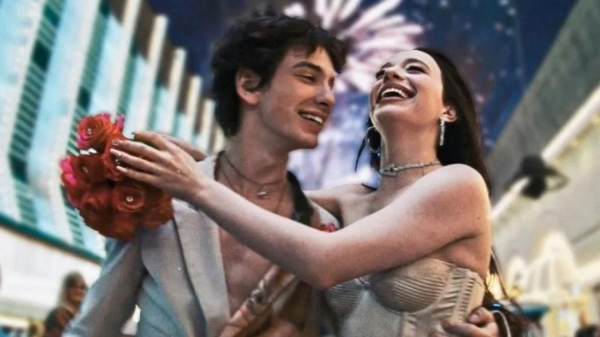
Like some others in different professions, Ani puts profits first. She does so in her work, and she does so in her personal life. The plot’s main focus is on her relationship --which starts out with plenty of paid sex--with a rich young Russian, Ivan (Vanya in Russian), played by Russian actor Mark Eydelshteyn. After he meets Ani at her sex club, she comes to a New Year’s Eve party to which he had invited her, and he asks her if she is “available tonight,” meaning sexually. She replies that she has “holiday rates.” Later on, he offers her a lot of money, $10,000, to come to his mansion for a week and be “exclusive” with him. She counters his offer by saying, “15, cash, up front,” to which he agrees. (All film quotes are from the filmscript, written by director Baker.)
After some time together--and plenty of sex--he asks her to marry him. The script reads, “she waves her left hand drawing attention to her ring finger” and then says,“Three carats.” To which Ivan replies, “I’d look terrible if you had anything under four.” The script then adds, “Ani’s smile is a mile wide.”
If Ani fails to present much in the way of positive values, Ivan’s lifestyle is also glaringly deficient. The film does not explain how his parents, who reside in Russia, got so rich as to afford a waterfront New York mansion that sits behind a privacy gate and a security booth and has an elevator and a garage with at least five high-quality cars in it, including a Porsche, Rolls Royce, and Mercedes Jeep. But we do know something in general about the nouveau riche who emerged in Russia after the collapse of the Soviet Union in 1991.
Once Putin was securely in power in the 21st century, Russia was on its way to creating what one former Russian, Masha Gessen, called a “Mafia state.” Others have referred to Putin’s Russia as a “kleptocracy.” In general, scholars agree that what Russia created after 1991 was an economic system that reflected some of the worst aspects of capitalism. U. S. Sen. Bernie Sanders characterized present-day U. S. capitalism as “unfettered” and called it “grossly immoral” and a “vicious dog-eat-dog economy in which the vast majority struggle to survive, while a handful of billionaires have more wealth than they could spend in a thousand lifetimes.” The post-USSR capitalism also bore a few of the same traits and some even worse.
The filmscript has Ani saying that Ivan’s dad, Nikolai Zakharov, is “worth [$] 22 . . . billion.” Ivan’s values are those of a very spoiled son--he says he is 21. What’s important to him is sex, drinking, taking drugs, partying, and playing video games.
Much of the film is set in the Brighton Beach area of Brooklyn, a neighborhood with a high concentration of Russian and other immigrants from the former Soviet Union--and also a significant Russian Mafia presence.
In her analysis of Putin’s Russia, Gessen writes of Putin’s stress on Russia’s “traditional values.” (See also here on such values.) One example she gives is the passage in 2013 of anti-gay legislation. She writes, “Gays had become Public Enemy Number One: foreign agents, the foot soldiers of a looming American takeover, a threat to the foundational values of the European civilization. One hardly had to mention pedophilia anymore to communicate that gays were dangerous. The fight against them, on the other hand, positioned Russia as the European civilization’s bastion of hope.”
In attempting to explain Donald Trump’s admiration of Vladimir Putin, many explanations have been given, but Putin’s emphasis on anti-modern values--like opposition to gay rights--is not often mentioned. However, Trump’s recent attack on diversity, equity, and inclusion (DEI) and his slogan “Make America Great Again” (MAGA) harken back to an older time--one before Affirmative Action and desegregation, one when white males still clearly dominated U. S. life.
The values highlighted in Anora, however, are neither Putin-like nor particularly Trumpian--unless one considers Trump’s 1995 remark that because he was a “star” he could “do anything,” he wanted with women including grabbing them “by the p****.” The values reflected in Anora, however, do reflect a money-first mentality that has become increasingly prominent in Trumpian times.
One reflection of this has been the decline of U. S. happiness since Trump was first elected president. According to World Happiness Reports issued each March, the USA was ranked 18th in 2018, the first full year of Trump’s first term. In the 2025 report, issued after Trump was elected again in November 2024, the U. S. “dropped to its lowest-ever position,”24th. The country that has scored the highest in 2025 and for eight straight years is Finland, and other Nordic countries--which include Denmark, Iceland, Sweden, and Norway--also consistently score well. Their higher scores compared to those of the USA are due to many other factors besides politics, but our increasing political polarization is certainly one cause, as is the greater Nordic “safety net.”
Happiness is also related to the values we hold, as well as to what political issues matter most to us. A Pew opinion poll of September 2024 indicated that by a wide margin U. S. voters placed the economy as their top issue, with seven other issues coming before “racial and ethnic inequality” and “climate change,” which tied for ninth place.
Thus, the deficient values of Ani and Ivan are part of a larger social picture. In the USA and most other countries, values are simply not taught, either formally or informally--if they were, most progressives fear right-wing indoctrination. Value-teaching is not part of most educational systems, nor does our informal media world instruct us about prioritizing values. And yet the economist and environmentalist E. F. Schumacher (1911-1977) stated that the “essence of education . . . is the transmission of values.” It should help us achieve happiness and how to find it. Schumacher indicated, however, that someone might say, "For happiness you need wisdom,” but that left unanswered what wisdom was.
Many decades later, psychologist Robert Sternberg, in an essay entitled “It's Not What You Know, but How You Use It: Teaching for Wisdom,” attempted an answer. He wrote that “teaching for wisdom recognizes that there are certain values—honesty, sincerity, doing toward others as you would have them do toward you—that are shared the world over by the great ethical systems of many cultures.” But that the goal of such teaching should not be propagandizing for such values, but rather helping students “develop positive values of their own that promote social welfare.” Sternberg also writes that “people are wise to the extent that they use their intelligence to seek a common good. They do so by balancing, in their courses of action, their own interests with those of others and those of larger entities, like their school, their community, their country, even God.” Another important goal he argues is to teach students to see “things from others' perspectives as well as one's own,” to tolerate “other people's points of view, whether or not one agrees with such views.”
When Ivan’s parents discover that he has married, they insist that he and Ani get an annulment, and they fly--in their private jet--to the United States to see that this occurs, which it does. Partly because this review is reluctant to reveal any more “spoilers,” it will not tell any more of the story. But there will also be no more revelations because the film has no more of interest--at least to this reviewer--to say. It tells the tale of two young people with misplaced values--a whim, a lark, for him; a financially profitable transaction for her--who flew to Las Vegas and got married. And then the disapproval of his rich Russian parents and their coming to the U. S. to oversee an annulment.
But if I do not have much interest in Ani, Ivan, or his parents, I do care about values. In a previous article I wrote that “before being elected to his first presidential term, Obama wrote in The Audacity of Hope, ‘I think that Democrats are wrong to run away from a debate about values,’ and that the question of values should be at ‘the heart of our politics, the cornerstone of any meaningful debate about budgets and projects, regulations and policies.’” That book also mentioned the importance of other values, especially empathy but also “honesty, fairness, humility, kindness, courtesy, and compassion,” as well as wisdom.
Later on, during Trump’s first presidential term, Obama stated, “All of us have to send a clarion call and behave with the values of tolerance and diversity that should be the hallmark of our democracy.” And he added that we should “reject language coming out of the mouths of any of our leaders that feeds a climate of fear and hatred or normalizes racist sentiments; leaders who demonize those who don’t look like us, or suggest that other people, including immigrants, threaten our way of life, or refer to other people as sub-human.”
In the films we choose to see, in the books we choose to read, in the college courses we choose to take, in the politicians we vote for, we reflect our values, though often unaware that we are doing so. Sometimes we choose well and sometimes not so well. I chose to see Anora (on Hulu) because of all the awards it won and because of its Russian connection--I taught Russian history for over four decades--but after seeing it my advice to filmgoers is to skip the movie and instead spend the time thinking about value priorities.
