



The futility of war clearly comes across, as does the way warfare disrupts the homefront.
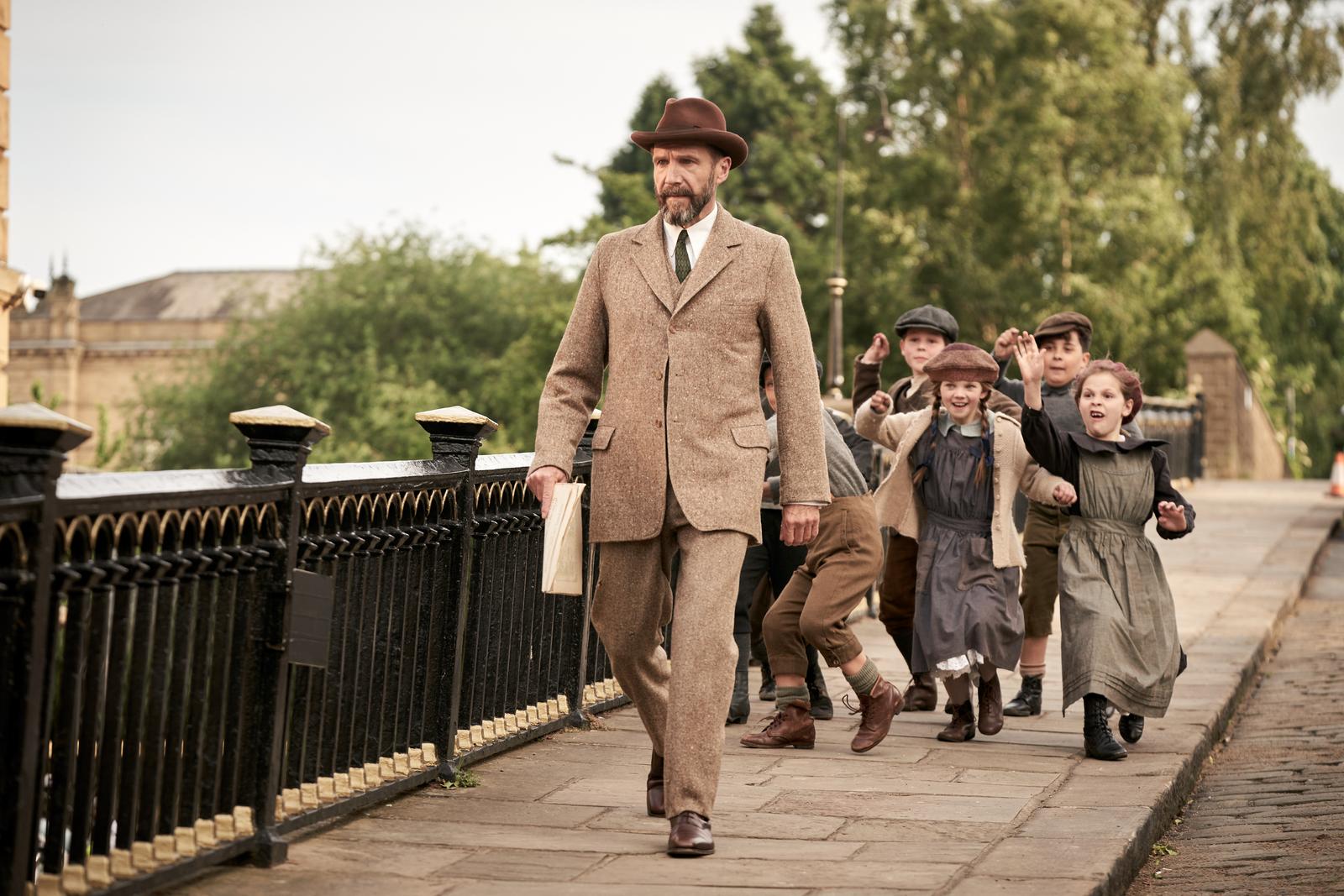
The Choral is set in Ramsden, Yorkshire in 1916 as the First World War rages and young Englishmen are conscripted and sent off to the frontlines. Nevertheless, the village’s Choral Society remains determined to present what I assume is an annual live performance, that is deemed so important (for some inexplicable reason) that the local draft board grants youths temporary deferments if they join the chorus. (The male teenagers are replacing the adult men who are off fighting the “Bosch” on the Continent.) However, as the usual chorusmaster has been shipped out to the Western Front, a new one must be found.
Ralph Fiennes’s musical character Dr. Henry Guthrie is suspect because not only is he an atheist, but worse, “he worked in Germany” before WWI broke out, and may be gay to boot. However, one of the Choral Society’s directors, influential factory owner Alderman Duxbury (Roger Allam), has heard Guthrie’s Requiem by Mozart, and pronounces it “wonderful,” so Guthrie is reluctantly hired to conduct the upcoming show. But, Guthrie is verboten from presenting anything by a German, and besides the performer who was to play Jesus in Bach’s St. Matthew Passion is now in uniform abroad, so the choirmaster opts in favor of conducting The Dream of Gerontius, an oratorio by the veddy British composer Sir Edward William Elgar (Simon Russell Beale, who played Soviet secret policeman Lavrenti Beria in the 2017 dark comedy The Death of Stalin), which Guthrie reinterprets in light of the wartime circumstances, accompanied by his scanty three-piece orchestra.
The Choral follows Guthrie as he auditions, trains, and rehearses singers for the upcoming big show. Although wartime conditions pressure the perfectionist conductor to accept subpar performers, there is one real standout, Mary (Nigerian English actress Amara Okereke, the first Black woman to depict Eliza Doolittle in the 2022 West End revival of My Fair Lady). She is the sole member of the choral society of African ancestry, as well as a goody two-shoes acolyte who collects coins for the Salvation Army.
There is commentary throughout this 113-minute movie about a number of subjects, including racism, assimilation, jingoism, and hatred of foreigners. Just as Jesus refused to persecute Mary Magdalene, the ironically named Mrs. Bishop (Lyndsey Marshal) is an archetypal hooker with a heart of gold who is treated benignly. Guthrie’s pianist Horner (Robert Emms) is a conscientious-objector who seems to be gay, which leads to his undoing. It’s unclear what Guthrie’s own gender preference is, but the lifelong bachelor is presumably gay, too.
The Choral has an overall antiwar vibe, plus a dollop of class consciousness. As the working class youths Lofty (Oliver Briscombe) and Ellis (Taylor Uttley) deliver government telegrams announcing the demise of soldiers on bicycles ride past factories, one ruminates: “England! We’re fodder for the mill, and we’ll be fodder for the front.” A more jaundiced view of Lord Alfred Tennyson’s jingoistic “Onward rode the six hundred,” eh wot?
The futility of war clearly comes across, as does the way warfare disrupts the homefront. In a poignant vignette Clyde (Jacob Dudman), a soldier reported as missing in action, surprisingly returns home – missing a limb, but still alive, only to find that his randy girlfriend Bella (Emily Fairn) has already moved on. Although more people died during World War II, the Allies had a real cause to fight for: The defeat of fascism. But WWI was just an inter-imperialist conflict that senselessly squandered proletarian and peasant pawns on both sides in the big power game of realpolitik rivalry for no good reason. At least with their “Bread! Peace! Land!” slogan, the Bolsheviks had the good sense to pull out of the global conflagration once they seized power in 1917.
The composer Elgar (an actual historical figure) makes a surprise appearance, and here The Choral may be making some points ranging from censorship to theft of intellectual property to artistic freedom. In any case, this sequence is a highlight in a mostly lowkey story.
This motion picture about putting on a musical show may strike some moviegoers as being, at least at times, as talky and stagey, without fully succeeding to translate the subject matter into cinematic syntax. (Screenwriter Alan Bennett is also a playwright.) I also didn’t quite understand why performing a piece of music during wartime was so important that male participants of draft age received deferment so they could sing for a pretty small audience. Maybe the film was trying to say something about the transcendence of music and art, how essential they are, even during wartime.
Having said this, I quite enjoyed The Choral, which is directed by BAFTA, Olivier and Tony Award winner Nicholas Hytner and written by BAFTA, Olivier and Tony Award winner Alan Bennett, their fourth collaboration that includes The Madness of King George and The History Boys (which Bennett, part of the famed 1960 satirical revue Beyond the Fringe, originally wrote for the stage). The Choral is Bennett’s first original screenplay in four decades. Hytner also helmed the 1996 screen adaptation of Arthur Miller’s The Crucible, starring Daniel Day-Lewis and Paul Scofield.
The Choral is being theatrically released starting December 25. Although this isn’t a movie for children, this period piece does express some of the season’s loftier sentiments about peace on Earth, goodwill toward men (and woman!), as Luke 2:14 puts it. Which is all the more important to remember as the Trump-erialists try to provoke yet another futile war against Venezuela, and god knows where else, even as the demented ignoble warmonger pines for a Nobel Peace Prize.
FUN FACT: Sergei Eisenstein’s immortal masterpiece, Battleship Potemkin, just turned 100 years old. The greatest revolutionary movie ever made world premiered Dec. 21, 1925 at the Bolshoi Theater in Moscow. Happy birthday, Potemkin!
