

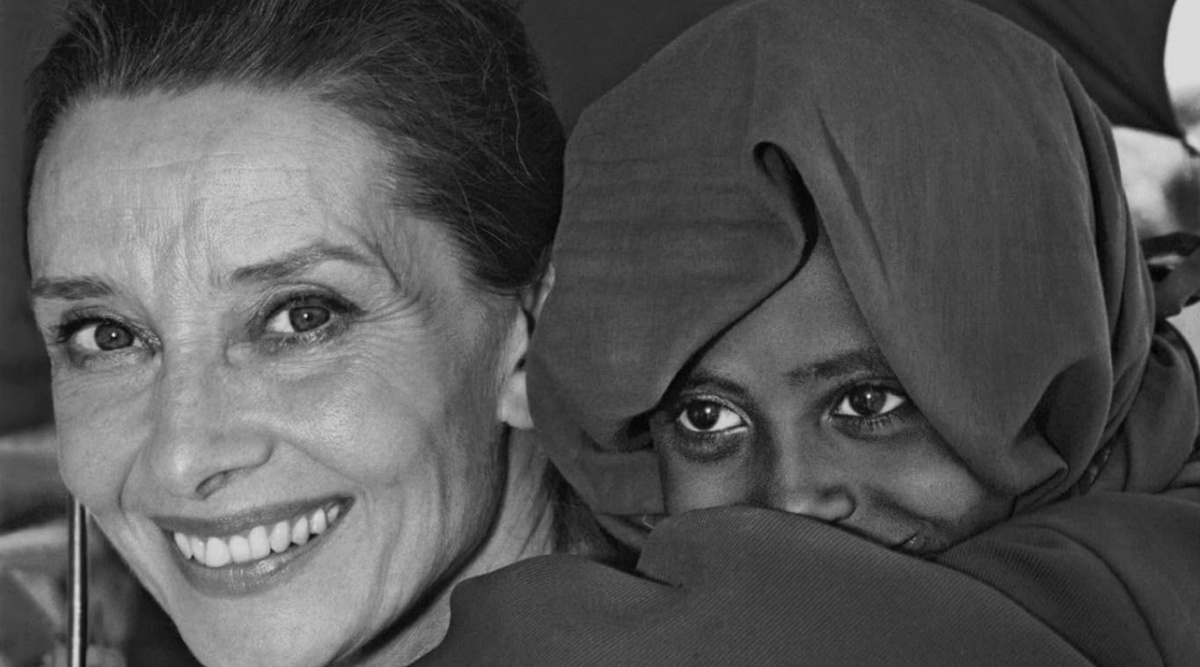

If a celebrity is a good person, even a role model for some, then a certain amount of attention is warranted. And to my mind, actress Audrey Hepburn was such a person.
I often think that celebrities have too much influence. Advertisers, for example, apparently think that people will buy products endorsed by celebrities even if the product has nothing to do with their expertise or claim to fame. Former baseball slugger Joe DiMaggio is just one past celeb who comes to mind. For millions of people, he became known not only for his past baseball heroics (and having briefly been married to Marilyn Monroe), but also as a spokesman for Mr. Coffee.
Nevertheless, if a celebrity is a good person, even a role model for some, then a certain amount of attention is warranted. And to my mind, actress Audrey Hepburn (1929-1993) was such a person. Therefore, I recommend Netflix’s biopic Audrey before the streaming service withdraws it after 14 March.
Although awarded an Academy Award as Best Actress in 1953 for her role in Roman Holiday and a Tony Award the following year for her portrayal as Ondine, in a play of the same name, it was not her acting that made her such a special person, though her smiling and charming characters usually delighted moviegoers. No, it was more her work for UNICEF in the late 1980s and early 1990s, work that earned her the U.S. Presidential Medal of Freedom and the Jean Hersholt Humanitarian Award. And that work revealed that by that point in her life, in the years bracketing her 60th birthday, she came to realize that loving others, particularly in her case, the world’s children, was the most important thing we can do.
At one point in Audrey, she says, “If this career [acting] has left me with something very special, it's the fact that it's left me with this voice, this curiosity, people have still to see me to talk to me, which I can use for the good of children.”
Her first memories of UNICEF went back to WW2, when she lived in the Netherlands and suffered from Nazi occupation. The film mentions her youthful assistance of the Dutch Resistance and that “she survived the Dutch famine on bread made of tulips.” And when liberated, UNICEF agents provided “aid to women and children after the war, they literally pulled her out of the famine.” (The film script can be accessed here.)
During the movie’s last quarter, we see shots of her in Somalia and other parts of the world displaying that love, and we hear family members and friends commenting on it. Her granddaughter Emma, herself today involved in UNICEF work, states “She was so compassionate about children who are suffering. She truly loved humanity.” And Emma speaks of “all the love that she showed to children and to mothers around the world.” Photojournalist John Isaacs, who sometimes travelled with her, relates that “dignity and love is what we always talked about,” and he stresses her emphasis on love and her desire to share it with children.
In 1988, her first mission as a UNICEF Goodwill Ambassador was to Ethiopia. About her trip, she said, “I have a broken heart. I feel desperate. I can't stand the idea that two million people are in imminent danger of starving to death, many of them children, [and] not because there isn't tons of food sitting in the northern port of Shoa. It can't be distributed. Last spring, Red Cross and UNICEF workers were ordered out of the northern provinces because of two simultaneous civil wars . . . I went into rebel country and saw mothers and their children who had walked for ten days, even three weeks, looking for food, settling onto the desert floor into makeshift camps where they may die. Horrible. That image is too much for me. The ‘Third World’ is a term I don't like very much, because we're all one world. I want people to know that the largest part of humanity is suffering.”
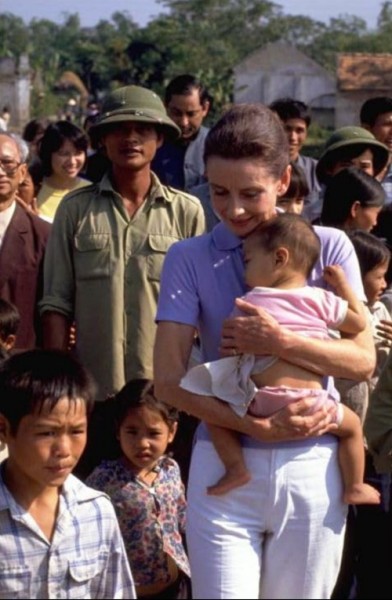
After Ethiopia, she went to Turkey to vaccinate people and later said, “ten days to vaccinate the whole country. Not bad.” According to a UNICEF tribute to her, she then went to “training programmes for women in Venezuela, initiatives for children living and working on the street in Ecuador, projects to provide drinking water in Guatemala and Honduras, and radio literacy programmes in El Salvador. She saw schools in Bangladesh, services for impoverished children in Thailand, nutrition initiatives in Viet Nam, and camps for displaced children in Sudan,” where civil war raged. About Sudan, she said, “I saw but one glaring truth: These are not natural disasters but man-made tragedies for which there is only one man-made solution – peace.” (If she were alive today to witness events in Gaza, she might repeat those words.)
In Bangladesh, photographer John Isaac observed, “Often the kids would have flies all over them, but she would just go hug them. I had never seen that. Other people had a certain amount of hesitation, but she would just grab them. Children would just come up to hold her hand, touch her—she was like the Pied Piper.”
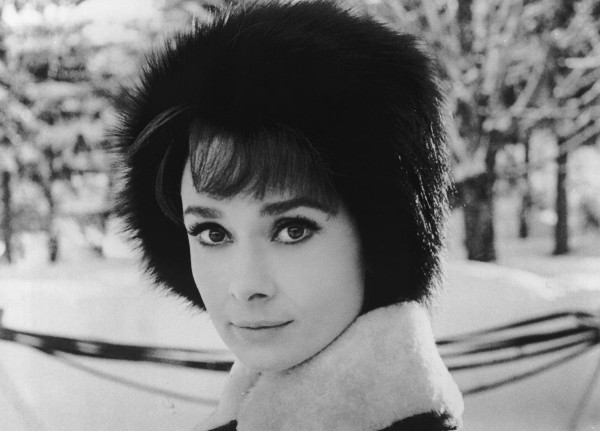
The UNICEF tribute also mentions some of her other contributions: “She testified before the US Congress, took part in the World Summit for Children, launched UNICEF's State of the World's Children reports, hosted Danny Kaye International Children's Award ceremonies, designed fundraising cards, participated in benefit concert tours and gave many speeches and interviews promoting UNICEF's work.” During her last full year of life, 1992, “though ill with cancer, Audrey continued her work for UNICEF, travelling to France, Kenya, Somalia, Switzerland, the United Kingdom, and the United States.”
Love became her prime value—as I think it should for all of us. But there were also others like humility and empathy. Her son Sean tells us, “I think she always felt throughout her life that she had shortcomings.” Like many attractive women, she underrated her looks, once telling an interviewer, “You can even say that I hated myself at certain periods. I was too fat, or maybe too tall, or maybe just plain too ugly . . . you can say my definiteness stems from underlying feelings of insecurity and inferiority.”
Shortcomings? Sure, like all humans, she had them. And as with all humans, we can usually discover events in the past that help explain them. In her case, as the film suggests, her father’s abandonment of his family in 1935 scarred her deeply, and affected her later relationships with men, including two whom she married and later divorced. Until her UNICEF work of the late 1980s, her need for love seemed to outweigh her ability to emit it, although she was a loving mother to her sons Sean (b. 1960) and Luca (b. 1970). Only with her UNICEF work did she reach that apex, which the poet W. H. Auden expressed when he wrote, “If equal affection cannot be / Let the more loving one be me.”
A true test of character is how one meets death. And as one would expect, she met it bravely at age 63. Audrey, one of her friends said, “She was very peaceful. And usually you are afraid, but she wasn't.” She told her son Sean that there were people in her Swiss bedroom with them. “That these were the people on the other side” who were going to take her away with them. The movie’s final words are hers, “When I love, I love unconditionally.”
It was fitting that after her death, her friend Gregory Peck recorded a tribute to her in which he recited one of her favorite poems, Rabindranath Tagore’s “Unending Love,” which pays tribute to “love but in shapes that renew and renew forever.” In her films of the 1950s and 1960s, such as Roman Holiday (1953), Sabrina (1954), Funny Face (1957), Breakfast at Tiffany's (1961), Charade (1963), and My Fair Lady (1964), it was Audrey’s physical appearance and spunky charm that captivated viewers. In the late 1980s and early 1990s, during her UNICEF days, it was her loving heart that touched the observant.
