

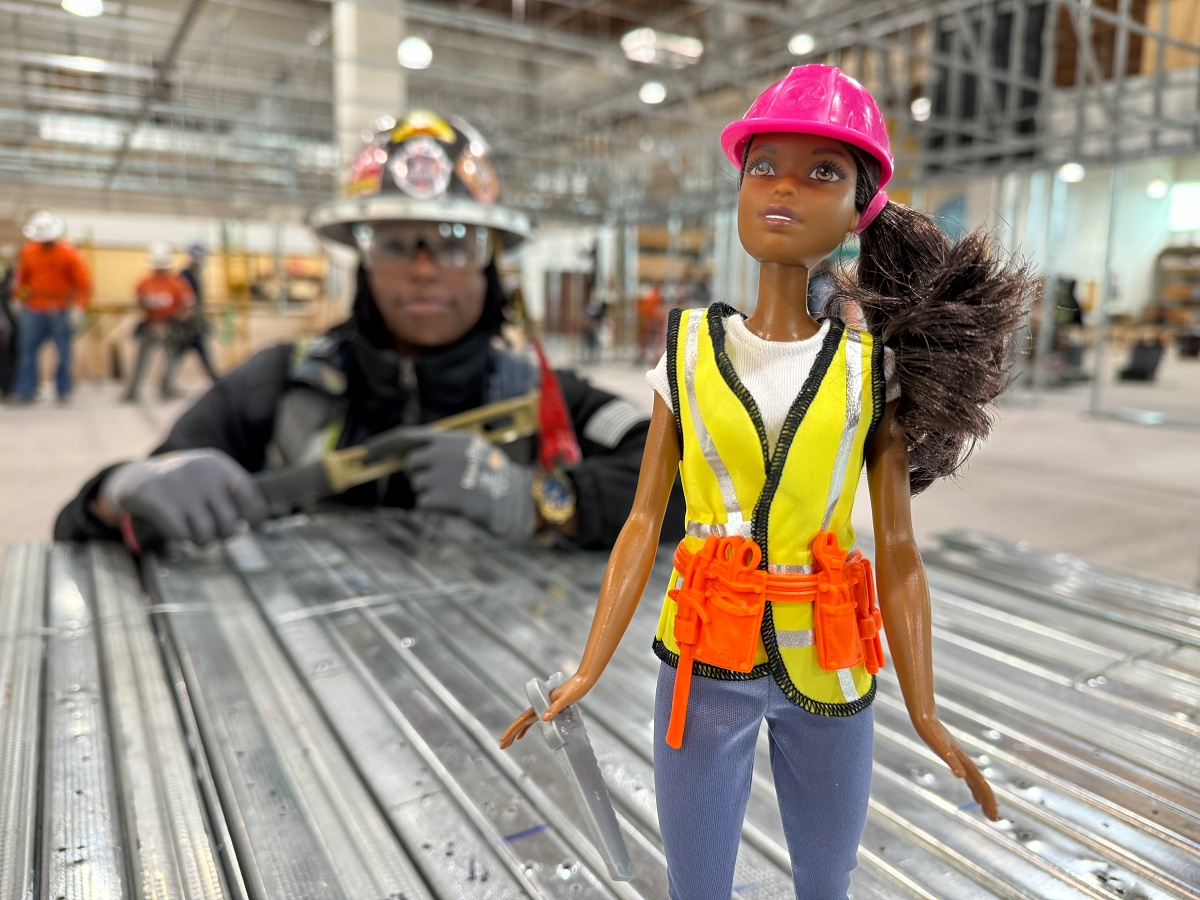


Part of the lingering perception of construction workers as white, bigoted, sexist, and downright dumb, is traceable to Hollywood itself. I
The movie Barbie has been nominated for eight Oscars including for Best Picture. Barbie offers a playful critique of rigid gender rolls and patriarchal fantasies, moving between Barbie Land, where women run things, and the real world, where corporate power, at least at the Mattel Toy Company, is wielded by clueless and misogynistic men.

It’s not just corporate executives who are skewered for their patronizing and controlling behavior. Male blue-collar workers get the same treatment. Shortly after arriving in the real world, Barbie and Ken walk along the beach in Venice and approach a construction site. The construction workers, mostly white, insult Barbie with sexually denigrating comments. One of the workers leeringly asks her if she has a mirror in her pocket, “because I can see myself in your pants.”
The scene is a cliché that, at least for California, was outdated decades ago. Not only are the vast majority of union construction workers in California Latino, but in the modern construction industry, verbally abusing women in any fashion is grounds for dismissal. Diana Limon, a union electrician who has worked in the industry for years, knows the current reality. “Today, there is no way a large union contractor would tolerate harassment of women as portrayed so often in movies and on television,” she said.
The same holds true for racist remarks. John Harriel, an electrical worker superintendent and anti-recidivism leader pointed out that if a worker is heard making bigoted or racist remarks, they could be expelled from their union. “We have misconduct articles in our union constitution that we take very seriously and we don’t put up with it,” Harriel said.
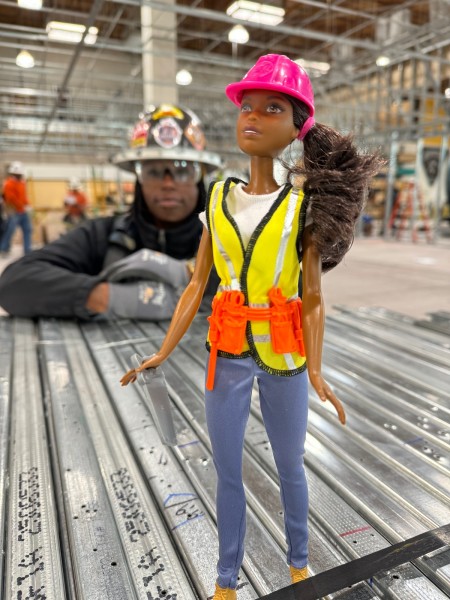
Part of the lingering perception of construction workers as white, bigoted, sexist, and downright dumb, is traceable to Hollywood itself. It was the construction worker in particular who became, according to labor historian Joshua Freeman, the “archetypical proletarian,” shown in popular culture during the 1970s and 80s as “the rudest, crudest, and most sexist of all workers.” And sometimes, they lived up to their reputation.
The event that stamped this toxic image in the public’s mind was the so-called “hardhat” riot of May, 1970, where hundreds of mostly white union construction workers in New York assaulted young anti-war protesters near Wall Street. The violence made international news and the workers were condemned by most commentators.
Since that time, construction unions have become more diverse nationwide, but especially in California. Most political commentators and journalists have missed that development’s significance.
According to the California Department of Industrial Relations, of the 55,000 construction union apprentices—new workers coming into the trades—over sixty-five percent are categorized as Hispanic.
Visit a real construction site of any size in Southern California, and you will find is a diverse workforce that more or less reflects the population of the area. Monserrat Roldan, an ironworker apprentice at the Intuit Dome in Inglewood, recently told me about how getting into the union changed her life and how much she respected the men and women she works with. She expressed annoyance at how construction workers are often seen by the broader public. “Sometimes the media make construction workers look less intelligent or brutish, and they are not,” she said. “I admire the skill and finesse of the people I work next to, and there is a lot of pride in our craft here.”
Scholars of popular culture keep a close watch on why certain imagery and themes emerge when they do. It’s clear, for instance, that current negative portrayals of working-class people are related to the fear that Donald Trump is successfully using xenophobia, misogyny, and white power rhetoric to solidify his support among voters without college degrees. If at certain moments in history hardhats were seen as the embodiment of “manliness” and virility, negative portrayals today often frame them as representatives of masculine crisis, blue-collar men lashing out at a world they don’t understand or accept.
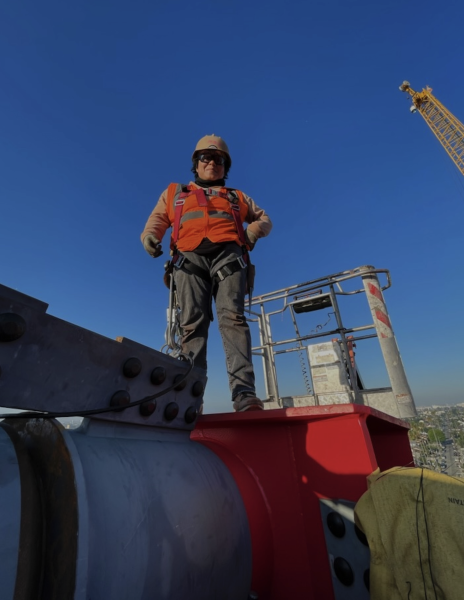 Monserrat Roldan
This outdated construction worker trope could also be a product of the anxiety of the professional class itself. In her book, Fear of Falling, Barbara Ehrenreich describes how anxious journalists and filmmakers in the 1970s and 80s, first “discovered” the working class, then went on to picture blue-collar environments as war zones, “invariably settings for masculine mayhem.”
In the movie Taxi Driver (1976), Robert De Niro portrays Travis Bickel, a loner with no institutional anchors, as a stand in for a working-class “in a stage of surreal degeneration.” For many middle-class liberals, Ehrenreich concludes, blue-collar workers became a “psychic dumping ground” for crude beliefs about race and male dominance.
Stereotyping of the construction worker today in California is surprising because the demographics are so wrong, but also because working-class men and women of all backgrounds, have joined together in massive acts of solidarity and militancy not seen in decades. Construction workers, auto workers, UPS drivers, nurses, Starbucks baristas, and actors have negotiated and gone on strike for dramatic gains that have improved the lives of hundreds of thousands of families.
But cliches die hard, and the “hardhat” is a symbol that keeps on giving. A Barbie sequel should include Barbie and Ken going on strike together to improve their lives. It would be more realistic and even more powerful.
