


Like many of us, Riggan seeks happiness through things he cannot control—people’s views of him, fame, good reviews of his play, being loved, etc.
Birdman (now on HBO Max) won four Oscars in 2015, including for best picture and best screenplay. Although it might give viewers some clues on what love is not, audiences looking for insights on what true love is should look elsewhere.
The film begins with some poetic lines from a short poem by Raymond Carver being flashed on the screen. They include: “AND WHAT DID YOU WANT? / TO CALL MYSELF BELOVED, TO FEEL / MYSELF BELOVED ON THE EARTH.
In an early scene depicting a play Riggan (Michael Keaton) is directing and acting in, friend Lesley (Naomi Watts) says that her ex-husband “loved me...Okay, well, he did beat me up one night. He dragged me around the living room by my ankles, yelling ‘I love you, I love you, bitch.” What do you do with a love like that?” (The words are almost the same as in Raymond Carver’s short story “What We Talk About When We Talk About Love,” the story that Riggan is adapting for the stage.) Despite the objections of Lesley’s second husband, she continues to insist that her first husband really did love her.
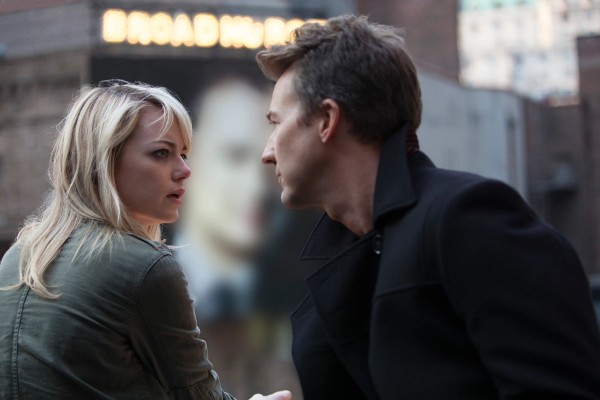 Emma Stone and Edward Norton
In a later film scene Riggan’s ex-wife Sylvia (Amy Ryan) says to him that they broke up because “you threw a kitchen knife at me...and one hour later you were telling me how much you loved me...You confuse love with admiration.”
Before analyzing why Lesley and Riggan fail to understand what true love is, it’s appropriate to indicate some of the reasons why I think this movie deserved its Oscars. First, it deals with important subjects—love, our self-images, celebrity culture, the meaning of life, etc. Secondly, the acting is first rate. Besides Keaton, Ryan, and Watts, add Zach Galifianakis, Edward Norton, Andrea Riseborough, and Emma Stone, to the actors that jointly won a Screen Actors Guild Award for “Outstanding Performance by a Cast in a Motion Picture.” Third, the film is plotted well and has some very good scenes.
Regarding plot, for a good part of the two-hour film we are left guessing whether Riggan’s drama is going to be a hit, a bust, or something in between. At one point New York Times critic Tabitha Dickinson (an excellent Lindsay Duncan) tells Riggan that she’s going to destroy his play. All along, we might also be wondering as to how Riggan is going to end up. Is he going to solve his poor self-image problem? Is he going to stop confusing “love with admiration,” as his ex-wife accused him of doing? Connected to that puzzlement is an ending that I won’t reveal here (in case some viewers have not yet seen Birdman.)
As to scenes, one that stands out is Riggan accidentally locking himself out of the theater, getting his robe caught in the door, and then walking along crowded New York city streets in only his jockey underpants. A little later his daughter, Sam (Emma Stone), shows him a video on her cell phone of him so clad (or unclad) and a newscaster saying the video got 1.3 million hits in 2 hours.
But now back to the whole problem of love and Birdman’s characters’ confusion about it. First, a few words about placing the desire to be loved (or “beloved,” as Carver’s poem has it) before the importance of loving, or the complaint of Lesley’s first husband, Ed (Keaton playing Riggan), “What's wrong with me? Why do I end up having to beg people to love me?” Simply put, placing being loved before loving is reversing the proper order. (Unless otherwise noted, direct quotes are taken from the screenplay.)
The poet W. H. Auden once wrote, “If equal affection cannot be, / Let the more loving one be me.” I agree with Auden—loving should come first. Being loved is great; but it depends on the will of another or others. But loving, determining how much we love and how to do so, is essentially up to us. And even though there are many different kinds of love (e.g., romantic, charitable, platonic, spousal, familial, etc.), this generally applies.
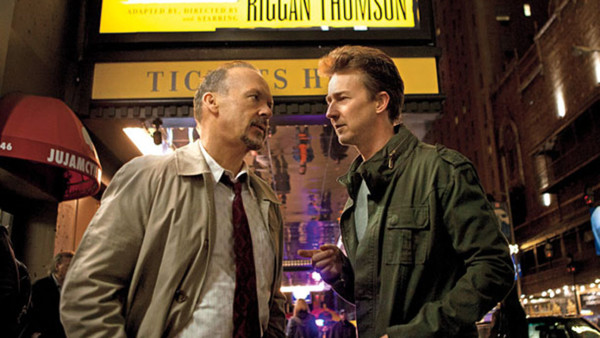 Michael Keaton and Edward Norton
A carer for the poor and needy, Dorothy Day, recognized by both President Obama and Pope Francis as a great American, appreciated various kinds of love, but thought that they all shared the primary concern of fostering the flourishing of the loved one (or ones). And that such love also implied a depth of concern and commitment that exceeds any mere “liking.” A few quotes from this woman who experienced romantic and paternal love before converting to Catholicism reflect her approach.
In 1938 she stated, “It was human love that helped me to understand divine love. Human love at its best, unselfish, glowing, illuminating our days, gives us a glimpse of the love of God for man. Love is the best thing we can know in this life, but it must be sustained by an effort of the will. It is not just an emotion, a warm feeling of gratification. It must lie still and quiet, dull and smoldering, for periods. It grows through suffering and patience and compassion. We must suffer for those we love, we must endure their trials and their sufferings, we must even take upon ourselves the penalties due their sins.”
And in a 1958 letter she wrote: “If we could only learn that the only important thing is love, and that we will be judged on love—to keep on loving, and showing that love, and expressing that love, over and over, whether we feel it or not, seventy times seven, to mothers-in-law, to husbands, to children—and to be oblivious of insult, or hurt, or injury—not to see them, not to hear them...not judge, not do anything, but love, love, love.”
Another person who grasped the significance of loving was Viktor Frankl who was a prisoner in Auschwitz. In his Man’s Search for Meaning he wrote, “I grasped the meaning of the greatest secret that human poetry and human thought and belief have to impart: The salvation of man is through love and in love.”
Although St. Augustine’s words—“I give you this one short command: love, and do what you will”—can be misinterpreted, they reflect a great truth: Loving, seeking and working toward the good of another or others, is the key to a good life.
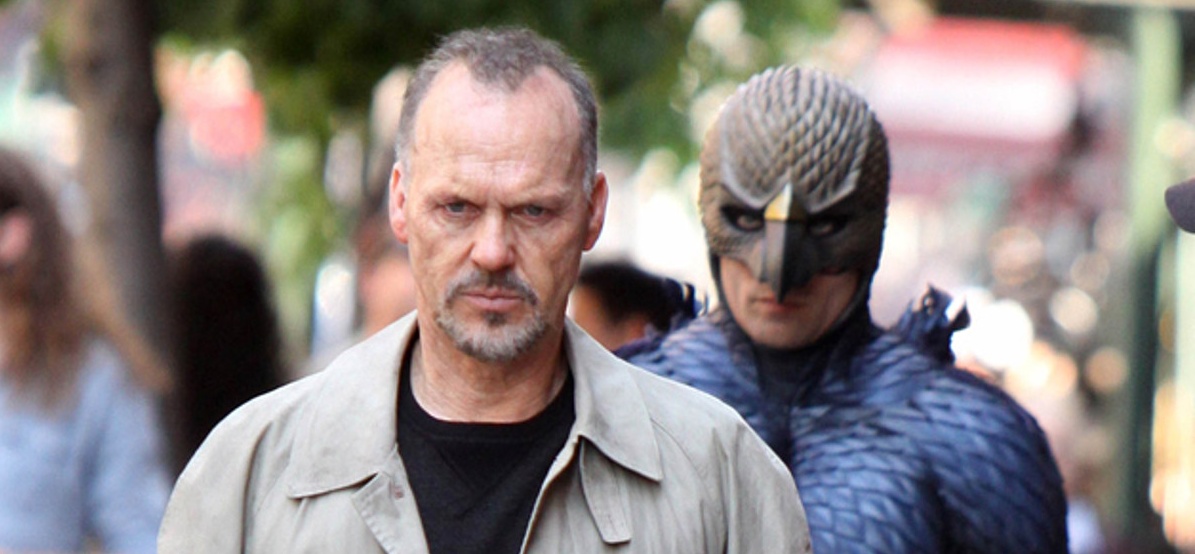
Like many of us, however, Riggan never seems to realize this. Like many of us, he seeks happiness through things he cannot control—people’s views of him, fame, good reviews of his play, being loved, etc. He had earlier in his career gained fame in films as the “Birdman.” And in this film reviewed here, a birdman-like figure appears from time to time urging Riggan to regain his fame by making still another Birdman film. But Riggan wants respect more than fame, and he hopes to gain it by directing and acting in his adaptation of Carver’s short story.
Yet, he continues to have his doubts and remains dependent on what others (like film critic Tabitha Dickinson) think of his work. At one point in the film a man of the streets outside a liquor store recites lines from Hamlet:
To-morrow, and to-morrow, and to-morrow,
Creeps in this petty pace from day to day
To the last syllable of recorded time,
And all our yesterdays have lighted fools
The way to dusty death. Out, out, brief candle!
Life's but a walking shadow, a poor player
That struts and frets his hour upon the stage
And then is heard no more: it is a tale
Told by an idiot, full of sound and fury,
Signifying nothing.
Such a gloomy perspective on life’s meaning haunts Riggan. At times he despairs, on one occasion throwing and smashing objects in his room, at other times trying to commit suicide. He confesses to ex-wife Sylvia that he sometimes failed as a spouse and father. In his failures to live a good life, he reminds us somewhat of Tolstoy’s titled character in The Death of Ivan Ilyich. Except toward the end of that novella, Ivan “fell through and caught sight of the light, and it was revealed to him that though his life had not been what it should have been, this could still be rectified.” Birdman’s conclusion is more ambiguous, but we have no assurance that Riggan has finally figured out the key to happiness.
In a sense he has been, and may continue to be, Everyman. Despite the wise words of Dorothy Day and Viktor Frankl about making loving our top priority, we still stagger through life, often looking for happiness in the wrong places.
