

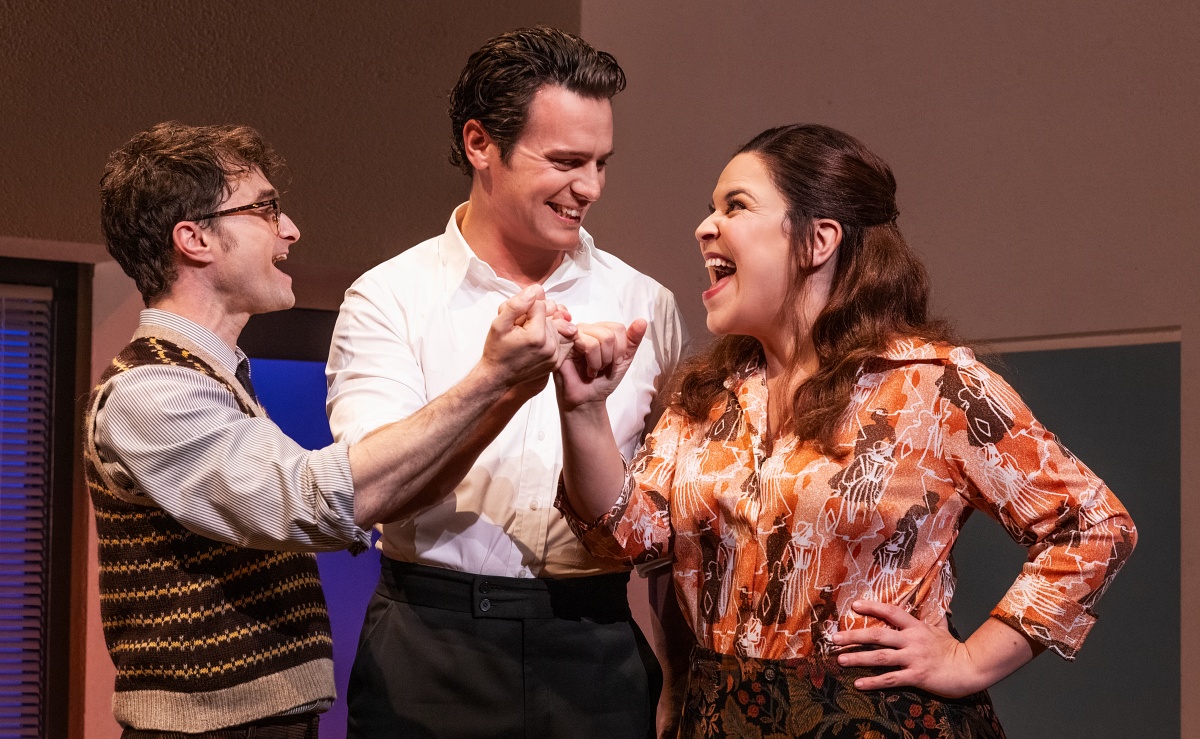

Sondheim’s adaptation musically rolls along, unfolding the story in an inventive way that turns chronology upside down.
The latest incarnation of Merrily We Roll Along adapts George S. Kaufman and Moss Hart’s 1934 Broadway play of the same name. The version opening in cinemas on December 5 hews closer to the 1981 iteration, which added music and lyrics by Stehen Sondheim and a book by George Furth. There was a 2013 screen version of the musical Merrily, while the current one also helmed by Maria Friedman was, according to a title at the start of this 150-minute movie, shot during a live performance in front of an audience at the Hudson Theatre (no, not the one on Santa Monica Blvd. in L.A., but the Hudson at the Great White Way in “Mamdani-Land,” aka New York City).
So, this import to the big screen from midtown Manhattan’s fabled Theater District is an exercise in filmed theater. As such, this Merrily can be stagey; for example, the locations are mostly interiors and the action is never opened up beyond the confines of the proscenium arch at the Hudson, which was designed 1903 in the Beaux-Arts style.
Be that as it may, Sondheim’s adaptation musically rolls along, unfolding the story in an inventive way that turns chronology upside down. The plot follows (albeit famously backwards) three striving artistes and how they each deal with fame and success, in their work and private lives. Mary Flynn (Lindsay Mendez, who won a Tony for 2018’s revival of Carousel, and played Elphaba 2013-2014 in Wicked) yearns to be a writer – and for the affections of the handsome, gifted composer Franklin Shepard (Jonathan Groff, who portrayed King George in Hamilton). His collaborator is playwright Charley Kringas, depicted by the cast’s best known thesp, the now grownup Daniel Radcliffe of Harry Potter fame.
As the bard’s moniker suggests, Kringas cringes at how success has taken its toll on Shepard, who slinks away from political theater aimed at changing the world to composing commercial, toe tapping fluff. Earlier in their careers in circa 1962, Shepard and Kringas, along with the former’s (eventual) wife Beth (Katie Rose Clarke), present satirical sketches about the then in office JFK administration, although there’s no scathing critique of the Kennedys per se. (The bit reminded me of impersonator Vaughn Meader, whose 1962 “First Family” record also poked fun at Jack and Jackie.) Merrily repeatedly references a musical Shepard and Kringas concocted, with the politically charged title Take a Left, which is perpetually sidelined in favor of more crowd-pleasing fare likely to sell more tickets, which irks the pure Kringas, if not Shepard, who is bedazzled by what acclaim perpetually brings him, once he has hit it big.
In the current Merrily Krystal Joy Brown, who played Diana Ross in the jukebox musical Motown, depicts Gussie Carnegie, the sexy torch singer who pursues the gifted but married Shepard. In the upcoming Richard Linklater rendition, Gussie is not played by an African American actress, but by Hannah Cruz. In the 2013 film, also directed by Maria Friedman, Gussie was portrayed by British actress Josefina Gabrielle, who also is not Black. I likewise doubt that the character now named Gussie was Black in the original Kaufman and Moss Broadway play in 1934, when much of America was an apartheid state.
My point in bringing this “color blind” casting up is that Gussie, who is first married to the Caucasian producer Joe Josephson (Reg Rogers), then couples up with the likewise lilywhite Shepard, is, during the course of the story, in not one but two interracial relationships, althought this is never so much as mentioned onscreen in the new edition of Merrily. While today interracial couplings routinely appear onscreen – especially, for some reason, in TV commercials – back in the years when this story is set, hanky-panky between the races was an eyebrow raising taboo. For instance, in a 1968 NBC-TV special, while they crooned a duet, British singer Petula Clark touched Harry Belafonte’s arm, which ignited a “scandal”: “That fleeting moment was controversial enough to prompt an executive with the Chrysler Corporation, the program’s sponsor, to protest vehemently—turning what one critic would eventually call “a stylish, sophisticated musical hour” into an inter-racial cause célèbre.”
Although this plot point that passes unnoticed seems unrealistic and merits at least some comment by the characters, I otherwise enjoyed Merrily. As said, Sondheim’s music keeps the story about success spoiling talent rolling along, and Radcliffe as the incorruptible Kringas croons well enough to carry a tune. However, he is not a wizard in the sonic department, and none of Sondheim’s song here have that “hum-ability” which is referenced by Joe the producer in order to make out like a thief at the box office. I didn’t leave the screening room singing one of Merrily’s songs, despite liking the film and its message about staying true to your creative and philosophical vision, instead of pursuing the brass ring.
