

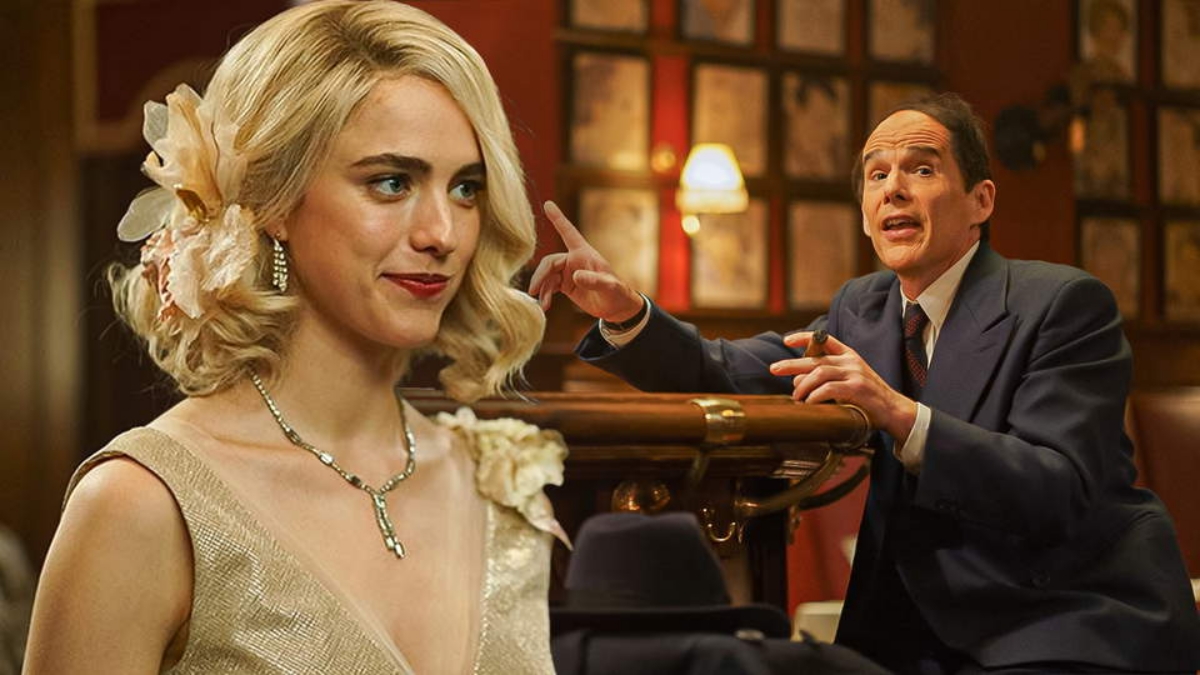

What makes the film so sad is not only that Hart died so young, but that his long-time song-writing partner, Richard Rodgers, in 1943 had Oscar Hammerstein replace Hart’s lyrical word-contributions to the team effort.
Blue Moon is a sad film, primarily about the last year of lyricist Lorenz Hart, who died in 1943 at age 47. But it is beautifully acted, especially by Ethan Hawke as Hart. (See here for more on Hawke’s career, and here for a recent interview with him.) For the role, the 5’10” Hawke had to appear as only 5 feet (or a tad shorter), the actual height of Hart. And through various stratagems, Hawke and director Richard Linklater managed to create that illusion.
This movie is not the first collaboration between Hawke and Linklater. They have joined together, for example, in making the Before Trilogy—Before Sunrise (1995), Before Sunset (2004), and Before Midnight (2013)—and in 2015, Boyhood, for which Linklater won the Golden Globe Award for Best Director (it also won the award for Best Motion Picture).
I have written before of both Linklater and Hawke, especially liking the latter in First Reformed and the eight-part FX series “The Lowdown.” And not only is he a gifted film and TV actor (and stage), but he has also written four novels, which are better than most books by actors. (His anti-Trump statements are also to my liking.)
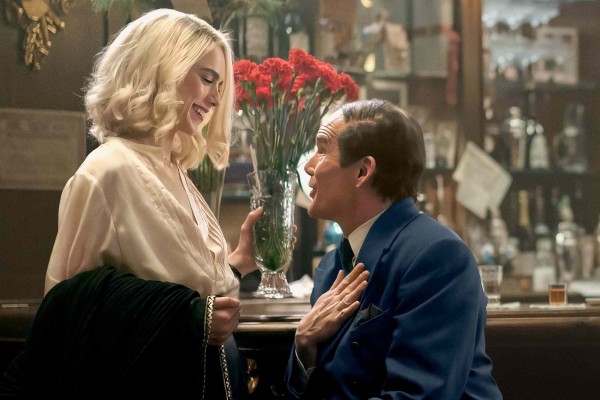 Ethan Hawke and Margaret Qualley
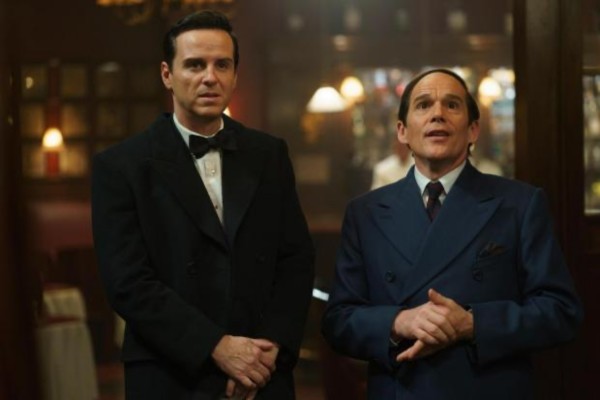
What makes the film so sad is not only that Hart died so young—partly caused by alcoholism—but that his long-time (a little over two decades) song-writing partner, Richard Rodgers (Andrew Scott), in 1943 had Oscar Hammerstein (Simon Delaney) replace Hart’s lyrical word-contributions to the team effort, starting with Oklahoma! (Prior to that Rodgers and Hart produced such classics as “The Lady is a Tramp,” “My Funny Valentine,” and “Blue Moon”; Rodgers and Hammerstein turned out the music for South Pacific, The King and I, and The Sound of Music). On one occasion, Rodgers complains to Hart that once in the past he had to ask Hart “for extra choruses, extra verses, and you were so drunk that you didn’t even show up.”
In addition to drinking too much, Hart’s personal life is also a mess in other ways, which he reveals through his many spoken words—primarily to a Sardi’s bartender Eddie (Bobby Cannavale), army-uniformed pianist nicknamed Knuckles (Jonah Lees), college girl Elizabeth (Margaret Qualley), the writer E. B. White (Patrick Kennedy), and Rodgers himself.
Although Linklater takes some artistic license, most of the story he tells is true. Why exactly Hart is such a misdirected person it’s hard to say. His short stature and his gayness (in an era when it was socially unacceptable), or at least bisexuality, probably contributed to his unhappiness. Hawke said this about him: “He was the bravest, and he was the most nervous and insecure. He was gay, and in love with a woman. He was full of contradictions. Everything about him was complicated.”
His cloakroom dialogue with Elizabeth, which lasts about 15 minutes, is especially painful. (His approximate words can be read in the film’s transcript.) He is smitten with this 20-year-od college student, though he is more than twice her age. Prior to this conversation, E. B. White asks bartender Eddie, “What do you think she sees in him?” To which Eddie replies, “I think she sees a rich and famous guy who can help her career. I think she recognizes she’s being adored by one of the great appreciators of beauty.” And, as the rest of the movie clarifies, the bartender is close to the truth.
In their cloakroom talk, Hart presses Elizabeth to tell him about her times with a guy named Cooper, who she says, “I’ve had a hopeless crush on this guy for over a year.” She relates that when they were finally alone, “Nothing happened....This was based on the fact that he couldn’t get the rubber on....It was the worst 10 minutes of my life.” And she continues, “When the girl loves the guy with all of her heart, and he just doesn’t return her feeling? Do you have any idea what that feels like?” Hart’s response is that “nobody ever loved me that much.” To which she adds, “I brought into that basement a year’s worth of adoration, yeah, studying his photograph, memorizing his phone number. And there he was, this half-drunk junior who couldn’t even pretend to love me.”
After mainly listening to Elizabeth talk about Cooper—she describes a second, more successful copulation, but then the failure of Cooper to ever contact her again—Hart says to her, “Tell me truthfully. How do you feel about me?” He mentions a night in Vermont when they “talked through half the night” and asks, “How do you feel about me....Did you actually love me a little bit that night?....You said you’d drive 30 hours to see Cooper. How many hours would you drive to see me?”
She then explains to him that she loves him, “just...not that way,” that she feels “something wiser and deeper....Respect. Gratitude for the generosity and selflessness you’ve shown me. No one has ever been more interested in my life than you have. I don’t deserve a friendship like yours. I am so grateful for you.”
Earlier, in a conversation with bartender Eddie, Hart asks, “Really, who’s ever been loved enough? Who’s ever been loved half enough?” And indeed love is a very complex phenomenon, and there are many different types of it, but Hart seems to have greatly missed being “loved enough.” (In his "Blue Moon" song he wrote, "Please adore me.") And that absence of being loved is what makes this film such a sad one. That and his obvious need for more love, more love that would pour into his aching, lonely heart and assuage his sadness. (Singer Mabel Mercer, who often sang songs composed by Rogers and Hart, once said that Hart was “the saddest man I ever knew.”)
