

From The Day of the Locust to Mulholland Drive


On the Chronicles of Nepotism and Corruption in Hollywood
Merriam-Webster recently announced “gas-lighting” as their word of the year. Soon after and not to be outdone, the Oxford English Dictionary—reminding everyone of their status as the “definitive record of the English language,” Scrabble’s™ officially sanctioned dictionaries be damned—chose the hipper phrase, “goblin mode.” As if anticipating the chaos to come, the Collins English Dictionary, the Rodney Dangerfield of the lexical world, was first to announce their word of the year giving the distinction to “permacrisis.”
If only they’d all waited . . . such a permacrisis of contending words may have been averted with the choice for the honor of a term that became a thorn in the body double’s side of the Hollywood elite: “nepo baby.” While this syntactic combination is relatively new, the concept behind it is nearly as old as civilization itself, bestowing a scheme of privilege and entitlement that functions to amplify and concentrate power and wealth.
It doesn’t take much thinking to recall a slew of examples of this phenomenon in American history and popular culture. After all, nepotism simply names various practices that have infiltrated nearly every nook and cranny of American society where there’s money to be made and influence to be wielded.
Although there will always be some notable exceptions to the rule of success by nepotism, the subjects of such stories are often offered up as convenient exemplars of meritocracy that feed the mythos of the American Dream. Refashioned into figures that serve to naturalize the inherent unfairness of the American class structure, such individuals serve as useful counterpoints to critics of economic inequality in the name of that distinctly American personage, ye olde puller-upper-of-oneself-by-one’s-bootstraps. This was the image, of course behind Horatio Alger’s advent of a raggedy character named Dick (does this make George Santos merely Dick-ish?) whose work ethic and determination was celebrated in fictional depictions of urban industrialism whilst becoming an expedient retort to those who question the fairness of an economic system built on exploitation and privilege since “anything can be achieved,” they say, “if only you (not them) work hard enough.”
Bound by the fleeting nature of the security and comfort that comes with success, many who do manage to pull themselves out of poverty, something that has become increasingly difficult in today’s socioeconomic context, then attempt to leverage forms of privilege to secure their own precarious statuses against the exclusionary forces and structures they struggled against in their climb up the slippery and pigeon-spiked rungs of America’s social ladder. Within a society driven so intensely by competition and conflict, the collusions and intrigues of nepotism have become naturalized through America’s homegrown brand of aristocracy that validates claims to status and reward within government, corporate structures, higher education and religious institutions, as well as in the modelling, music and movie industries.
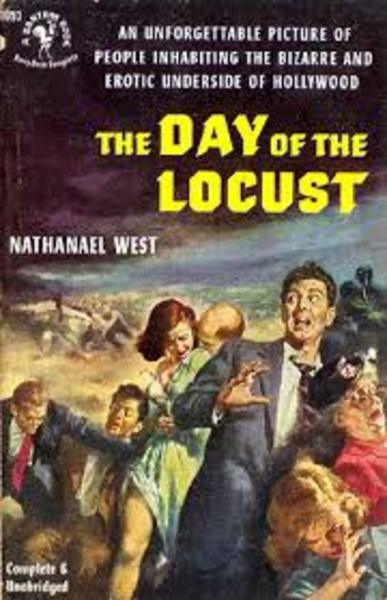 Cover art, Bantam Books paperback edition of The Day of the Locust, 1953
Given the pervasiveness of the problem and the stakes involved, why so much recent uproar directed at the entertainment industry regarding the advantages enjoyed by Maya Hawke, Zoë Kravitz or Maude Apatow as the offspring of prominent Hollywood families? The backlash seems especially notable in a country struggling to recover from the effects of a political morass that gave rise to some of the most blatant and destructive examples of nepotism in our nation’s history.
I mean, it’s not like Maya, Zoë, Maude, or even Chet Hanks, have been installed into positions granting them input on major domestic policy decisions. Nor are they serving as high-level advisors to the President, much less negotiating with world leaders on his behalf. And as far as I know, none of them have ever even been members of USC’s rowing or water polo teams.
The profusion of well-known examples is a clear factor with the flaunting of wealth and pedigrees so common amongst the children of Hollywood royalty, which also grants them access to studios, producers, directors and casting agents. Celebrity scions make little effort to downplay their connections, while it is also much less common nowadays for them to adopt professional names to create distance from familial associations *coughs Nicolas Cage.* In an historical moment where image is everything and conspicuous consumption carries its own social capitol within a society enamored with surfaces refracted through the inescapable virtual panopticon that has resulted from the merging of the media with the internet, the aura of celebrity has become more alluring than ever.
Such practices and systems, and the oblivion to the struggles of others that they signal, present an especially stark juxtaposition to the experiences of the vast majority of the population. Many of which have been overburdened by the physical and psychological effects of the COVID-19 pandemic, with the social isolation that has attended, while also being demoralized by the political and economic turmoil of recent years. Given the confluence of all these forces, the release of so much pent-up frustration, fear and outrage directed against the privileged and wealthy isn’t surprising. What makes all of this seem so threatening, perhaps, is the speed by which information can become ‘viral’ and saturate public discourse, an effect made more potent by the proliferation of social media platforms and the rise of so-called cancel culture.
The prevalence of nepotism as a driving force of the Hollywood dream factory has a long history and has largely operated in the open. Free from restraint, it has practically become a natural feature of an industry in which an inordinate share of opportunity and reward is bestowed upon the well-connected and privileged. Considering the nature of this system, I’m reminded of the reflections Dexter shares in “These Kids Aren’t Alright” about growing up in California “where the future was so bright” with dreams of “making it big,” only to see so many friends worn down and broken along the way as he bellows, “chances thrown, nothing's free, longing for what used to be. Still, it's hard, hard to see, fragile lives, shattered dreams.”
This rebuke seems reflective of the frustrations now boiling over across social media at the lack of opportunity and against the same corruption and institutional rot that numerous writers and filmmakers have also addressed in a body of works built over more than eighty years.
A sampling includes Nathanael West’s The Day of the Locust (adapted into film by John Schlesinger), Eve Babitz’s Slow Days, Fast Company: The World, The Flesh and L.A., and Bret Easton Ellis’ Less Than Zero (adapted by Marek Kanievska), along with films such as George Huang’s Swimming with Sharks (talk about art imitating life!) and Nicolas Refn’s The Neon Demon. Added to these are a slew of other works from Evelyn Waugh’s The Loved One, Babitz’s Eve’s Hollywood and several of the prose pieces in Joan Didion’s Slouching Towards Bethlehem, along with Ellis’ The Informers (adapted by Gregor Jordan) and David Lynch’s Mulholland Drive and Inland Empire.
Corruption and vice, desperation and pain collide spectacularly in these books and films, all set in a place described by a character writing a letter to his mother in one of Charles Bukowski’s stories as “an evil town” where “the Devil is in control,” or more simply a “wasteland” as Babitz reports while proudly identifying herself as a “daughter of the wasteland.” As an introductory statement to his novel, The Loved One, Waugh goes so far as to append a “Warning” in place of a preface to a story introduced as “a little nightmare produced by the unaccustomed high living of a brief visit to Hollywood.”
That a profusion of such ominous tales emerge from creatives with an intimate knowledge of Hollywood speaks to a shared imperative to expose the perils of tinsel town in stark terms. But to what end? Catharsis? Perhaps, but inherent to all these texts lies a forewarning to the starry-eyed and naïve, and to those with a tendency for recklessness born of the youthful delusions of indestructability.
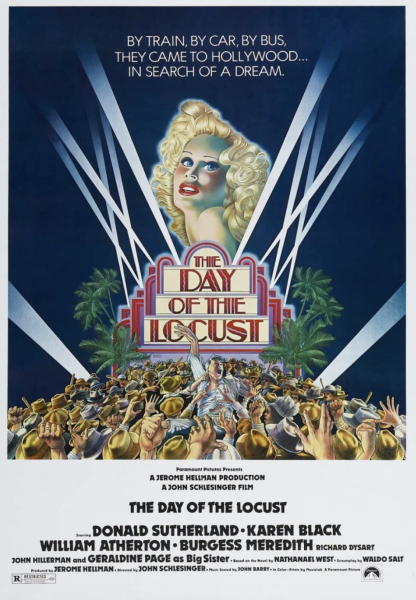 The Day of the Locust poster, John Schelsinger, 1975
West’s The Day of the Locust serves up a particularly scathing vision through its devastating portrait of Hollywood as a place of deception and violence against the desire of those who only want to see the “glamor girls” there. It’s also interesting in the present context as West’s life testifies to the cultural capital of an Ivy league pedigree in scamming his way into Brown using stolen transcripts to gain the mark of superiority long associated with elite universities. In his story, which features a cast of freaks and misfits driven by desires for fame, fortune and lust, the main character, a set designer named Tod Hackett, describes the people of Hollywood as seething with resentment, “eyes filled with hatred.” For Hackett, the denizens of Hollywood consist of a population raised on movies and drawn to “the land of sunshine and oranges,” but after getting a taste of reality they reel from the perception of being “cheated and betrayed.” Reduced, in the end, to a pathetic mass who had “come to California to die.”
Another of West’s characters, an aspiring actress named Faye Greener, struggles to repel aggressive advances from host of creepy men, while clinging to the dream that she will “be a star someday.” Emphasizing the desperation that defines her aspirations, and those of so many others driven by fantasies of stardom to Hollywood, she adds, “if I’m not, I’ll commit suicide.”
In the absence of the ‘right’ education, family relations or insider connections, Faye’s hopes collapse in spiraling episodes of disappointment and gloom, each more grotesque than before. As the story advances towards its ferocious apogee, Faye’s destiny becomes one that seems worse than death as she turns to prostitution for survival, before taking the lead role as the figure of desire and hatred in a painting done by Hackett titled, “The Burning of Los Angeles.” Here, she is depicted naked and pursued by a mob of men and women—“all those poor devils who can only be stirred by the promise of miracles and then only to violence.”
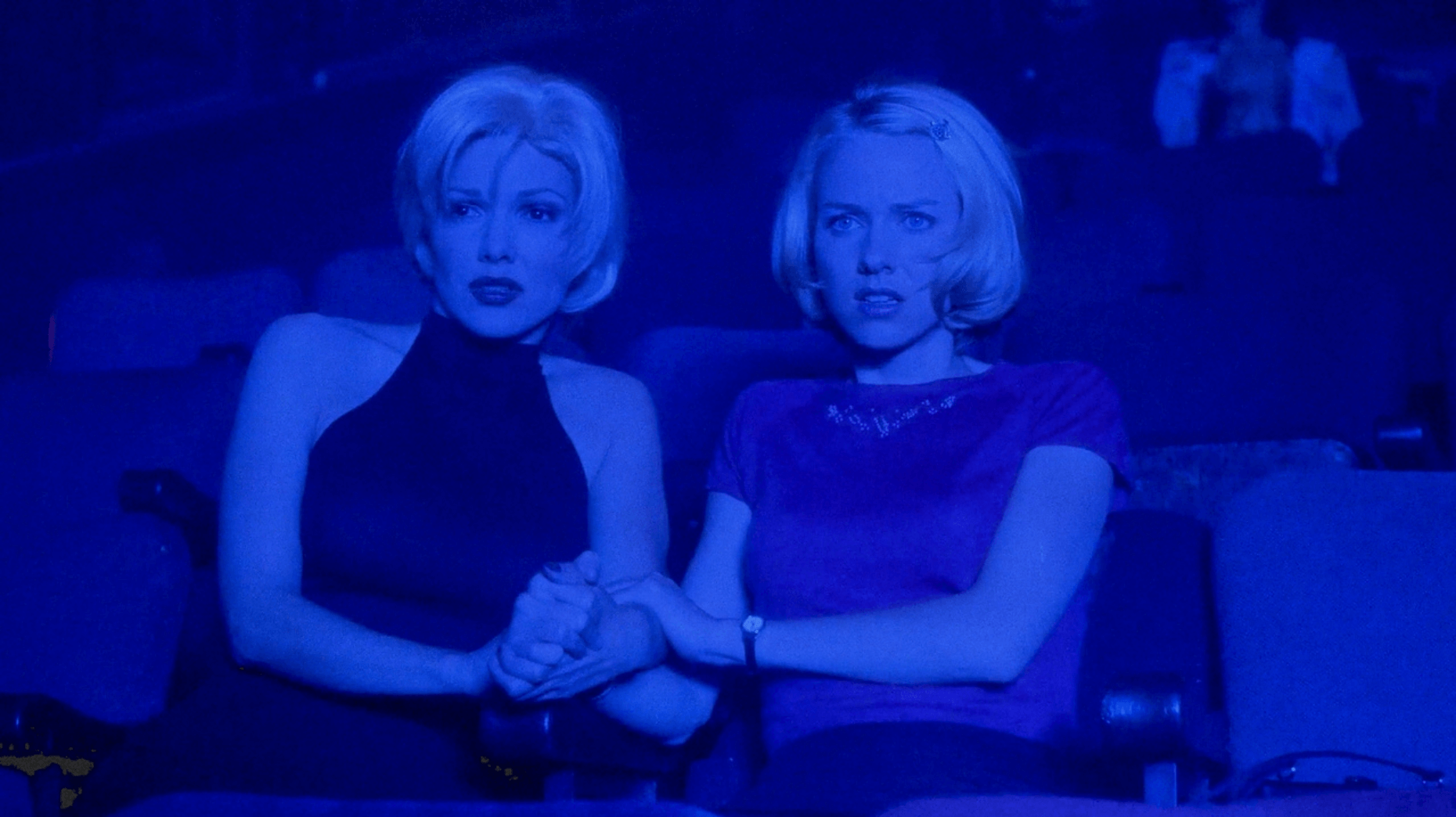
Similar situations and sentiments resound in Lynch’s Mulholland Drive, which exposes the hazards of Hollywood and the venality of movie industry through the circular journey of another aspiring actress, Betty Elms (Naomi Watts). Freshly arrived in Los Angeles on a flight from a small town in Ontario, the path Betty follows is revealing of the dearth of opportunity in a city more welcoming to demons than angels. Welcome to the jungle. Lynch masterfully amplifies this reality through dramatic irony as we see Betty sharing her own naïve hopes and unrealistic expectations.
Wide-eyed and gripped by the blinding spell of the neon lights and palm trees of Hollywood that she sees as a “dream place,” Betty reveals to the furtive and sultry, “Rita” (Laura Harring)—an actress herself suffering from amnesia due to an accident that occurred during an assassination attempt (yeah, it’s complicated)—the precariousness of such pursuits: “I couldn't afford a place like this in a million years . . . unless, of course, I'm discovered and become a movie star. Of course, I'd rather be known as a great actress than a movie star. But, you know, sometimes people end up being both. So that is, I guess you'd say, sort of why I came here.”
While Betty reiterates the kind of self-assuredness that might otherwise anticipate the achievement of success that the mythos of the American dream endlessly plays back to us, we know that in the world of David Lynch darkness and dread always lurks around the next corner. It doesn’t take long before Betty begins to see through the cracks in Hollywood’s glamorous façade. We watch as a series of seemingly unrelated characters and events, which manifest the fears and sorrows, cruelty and vice shadowing unfulfilled plans and shattered dreams, close in around her. Chance events and encounters that further entangle Betty, drawing her ever deeper into Hollywood’s dark underbelly.
In a scene where Betty sets off into the night with Rita through the streets of Hollywood to uncover the mysteries that seem to hide just below the surface, a flyer can be seen stuck to the pole of a streetlamp as they wait for a cab. The message, which neither woman observes, reads “Hollywood IS HELL.” This obscure emblem becomes yet another overlooked warning as Betty descends into the depths of what Hackett called the Hollywood “dream dump.”
 "Hollywood is Hell," from Mulholland Drive, David Lynch, 2001
They arrive at the shabby entrance of a theater with a neon sign beckoning, Silencio, and upon entering, bear witness to a scene charged with disorder and chaos. Betty is driven to a fit of panicked trembling as the emcee declares ominously, “No hay banda! There is no band! Il n'est pas de orquestra! This is all . . . a tape-recording. It's all recorded. . . It's all a tape. . . It is . . . an illusion!” The uncanny performances culminate with Rebekah Del Rio giving a haunting rendition of Llorando (Crying), in which she collapses mid-performance and is carried from the stage while her singing continues.
Betty is brought tears through the dawning awareness of the reality in which she has become entrapped. It’s all recorded, an illusion, imitation, fake and copy. Pure simulation, hyper-reality.
This epiphanal moment intrudes upon Betty’s life as she goes through an audition process in which the result has been pre-determined by a group of mysterious men who dwell in the shadows, wielding enormous control over Hollywood. We then see the budding romance between Betty and Rita revealed for the fleeting and insignificant fling Rita takes it as. All while the identities of both characters merge into their uncanny doubles as Diane Selwyn and Camilla Rhodes (like I said, it’s complicated).
Eve Babitz could just as well be speaking to all these characters when she matter-of-factly stated in Eve’s Hollywood that almost any job in the movie industry, down to studio musicians “was a matter of nepotism.” The pervasiveness of this practice aside, feeling the sting of the nepo baby discussion on social media, Jamie Lee Curtis—admittedly, one of my own cinematic heroines—the daughter of Tony Curtis and Janet Leigh, pushed back ostensibly against the tone of the critique as intended to “diminish and denigrate and hurt.”
While some might take Curtis’ point as gas-lighting, it is not without merit, especially when viewed within a broader context in which attacks on the beneficiaries of nepotism are hurled in the absence of constructive solutions or without any seeming desire to remedy such inequities. Instead, serving as a little more than a vehicle of public condemnation and humiliation propelled by what some celebrities naturally see as vindicative motives, or merely bitterness. Haters gonna hate, right?
In the literary and cinematic examples that deal with nepotism as an element of a broader system of corruption and inequity in Hollywood, however, the picture is much more nuanced and complex. As we see in The Day of the Locust and Mulholland Drive, the appearance of nepotism as the lever of a rigged system is not so much about denigrating those who benefit from it (and very handsomely, too). These critiques, instead, highlight nepotism as an entrenched practice and byproduct of a system driven by corruption and greed.
The pressing concerns raised by West and Lynch seem pointed at the sprawling hidden structures controlled by that small circle of ominous figures who orchestrate much of the corruption and exploitation. In Mulholland Drive they remain in the shadows, represented by a wheel-chaired man and a related pair of seeming mobsters who pass a head shot to the director, Adam Kesher (Justin Theroux), who is recasting the film Betty auditions for and says, “this is the girl.” Neither Kesher nor the audience gets any explanation for the demand, highlighting the opaque and labyrinthine machinations that drive the industry.
In true Lynchian fashion, the malevolence spreads even deeper as intimated in Kesher’s nighttime meeting at Beachwood Canyon in the Hollywood hills with a man in a cowboy costume who works for the mobsters and offers menacing advice on his choices. Even more unsettling is a nightmarish figure laying wait behind the dumpster of a Hollywood diner called Winkies in full-on goblin mode, who has a terrifying grasp over the city and the people there.
Viewed in the wake of Harvey Weinstein, audiences may be more inclined to see the sinister men pulling the strings in the movie industry as being the true core of the misery and rot. In the end, isn’t it the secretive nature of this system that operates as the primary mechanism by which so many vulnerable and disempowered women were drawn into Weinstein’s waiting clutches and others like him? This is certainly suggestive from many of the reports that have surfaced since relating to the numerous criminal charges brought against Weinstein and other predators such as Bill Cosby. Crimes that we also know represent only the tip of an iceberg of the dehumanization, humiliation, sexual abuse and violence that women in the entertainment industry have been and continue to be subjected to.
The continued vulnerability and subjection those without wealth or connections continue to endure within such an environment, seems part of the underlying frustration behind much of the current discourse on nepo babies. Although membership in the Hollywood elite certainly doesn’t guarantee one’s safety from predators like Weinstein and Cosby, it does offer a level of protection those arriving in Hollywood to pursue their dreams of fame and fortune like Faye and Betty/Diane are sorely without.
The dreams pursued by such characters remain alive and well, of course, even despite the revelation of Hollywood’s most recent horrors just as the revelation of a culture of sexual abuse within the Catholic church has done little to diminish the devotion of the faithful. It’s a fact that speaks to the durability and potency of the American Dream, even in the face of data that shows that the success it represents is beyond the reach for an increasing portion of the population. It’s continued influence as materialized through the pursuits of all who continue to be drawn to Hollywood with hopes for fame and riches, underscores the extent of it’s embeddedness within the American psyche.
And who’s to question the decisions others make in pursuit of their dreams, regardless of our conceptions of reality. For as Faye frantically offers to a screen writer near Locust’s end, “all I ask is a chance. I’ve been buying a lot of clothes lately to make myself one. I don’t believe in luck. Luck is just hard work, they say, and I’m willing to work as hard as anybody.” Despite her assertions, the narrator notes, “None of them really heard her,” emphasizing the truth of a system laid bare by West and Lynch whereby the endeavors of their characters are made impotent, or worse, by the whims of others.
And not even out of malice or an intention to harm, but simply as a function of the way things work in systems ordered by the binary of exclusion and privilege. The revelation of the American dream as chimera offers just one such example, while the inescapability of the limits and barriers many are born with, and often acting as enclosures or cages that are only revealed when exploring the world beyond one’s horizons, can be the most disheartening and terrifying truth of all.
Yet, as we see with Faye and Betty/Diane, embracing the illusions of freedom and agency in a society where the systems of reward and success are rigged is not merely a matter of contentment or happiness, but the very substance of which one’s very life may depend.
