

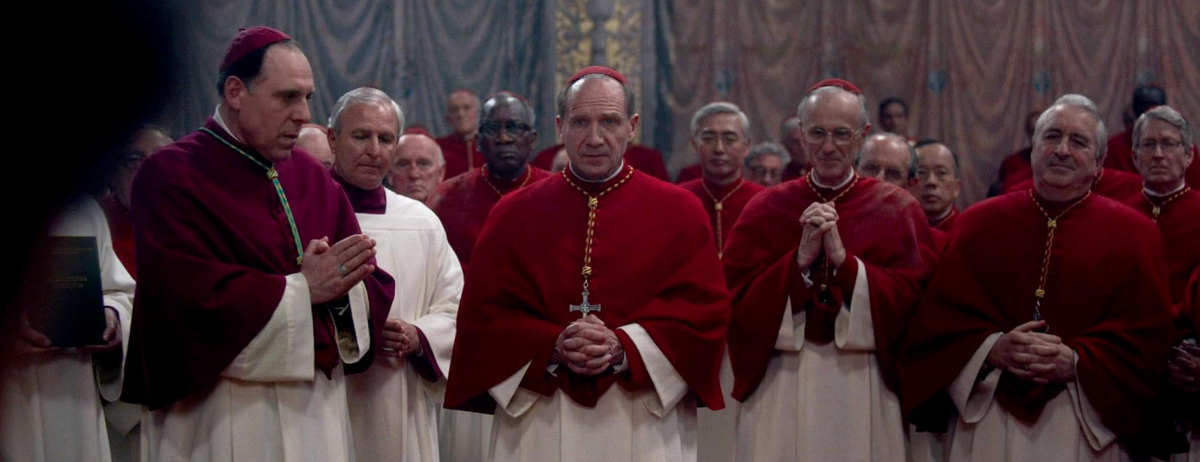

The movie is well acted by such leading actors as Ralph Fiennes, Stanley Tucci, and John Lithgow, all of whom play cardinals, and Isabella Rossellini, who plays a nun.
Although the film “Conclave” just had its U. S. theatrical release two months ago, it is already streaming on Peacock. The “Conclave” alluded to in the title is a fictional conclave held on the death of a pope. It is directed by Edward Berger, who directed the Oscar winning (for best International Film) “All Quiet on the Western Front” (2022), and it is based on the same-titled 2016 novel by Robert Harris. The movie is well acted by such leading actors as Ralph Fiennes, Stanley Tucci, and John Lithgow, all of whom play cardinals, and Isabella Rossellini, who plays a nun.
Reviews of the movie has been largely influenced by reviewers’ ideological disposition. In a article by Tyler Arnold, who has written for the conservative National Review and The American Conservative, he quotes Bishop Robert Barron. The bishop has been identified by a Catholic website as “not a progressive,” “not a Churchman of the Left.” Among the Bishop Barron quotes are the following:
- “Conclave” the film “checks every woke box.” It depicts “the hierarchy of the Church [as] . . . a hotbed of ambition, corruption, and desperate egotism and “conservatives are xenophobic extremists . . . the liberals are self-important schemers. None can escape this irredeemable situation.”
- “If you are interested in a film about the Catholic Church that could have been written by the editorial board of the New York Times, this is your movie.”
- “The only way forward [according to the film] is the embrace of the progressive buzz words of diversity, inclusion, indifference to doctrine, and the ultimate solution is a virtue-signaling cardinal who takes the papal name of Innocent.”
- “Run away from it [the film] as fast as you can.”
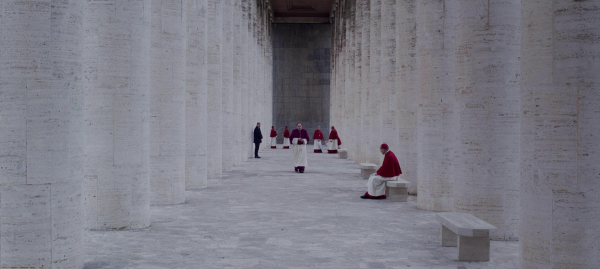
At the other end of the Catholic ideological spectrum is the Jesuit magazine America--Pope Francis is a Jesuit. One of its articles concluded, “The film is generally very well-researched, and its portrayals of the voting portions of the conclave follow the proceedings exactly as described by former participants and Vatican reporters.”
Another America piece mentioned it as a “film that is magisterial when it isn’t simply being brilliant,” and called it “cinema of the first rank.” It also devotes paragraphs to a surprising twist that comes near the end of the movie--but a twist I will not say more about lest I become a “spoiler.” Indicating its overall positive view of the film are these sentences, “Mr. Fiennes seems destined for nominations this awards season, as does Mr. Tucci, Mr. Berger and the movie itself. One delightful counteragent to the overload of testosterone is Isabella Rossellini, who, as Sister Agnes, quietly directs the care of the assembled cardinals. But she does have one moment when she delivers a withering indictment of certain men, before a crowd of other men, and then curtsies before exiting the chamber.”
Stepping away from Catholic positions, let’s look at a more secular review from the left-leaning Slate website. It highlights “the infighting between progressives led by Francis and conservatives, who oppose his reforms, [and notes that the conflict] has already spilled into the public.”
To look at another more secular view, we can examine what two of the films stars, Rossellini and Fiennes, had to say about the movie on the Today show. According to the Today website, Rossellini thinks that “the core of the film” is a “beautiful speech [by Fiennes’ character] at the beginning of the film about certitude and doubt.”
Here is what Cardinal Lawrence (Fiennes) had to say:
Let me tell you, there is one sin, which I have come to fear above all others. Certainty. Certainty is the great enemy of unity. Certainty is the deadly enemy of tolerance. Even Christ was not certain at the end. (in Italian): My God, My God, why are you forsaken me? (In English): He cried out in his agony at the ninth hour on the cross. Our faith is a living thing, precisely because it walks hand-in-hand with doubt. If there was only certainty… and no doubt… there would be no mystery… (whispering) and therefore no need… for faith. Let us pray that God will grant us a Pope who doubts. And let him grant us a Pope who sins and asks for forgiveness, and who carries on. [All film quotes are taken from filmscript.]
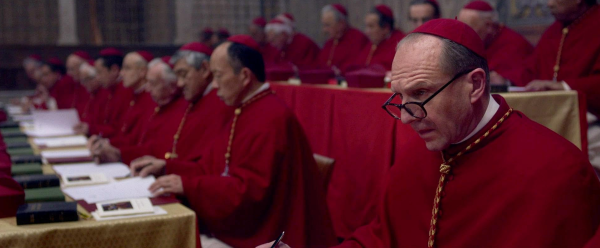
Two more key speeches occur near the end of the film. The first is made by a conservative cardinal:
Here at last we see the result of the doctrine of relativism so beloved by our liberal brothers! A relativism that sees all faiths and passing fancies accorded equal weight. So that now, when we look around us, we see the homeland of the Holy Roman Catholic Church dotted with the mosques and minarets of the prophet Muhammad! (In English): You should be ashamed ashamed. Ashamed. Ashamed. We should all be ashamed! (In Italian): We tolerate Islam in our land, but they revile us in theirs. We nourish them in our homelands. But they exterminate us. How long will we persist in this weakness? They are literally at our walls right now. What we need now is a leader who understands that we are facing a true religious war. . . . We need a leader who will put a stop to the drift that has gone on almost ceaselessly for the past 50 years. How long will we have to persist in this weakness, how long? We need a leader… (in English):…who fights these animals!
But he is answered by a more liberal cardinal who says:
Is this the man you want to lead us? . . . Would you say we have to fight? What is it you think we’re fighting? . . . The thing you’re fighting is here … inside each and every one of us, if we give in to hate now, if we speak of “sides” instead of speaking for every man and woman. . . . Forgive me, but these last few days we have shown ourselves to be small petty men, we have seemed concerned only with ourselves, with Rome, with these elections, with power. But things are not the Church. The Church is not tradition. The Church is not the past. The Church is what we do next. . . . O Father, so that we may guide and watch over Your Church. Give to us, Your servants, the blessings of intelligence, truth and peace, so that we may strive to know Your will, and serve You total dedication.
Of course, the film gives the better speech to the liberal cardinal. Conservatives would say it is because of the “woke” nature of the film. But we progressives think that “intelligence, truth and peace” are among our core values. We also value doubt and think that humility inclines us more toward it than it does certainty--whether stemming from religious dogma or some other source (see, e.g., here, here, and the book “Doubt: A History: The Great Doubters and Their Legacy of Innovation from Socrates and Jesus to Thomas Jefferson and Emily Dickinson”).
