

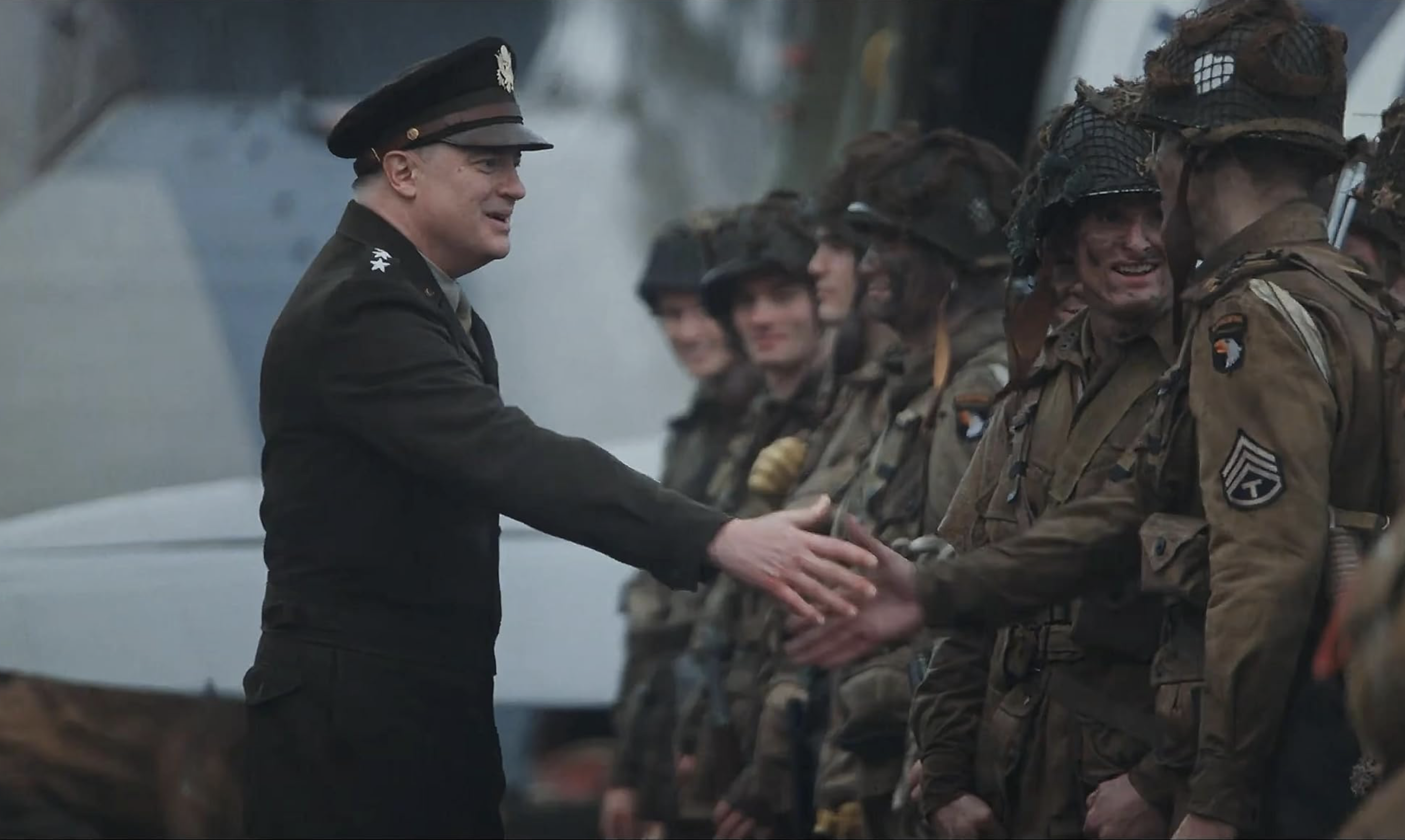


Pressure captures the strained personal clashes and moments of shared anxiety between experts and celebrated military leaders.
If any blame or fault attaches to the attempt, it is mine alone. General Dwight D. Eisenhower from his notes for an address if the Normandy invasion failed.
June 6 this year marks the eighty-second anniversary of the Allied invasion of Normandy, France, the largest amphibious invasion in history and the beginning of the end for Hitler’s Third Reich.
On that day in 1944, 156,000 Allied troops and paratroopers from 13 countries stormed onto five French beaches or parachuted into the surrounding countryside. The assault force relied on a massive armada of 7,000 naval vessels with 195,000 naval personnel. Allied forces went onto victory, defeating fascism in Europe by May 1945.
We now know that, despite thousands of casualties, this massive Allied operation succeeded in establishing a beachhead and a staging ground for liberating France and then defeating Germany. But that planned outcome was not a certainty. Indeed, that outcome hinged on the weather.
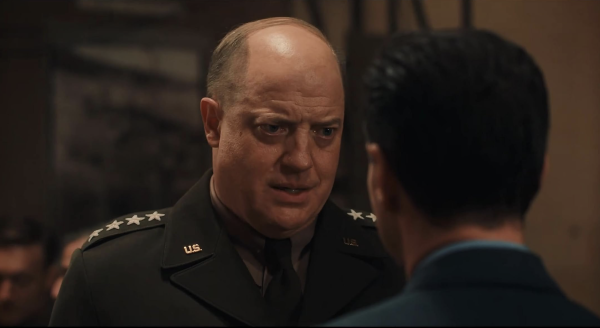
In his new movie Pressure, acclaimed Australian film director Anthony Maras captures the intense 72 hours before the invasion when Supreme Allied Commander General Dwight D. Eisenhower (played by Brendan Fraser) was under tremendous pressure to decide when to launch the largest seaborne force in history.
But inclement weather threatened the complex invasion plans. The Allies needed a clear window between sea storms during the first week of June to successfully reach the coast of France and avoid a nautical catastrophe. To wait until any later for better weather meant they would lose the element of surprise and face overwhelming German military resistance.
Mr. Maras’s film focuses on Eisenhower and two brilliant meteorologists who advised him: his trusted American expert Colonel Irving Krick (played by Chris Messina) and the stubborn and courageous Scottish Captain James Stagg (played by Andrew Scott) who did not shrink from sharing his expertise, even when threatened or mocked. At that time, long before today’s satellite imaging and computer weather models, weather forecasts were based on extremely limited information and Channel storms were notoriously unpredictable.
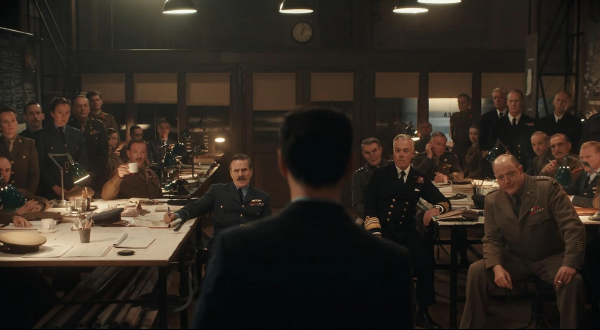
Pressure captures the strained personal clashes and moments of shared anxiety between experts and celebrated military leaders. And Supreme Allied Commander Eisenhower, as played by Oscar-winning actor Brendan Fraser, reflects the enormous burden of leadership as he projects confidence and calm but suffers emotionally in private as he weighs contradictory evidence from experts including the meteorologists.
And Eisenhower famously feared the loss of his men. He was haunted by the disastrous attempted invasion of France at Dieppe in 1942. Even more disturbing were the shocking recent deaths of 749 American troops in a tragic D-Day rehearsal called “Exercise Tiger.” The film opens with a vivid depiction of this horrific training disaster in April 1944, only a few weeks before the planned invasion.
Mr. Maras’s film has special relevance today by reminding viewers of the sacrifice and the brutal struggle to end the evil scourge of fascism. It’s also a study of leadership and rational decision making, of listening to experts, of weighing a range of opinions, and of speaking truth to power even at the risk of contempt or disgrace. And, at our time of numerous ecological crises, the unpredictable power of nature looms large.
Mr. Maras is known as a cerebral director who explores deep human emotions and vexing moral dilemmas as he extensively researches each project, assures historical authenticity, and finds the humanity, awkwardness and grace of his characters in extreme circumstances. His award-winning first feature film Hotel Mumbai, about civilians caught in a terrorist attack, was widely praised for these qualities as were his shorter award-winning films on intense crises, including The Palace, Spike Up and Azadi.
With Pressure and all of his other films, Mr. Maras multitasked as the director, screenwriter (with playwright David Haig on Pressure), editor, and executive producer.
Pressure opened in theaters on May 29 to positive reviews.
Mr. Maras graciously responded from Los Angeles by Zoom to a barrage of questions on Pressure. Here are a few excerpts from our longer conversation.
On discovering this historical incident from David Haig’s play Pressure.
Anthony Maras: I was sent the [David Haig’s] play Pressure . . . just as COVID was beginning here in America. And then, I flew back to Australia just after the bush fires had destroyed millions of acres of my home country. And the many themes that this film explores are timeless themes and as relevant now as they were relevant when I started making the film,
On the theme of decision making.
Anthony Maras: How do we make the right decision? In this case, it was a decision that was one of the most consequential of the 20th century, but it was also very personal in the sense that, in our own everyday lives, we have decisions about our jobs, about our loved ones, about health matters. How do you bring your best self to the table when you don't have all the answers? There's something inherently human in that. And that's something I very quickly responded to.
On heeding the advice of experts.
Anthony Maras: We hear a lot about the denigration of the scientific effort or the scientific method. And I just thought it would be fundamentally a good thing to tell a story about a very precise and particular moment in history where one of the biggest conflicts on earth was . . . decided by a leader having the wisdom to listen to people beneath him in the pecking order. But they knew more about the specific subject at hand than he did. I was very drawn to [meteorologist James Stagg] as a character who was compelled to look some of the most powerful figures in the world in the eyes, and tell them something that he knew they didn't want to hear but knew that they needed to hear.
In the underlying story, this idea of speaking truth to power has always been important and it’s not recent, but it has become more important as technology has developed and has caused people to think all sorts of new ways.
I was interested in making a movie with a protagonist [like Stagg] who was someone who inherently understood the complexities of [the power of nature] and the danger that it posed. The challenge as a filmmaker is how you can make something that's quite abstract feel terrifying. And that was the challenge with this film that we set out to address.
On unpredictable threats from Nature.
Anthony Maras: There is a big, dangerous monster lurking around that corner. And if you don't respect it, and if you ignore it, it will eat you. In this case, the monster was a massive weather system, which we're not really instinctively designed to fear in ways that we would a monster or a predator. I'm talking about. . . biological threats, whether they be viruses or natural environmental threats like catastrophic weather events. These big systemic issues can be difficult to fear because they're very complex and difficult to understand.
On James Stagg’s stand for his truth despite inviting contempt.
Anthony Maras: And we love that about him, right? He means business. And you must remember all the people in those rooms are very brilliant people. . . in the Allied leadership. I'm sure there were exceptions, but those other meteorologists, the scientists, the logicians, and the generals had very, very clear-eyed opinions. They were very distinguished and had done really well, but they were . . . at absolute loggerheads as to what to do next. And when you have these big personalities who really know their stuff and you watch them clash, it's inherently dramatic. And I was interested in exploring that element further too.
On the reality of Eisenhower’s deft leadership under intense pressure.
Anthony Maras: I was thinking a lot about which Eisenhower is it that we want to explore and show in the film? We know the myth. We know the icon. We know the hero of World War II. And we know the president.
Many people don't know that there was just a human being ultimately. And [Eisenhower] was a human being who was under immense psychological stress for a very prolonged period of time. By the time we find him in the lead up to D-Day, he is smoking four to six packets of cigarettes a day. He's drinking over 20 cups of coffee. His body is literally breaking down. He's got an open wound, a stress ulcer, just above his hip so that he can't even sit down. He's coughing his guts up and, in his private moments, he’s terrified that he's going to make the wrong decision, and he will send many more men to their death than he lost in the training exercise, “Exercise Tiger” [when 749 US troops died just weeks earlier], which we show at the beginning of the film.
On Brendan Fraser as Eisenhower.
Anthony Maras: What I was very interested in, with Brendan in particular, was not a performance which was grounded in an impersonation of Eisenhower. We could have got an actor that maybe looked a little bit more like him, although I do think if you actually look at the eyes and you look at their facial structure, they do look alike. His body is different. I wasn't as interested in that.
I was more interested in how we show a portrait of a man who, in front of his men, in front of the commanders and chiefs, he projected an easy charm, a confidence, a certainty that is needed to lead men. But in his private moments, he is plagued by doubts, is crippled with fear, is very vulnerable to this idea that maybe he doesn't have what it takes. Eisenhower had never fired a shot in battle, and never had a shot fired at him. He was too young for World War I, and he was too old for World War II, and he was surrounded by these other military war heroes who had proved themselves in battle, and he was very conscious of that.
But I think that was his character and that is what history needed at that time, because the Allied war machine was so huge that it didn't necessarily require a courageous swashbuckler who could fire a bullet necessarily. It required someone who could deal with complexity, who could bring opposing factions together, who could instill fear when he needed to get a result.
I thought Brendan had this strange combination of traits where he had the courage to be vulnerable in his private moments with Kay Summersby [Eisenhower’s aide and driver, played by Kerry Condon], but who could show leadership.
On directing and preparing Brendan Fraser to play Eisenhower.
Anthony Maras: Look, with all the actors, I try to provide not as much material as I could because I don’t want to drown them in facts and figures. But [Brendan] read many letters of Eisenhower. . . and more personal things like his own memoirs, his accounts. We watched a lot of footage of Eisenhower.
But in many cases, a lot of the directing weirdly is in the casting. And then it’s having the kind of faith in your actors, maybe the wisdom, to let them explore their roles . . .
Acting is not about putting a mask on. It's about taking a mask off, finding the part within one's own character that aligns. There are many different ways that people project this, but one school of thought is to find the part inside that feels whatever the character in the screenplay is going through, and try to channel that.
With Brendan, I think a lot of it was instinct as well as preparation. There are also very different acting styles between all of our casts and, to watch the chemistry that occurs when they when they first get in a room together is almost like watching a new draft of a screenplay because what means one thing on the page can be expressed very differently in the room. And, as a director, being open to that and letting actors follow those impulses and seeing where they lead you is what you do with a film like this because it sinks or swims on their performances and it sinks or swims on the human element. [Pressure] is not an action film, so . . . it has to be grounded in the fears and the hopes and the anxieties of the characters that we're following.
On assuring historical accuracy—A million little details.
Anthony Maras: Look, I don't profess to be an expert in that period of history. I read a hell of a lot. I absorbed as much as I could. But I got experts in every walk of life that I could.
Our costume people were looking at the most intricate little details for the costumes . . . Our production design team sorted out the paper mills that the [original] maps were printed on so that, when you hold them up to the light, they react the same way.
In terms of the military, I'm looking at granular details first . . . like the protocol. What happens when an American officer walks in the room as opposed to a British officer? Or where were the “sausage camps” where the soldiers were held were before D-Day? What did they look and feel like? What was their proximity to [the command center at] Suffolk House? There are so many details that we had many, many, many people on board as advisors.
On the meteorological side of things, we had Jim Galvin, who's a long-time meteorologist and forecaster. We also had Marty Young who was the chief forecaster of the same facility where Stagg worked. And Marty was there for 14 years. Not only was he able to advise on the bigger picture and the flashier elements of meteorology, but he was able to give the insider details of what it felt like in those rooms and how the people acted to one another. The egos. The glass ashtrays full of cigarettes. And . . . the eraser rubbings everywhere because they were constantly revising and redrawing their maps.
A million little details will all come together hopefully to transport us to another time. And we did it for real. We got as many real-life things as we could. We shot all on locations, not on sets. And it was a particular choice to shoot in England . . .There are cheaper places to shoot or places that finances might want you to shoot for other reasons and tax offsets and blah, blah, blah. But in England, you're drawing from a cast and crew of people whose families had lived this experience. Everyone had a grandpa or an uncle or a grandma who was involved in the war in some way or another. And bit by bit that drips into the movie and we . . . embraced as much of that as we could.
On multitasking as a filmmaker—directing, screenwriting, editing, producing.
Anthony Maras: I've done all that on every one of my films, so I'm used to it now. And it's worth noting though that that's four roles out of about a thousand on a movie. I'm not painting in a studio somewhere by myself. I’m constantly relying on the work of other people. And I say that out of seeing what it looks like to have a good cast and crew. And without them, your film is nothing. You could be the best writer and director and editor in the world, but if you haven't got a good crew and cast around you, your movie will be terrible. At every step of the way, one of the best things I did was picking great people around me.
On how the making of Pressure mirrored the preparation for D-Day.
Anthony Maras: We faced similar [stressors], not with the same things at stake, but we got a little taste of what these heroic people went through for D-Day when we were just trying to film our movie.
Ironically, we only had four days to shoot all our battle scenes, and that was definitely not enough time. We had three sets of our own marine biologists who were there measuring the tide and our meteorologists who were measuring the weather because we needed . . . conditions conducive to filming. On the Wednesday before the Monday when we were set to do our battle scenes . . . they all came in stoop shouldered, long faced, and I could tell they had something bad to say. . . On Monday, [they predicted] catastrophic weather with 50 to 80 knot winds, maybe more. And six-foot waves, maybe eight-foot waves. And, you won’t be able to film anything. Or if you do, you're won’t see much. It will be sand flying everywhere. It will be horrific.
My initial impulse was there's no point in going to film with conditions like this. Maybe they hold, maybe they don't. But if we don’t risk it, we’ll lose a week of filming with nothing to show for it. And so, we're watching the weather and watching the clock on the days leading up to when we're going to shoot our battle scenes. You can't just snap your fingers and choose to shoot one thing or another. You need to prepare weeks out, let alone days out. And so, we had to make a decision.
And then on the weekend, a meteorologist said, we think there might be a window. You got to be kidding me. I said, well, when, and they said, maybe the Tuesday morning. I'm like, come on, is this a practical joke? He said, if a storm comes Monday, maybe there's a window.
The storm smashed our sets on the Monday. It pulled the sets out to sea and all this time had been spent setting up our D-Day. The storm smashed it as the storms smashed the Normandy coast [the day before D-Day].
Come Tuesday morning, our crew went back and they started rebuilding. And would you believe that just hours before the rest of us, the whole caboose, all the trucks and crew and cars and hundreds of extras rolled in, and the weather parted. The gap came and we had our four days and we filmed our D-Day. That was just uncanny; how art and life imitate each other.
On hopes for the film Pressure.
Anthony Maras: You spend so long making these things, and shed a lot of blood, sweat and tears. But really, you’ve got to kiss them on the forehead and give them a smack and get them to go out into the world. And, hopefully they connect with the audiences, and that's the ultimate hope.
I hope when people watch it, they reflect on what leadership looks like, and that they reflect on the importance of having people who are willing to voice unpopular opinions.
And I hope they’re just excited by what it's like to be in a war room for the biggest seaborne invasion in history. There aren't that many movies that cover that side of the war. And I found it a unique angle to look at it in such a granular fashion with a laser focus on what it looks like to send off a million men into battle. Now, there weren't a million men that landed on D-Day, but over that first week, they were moving hundreds of thousands a day, and there was over a million in the total logistics chain.
We explore this story in a way that's honest and exciting in its own way that gets to the unbearable, unspeakable pressure these people were under. And how an ordinary guy, a meteorologist, not really known, can step up at a critical moment, do this miraculous thing, and then just quietly, like a cowboy at the end of the movie, get on his horse and go back into his quiet life, in this case just doing meteorology. I think there's something poetic in that.
