



A Clockwork Orange and Videodrome in the Society of the Spectacle 2.0
In a historical moment where meanness, cruelty and senseless violence seems to saturate almost every part of our world, and with the shock of behaviors imparting a profound sense of frustration and helplessness, fear and despair, it can be easy to surrender to the cynical view of a world in which gloom rules. This perception is reinforced with each new outbreak of violence, whether through the tragic repetition of mass shootings, the unceasing toll of police brutality perpetrated against African American and other marginalized and economically disadvantaged groups, or through the inhumanity of the ruthless assaults of the Russian military against the people of Ukraine.
The pervasive reach of the media and the internet only make these effects seem more pervasive and all-consuming, and through the merging of the two, depictions of violence and death have become nearly ubiquitous in their saturation through images. Considering that Americans spend an average of 6 hours and 57 minutes a day looking at the screens of internet connected devices, with an additional 3 hours spent watching TV, we may wonder what kind of impacts being subjected to so much violent imagery can have on our psychological wellness and in society, more broadly.
The extent and magnitude of our present entanglements in visual media is representative of an accelerated development of the kind of social existence Guy Debord conceived as the “society of the spectacle.” A central theme of Debord’s thinking lies in his notion of the spectacle as a structure which comes into existence through the representation of images that create “illusion” and “false consciousness.” And as Debord clarifies, the spectacle itself does not merely consist of “a collection of images; rather it is a social relationship between people that is mediated by images.”
The cumulative effects of the incessant stream of death and violence flowing from these and print sources into our consciousness provoke thought processes that can feed into vicious cycles of fear, terror, hopelessness and despair. Here, as with other complex social issues confronted in our daily lives, we can turn to enduring works of art, literature and film to help us in our understandings of the nature of such spectral objects and their unsettling effects. As last week marked the anniversaries of the American releases of two widely influential films in which the presentation of images of violence form core themes in Stanley Kubrick’s A Clockwork Orange—released in February 1971—and David Cronenberg’s Videodrome—40 years ago in 1983—we are offered, perhaps, a useful means of confronting both the treachery and tyranny of the image.
In Kubrick’s film, adapted from Anthony Burgess’ 1962 novel of the same title, the power of the image lies at the center of an unusual approach to the treatment of the kinds of criminality referred to as “ultra-violence,” through an invasive form of government-sanctioned therapy imposed upon violent criminals and known as the “Ludovico Technique.” The film’s main character, an extremely violent and socially disaffected youth named Alex DeLarge (Malcolm McDowell), volunteers for this experimental treatment after being imprisoned for a particularly brutal murder.
Through “treatments” administered at a medical facility after serving a portion of his sentence and exhibiting a degree of docility that seems indicative of reform—behavior that can be seen by the viewer as insincere—Alex is subjected to sessions in which he is shown relentless scenes of violent imagery. The mode by which this brand of aversion therapy is administered contributes a decidedly dystopian flavor to the film as he is forced to view images of violence and perversity while wearing a straitjacket and strapped into a chair, with his eyes held open by the attachment of a draconian device in what has become the film’s most iconic scene.
The goal of the treatment is intended to transform Alex from a “viscous young hooligan” who revels in all manner of senseless violence, into subject cured of violence who “is impelled to the good by, paradoxically, being impelled towards evil.” The means by which Alex’s conversion is carried out, however, has an unexpected side effect as scenes of Nazi Germany included in the violent reels he is forced to watch happen to be set to his favorite music—Beethoven’s Ninth Symphony—inducing a similarly strong sense of revulsion as he’d been conditioned to have in response to violence and sexualized imagery.
Reflecting the claims put forth in different ways by both Debord and Jean Baudrillard that “all that was once directly lived has become mere representation,” Alex similarly observes of the images he is subjected to that “it’s funny how the colors of the real world only seem really real when you viddy them on the screen.” Further, the deployment of techniques in which visual imagery is transformed into a kind of internalized disciplinary apparatus, combined with the unanticipated effect of Beethoven’s music, undermines a treatment that the Prison Chaplain dismisses from a perspective of grace in a process by which Alex “ceases to be a wrongdoer. He ceases also to be a creature capable of moral choice.” Thus, a human being capable of free will.
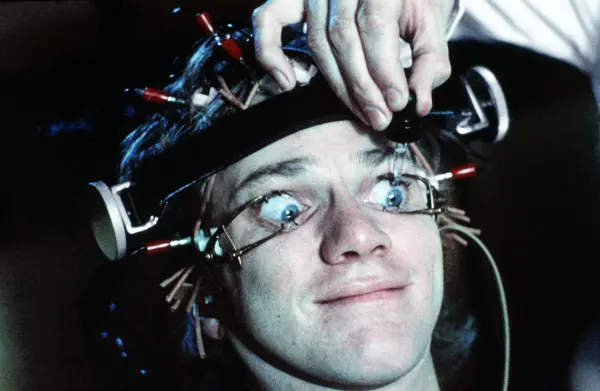 Malcolm McDowell as "Alex DeLarge," from A Clockwork Orange, Stanley Kubrick 1971.
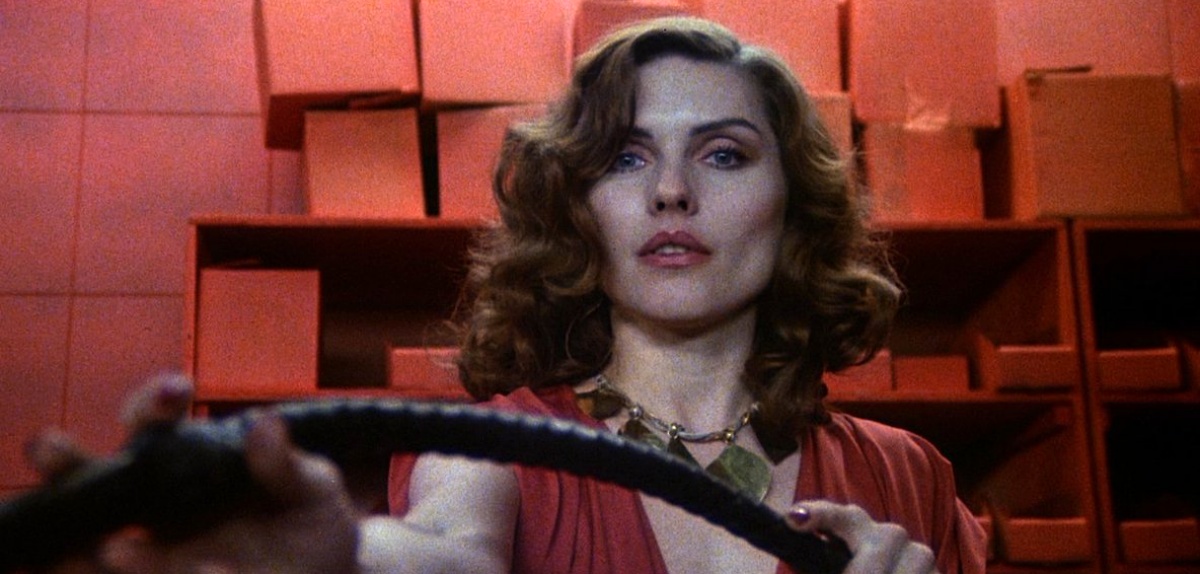
Cronenberg’s classic of body horror, Videodrome, by contrast, focuses on the pathological fusion of sexuality and violence that figure prominently in the practices of sadomasochism—a term inspired by literary works and named for their authors, the Marquis de Sade and Leopold Von Sacher-Masoch. These themes are explored through the perspectives of the film’s two main characters. The first, Max Renn (James Woods), is the president of a media company specializing in sleaze who runs a television channel called “Civic TV,” flaunting the slogan “the one you take to bed with you.” The other is Nicki Brand (Deborah Harry), a self-confident and assertive libertine who hosts an “emotional rescue” call-in radio show and harbors a taste for consensual kink—a real horrorshow babe.
Max and Nicki meet on a TV talk show as guests for a segment in which the host probes at the value and effects of sexually explicit imagery and the representation of violence on TV. Max justifies his broadcasts based on a capitalist rationale, while also claiming an altruistic motive in simply trying to give viewers “something they can’t get anywhere else.” When asked if his programming contributes to a social condition of violence and sexual malaise, Max responds that it gives viewers a “harmless outlet for their fantasies and frustrations.” Nicki follows up with the observation that seems to challenge this idea, stating, “we live in overstimulated times. We crave stimulation for its own sake. We gorge ourselves on it. We always want more, whether it’s tactile, emotional or sexual. And I think that’s bad.” Her devious smile, however, belies the mundane response while hinting at Cronenberg’s satire.
While the statements of both characters echo conventional responses that reflect divergent socio-political positions, in a scene that follows in which they meet for a date, these statements are revealed as veils for hidden motives and desires that lead them in search of increasingly extreme and intense forms of stimulation and pleasure. The internal conflict between socially acceptable behaviors and the elicit desires revealed through Max and Nicki reflects the sense of shame and isolation that thoughts or behaviors deemed as deviant can produce amongst people living in morally restrictive cultures and societies.
Max and Nicki uncover a way to escape such strictures through the discovery of a pirate TV channel broadcast over satellite called, ‘Videodrome.’ Aligning with Debord’s notion of images as carrying “a world view transformed into an objective force,” Max is drawn in as it features programs with “no plot, no characters” and only endless “torture, murder and mutilation.” Crime as entertainment, entertainment as crime, taking viewers beyond the limits of comprehension to expose a similar presentation of signs that Debord associates with “the dominant organization of (capitalist) production.” This discovery leads Max on a mission to uncover the source of Videodrome, which he admires as a “video circus, video arena” and is eager to share with his audiences.
His fascination is further spurred by Masha (Lynne Gorman), an associate who produces porn for his channel, who sees more than just violence in the “very, very realistic” images Videodrome presents. She frames the repellant programming as “snuff TV” that haunts the fringes beyond entertainment for its visceral effects, stating, “it has something that you don't have, Max. It has a philosophy. And that is what makes it dangerous.” Masha’s appeal to what we might call an ‘ideology of the flesh’ and the sense of menace and horror it carries, transcends the mere representation of sex and violence through the breaking down of the walls of simulation in depictions that transgress mere performance.
Max sees Videodrome as the future of programming within an industry always pushing against the edges of the impossible, while Nicki is so enthralled, she decides to audition, declaring, “I was made for that show.” What neither realizes but are to discover in their own dreadful ways is that Videodrome lies in the gap between representation and what Julia Kristeva, in her elaboration of abjection, calls “non-sense or the impossible real” for its delivery of an experience that is both mind and body-altering in ways neither could imagine. This is rendered in scenes involving breathing video tapes (Betamax actually) and television consoles that assault and devour, to a vaginal slit that opens in Max’s chest as monstrous organ and effect. These images spiral into a mind-bending phantasmagoria that now appears as low-budget camp, although viewed at the time as bizarrely horrific gore, which one reviewer characterized as “overpowering”—itself a reflection on the continued development of our perceptions and the intensity of the sort of images it takes to provoke the shock of abjection.
Videodrome addresses the allure of the forbidden and the way that extreme behaviors can often lead to still further extremes in an endless pursuit where gratification is always fleeting. At the same time, Cronenberg offers a commentary on the dangerous effects of desensitization that may come with the saturation of sex and violence in the media and its broader effects within a society where representation and the real, fantasy and reality can become entangled to produce horrific results.
Although Roger Ebert panned Videodrome as “nauseating” and “bleak,” while calling it “one of the least entertaining films of all time,” that it went on to be christened a classic through its inclusion in the Criterion Collection where it is recognized as “one of the most influential and mind-bending science fiction films of the 1980s” is a validation of Cronenberg’s bold and uncompromising philosophical vision. Yet, despite such recognition, it’s also not surprising that critics continue to echo such revulsion, or worse yet, the trite objections that groups such as the PMRC leveled against rock music in the 1980s, resulting in the epic intellectual beatdown delivered before a congressional panel by none other than the front man of Twisted Sister, Dee Snider.
 Deborah Harry as "Nicki Brand," from Videodrome, written and directed by David Cronenberg, 1983.
There will always be critics who, while ignoring industries such as gun manufacturers a pharmaceutical industry that profits on real death and suffering, along with the clear and present sources of violence, racism and hatred that saturate our political and social discourse, will continue to denounce TV, movie and video games as the most corrosive influences on America’s moral compass and the source of society’s ills. Luckily, films such as A Clockwork Orange and Videodrome will continue to remind us how out-of-touch and simplistic this kind of thinking can be.
In many ways the ideas pushed by those who want to cast the media as the scourge of a wholesome society merely reiterate a form of misdirection in which tangible and obvious causes and effects such as economic inequity and unjust legal and political systems are obfuscated through layers of pseudo-psychological, and often deeply hypocritical, drivel. In departing from the classic dystopian narratives and conventional horror in which the site and source of oppressive structures and the violence perpetrated by governments, social institutions and corporations, and in humans rather than monstrous creatures, films such A Clockwork Orange and Videodrome call us to shift the gaze inward to the more private and internalized domains of our psyches.
While these films speak directly to the alarming human propensity for callousness and inhumanity, as well as our base attractions to forces and energies that often border these realms, both continue to have relevance for their reflections on urgent suspicions and fears about the role of the media in shaping our perceptions of reality, and well, our very identities. The inherent sense of individual psychic disorder and social disruption initiated by the violence depicted in A Clockwork Orange and Videodrome only seem to have intensified in a social environment awash in conflict and fueled by political, class and ethnic divisions with a propensity to ignite into outbreaks of horrific violence and carnage.
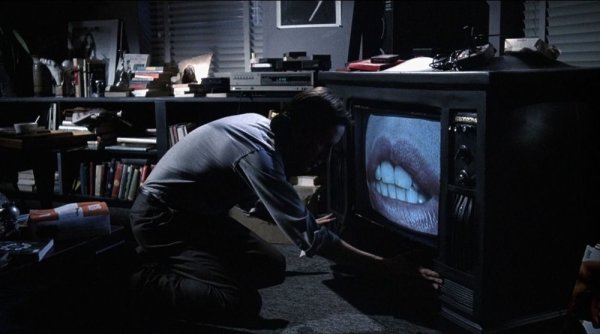 James Woods as "Max Renn," from Videodrome, written and directed by David Cronenberg, 1983.
Such is the nature of the seething hostility and senseless violence chillingly enacted by Alex in A Clockwork Orange. For Nicki in Videodrome, this occurs in a sense described by Kristeva as she becomes another of “its fascinated victims—if not its submissive and willing” one. Max confronts the stark truth uttered by Dr. O’Blivion that “the battle for the mind of North America will be fought in the video arena,” submitting in a more violent way as he undergoes a grotesque bodily transformation whereby he is transformed into an assassin fighting against the mysterious forces behind Videodrome, culminating in his own ghastly death.
Each film, in their own uniquely stylized ways, brings scrutiny to longstanding sources of disillusionment which continue to course through modern, patriarchal, Judeo-Christian culture and society, in which its very functioning produces the same forms of violence that their faithful are quick to condemn in the form of mere image. More disquieting, perhaps, is that the social realities depicted in films such as A Clockwork Orange and Videodrome seem to bear witness to the demise of the capacities of kindness and empathy that form the foundations of fair and just societies and communities of care.
These are ideas and provocations that track to a social context in which the growing gap between the rich and everyone else drives a process whereby sex and violence are primed to become either catharsis or the balm utilized to soothe the exasperation of a large portion of the population to whom the rewards of the American Dream have now become unattainable. It is historical developments like these that can lead to the ennui that viewers see in Alex’s distant and aloof parents in presenting the façade of a good “humble, mumble, chumble,” life in merry old England, all the while fostering a growing estrangement from a future increasingly in the control of “young hooligans” who like in the sharp-edged lyrics of Johnny Lydon “got no emotions for anybody else . . . got no feelings, no feelings, for anybody else.”
It’s a response manifested in a different way through Max’s and Nicki’s heedless pursuits of pleasure in Videodrome. In the end, both suffer similarly gruesome fates in their ironic ratification of the slogan, “Death to Videodrome; long live the new flesh.”
The socio-cultural effects evinced in these films are reinforced within cultures in which violence is celebrated, but not as a means to some sort of liberation from an oppressive or unjust political system, but more in following Alex’s declaration that “what I do, I do because I like to do.” Yet, even this draw towards aggression is depicted by Kubrick as stemming from that “adult world” created by Alex’s parents and grandparents who in Burgess’ novel “could take responsibility for this with their wars and bombs and nonsense.”
This misalignment of responsibility and blame is most aggressively expressed by the character Frank, the writer who survived an earlier attack by Alex and his gang of droogs. When Alex seeks refuge after a severe beating from his former mates, Dim and Georgie, who are now police officers, Frank sympathizes with Alex as a hapless tool of a corrupt government that rules by fear and oppression: “the government's big boast, as you know, sir, is the way they have dealt with crime during the last few months: Recruiting rude, young roughs into the police, proposing rehabilitating, will-sapping techniques of conditioning. . . Before we know where we are, we'll have the full apparatus of totalitarianism.”
Alex’s eventual and mocking response to this whole system, “I was cured all right!,” uttered in the film’s final scene, like the actions taken by Max, serves as a denunciation of such systems of manipulation, control and social guilt, even if it means a return to a path that seems certain to lead back to prison or death. An act of will that, nonetheless, desperately seeks to claim agency and control in a world of contracting freedom and opportunity, while bearing witness to the broken promise of a present and future frittered away to pay for the trifling lavishness and irresponsibility of past generations.
