

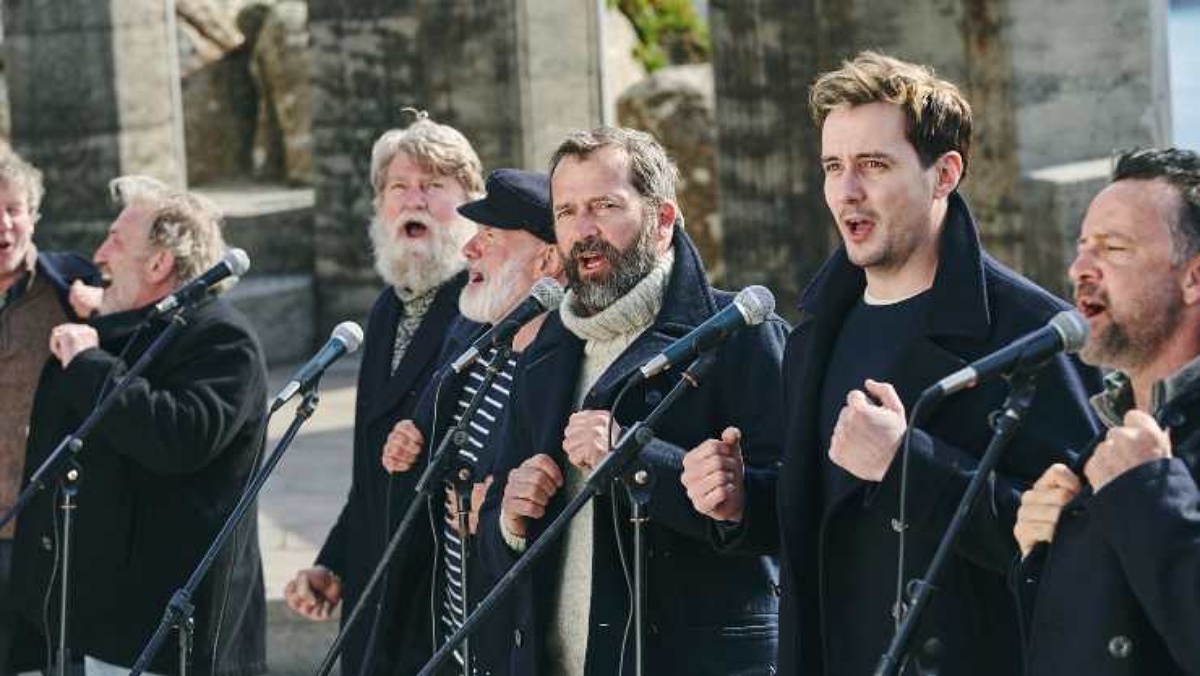

After the death of a loved one has shaken us to our core, how do we recover? This film sequel provides one answer, and it’s probably the best—love.
In reviewing the first “Fisherman’s Friends” (2019) for Hollywood Progressive in 2020, I concentrated on “1) how enjoyable it was; 2) how many worthwhile qualities abide in some hard-working, non-college-educated, people; and 3) what great pleasure comes from ‘folk’ music.” About this 2022 sequel, available on Amazon Prime, my focus will shift.
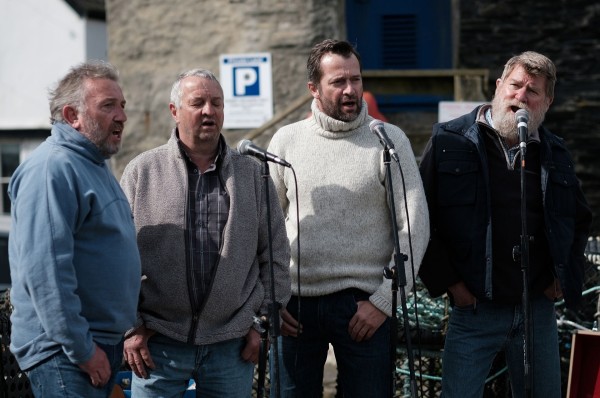
There is still the beauty of the folk music—and the film’s main setting (the Cornish coastal village of Port Isaac, near the southwest tip of England, the same setting as the popular British TV series “Doc Martin”). One scene reflects this well when the main character, fisherman Jim (James Purefoy), sits with a few others overlooking the beautiful bay of Port Issac as they wait to hear how Jim’s hospitalized mother will fare, and they sing “Cornwall My Home.”
Despite the general beauty of the the singing—though genuine folk songs are not especially fashionable these days—and of Port Isaac, many critics have found the film trite and full of predictable scenes. But to this reviewer, predictable or not, this sequel still illustrated some powerful truths.
One is the strong impact that the death of a loved one can have on his/her survivors. In this sequel, much of the action revolves around Jim, and at one point he admits that much of the fault for the decline of his singing group (Fisherman’s Friends) lies on him: “Yeah, well, my father [Jago] had passed away, you know. I was drowning my sorrows [by drinking too much] and behaved like a complete arse.” [All quotes from the film are taken from the filmscript.] And on one occasion, Jago’s wife (and Jim’s mother), Maggie, has to remind her son, “You're not the only one who's hurting, son.”
Moreover, Maggie does what she can to keep Jago’s memory alive. After a record company that was going to release an album of the singing group tells Maggie that won’t happen, she replies that she takes such a decision personally. “Jago sings on
a couple of the tracks, it's dedicated to his memory.” And he “has a chance to live on through song.” The departed Jago also appears on the screen (and in the memories of Jim and Maggie) many times during the film, including at the bedside of a hospitalized Maggie.
Death and what happens to us after we die is, of course, a big mystery.
Death and what happens to us after we die is, of course, a big mystery. None of us still living know for sure. But certainly in one sense or another the dead or the memory of the dead can still influence us.
After the death of a loved one has shaken us to our core, how do we recover? This film sequel provides one answer, and it’s probably the best—love. That word has many meanings, but Jim’s recovery is at first propelled by the most popular type—romantic love.
She comes in the form of an Irish singer, Aubrey (Irish singer Imelda May), once popular, but who then engaged in self-destructive behavior, including drinking too much. She tells Jim, she came to Port Isaac (and at first to Jim’s mother’s place, where she rents a room) “to get away” from her past complicated life. Although they at first clash, they gradually come together. He takes her out on his boat. They increasingly spend time together, sharing stories of their past, including their spouses being unfaithful to them, and their subsequent divorces. Eventually, they find themselves in bed together, and in the film’s final scenes she comes to support him and his singing group as they perform at Glastonbury, in what the script describes as “the biggest music festival in the world.” (In real life, the group did appear several times at the festival, and were scheduled to again in late June 2023.)
Jim’s recovery from being (in his own words) “a complete arse” is also aided by another type of love, the type that is sometimes referred to as “brotherly love.” It is the type described by St. Paul and Dorothy Day. Paul: “Love is patient, love is kind. . . . it is not self-seeking. . . . It always protects, always trusts, always hopes, always perseveres.” Day: “If we could only learn that the only important thing is love, and that we will be judged on love—to keep on loving, and showing that love, and expressing that love, over and over, whether we feel it or not, seventy times seven, to mothers-in-law, to husbands, to children—and to be oblivious of insult, or hurt, or injury—not to see them, not to hear them. . . . not judge, not do anything, but love, love, love.”
Jim projects this feeling toward a man he had earlier rejected, a Welshman named Morgan Jenkins, a farmer by profession who had earlier auditioned to become part of the Fisherman’s Friends. Partly because he was a farmer and an outsider, Jim had rejected and disparaged him. But after Aubrey had softened his heart and Morgan had helped Jim find his mother, who had the accident that hospitalized her, Jim realizes he had been wrong to treat Morgan so callously.
A final example of brotherly love is displayed by Jim and his singing group at the Glastonbury music festival, when they sing “The Union of Different Kinds.” Jim introduces the song by telling the many thousands at the festival (about a dozen years ago) words that seem just as relevant today: “There's been an awful lot of things going on in the world at the moment that's dragging people apart. So I'm grateful that we're all here in this field. . . . And that's 'cause we all believe. We've got much more in common than we have which divides us. And out first song is a celebration of that.”
It begins, “For all the small people, and the tall people / For the dispossesed and the observers / For all the brokenhearted, and the recently departed / And the unwashed and the unheard.” Later on it mentions “the unloved and the denied.” Hearing the words of this song, I thought of the words of Frederick Douglass desiring and welcoming a “composite nation,” a United States of many nationalities and beliefs. I thought of Martin Luther King Jr’s hope that “we will be able to speed up that day when all of God's children, black men and white men, Jews and Gentiles, Protestants and Catholics, will be able to join hands.” And I thought of a hoped-for future when transgender people and all others who seem different to some will be tolerated. As Jim’s mother says to him—after members of his group are told that calling women they don’t know “darling” or “my fair maid” is inappropriate—“A little awareness of what other people might find offensive can't do no harm, can it?”
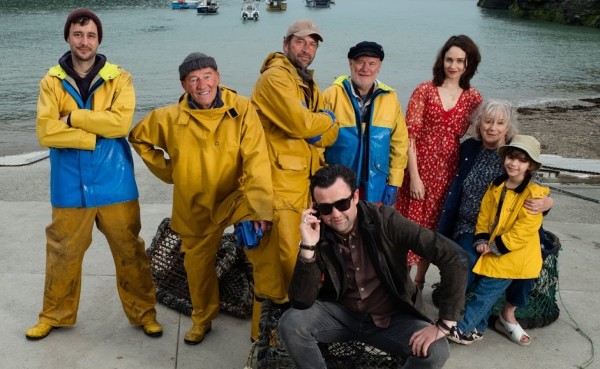
Listening to the Fisherman’s Friends sing about “The Union of Different Kinds”—or earlier such traditional folk songs as “What Shall We Do with a Drunken Sailor?” or “The Wild Rover”—reminds one of the tremendous power of song. So too does watching the enormous happy crowds at Glastonbury—watching huge gatherings at Woodstock in 1969 or at other large musical festivals can produce a similar feeling. Music therapy has shown to be a powerful tool for all sorts of diseases and ailments (see, e.g., here and here).
As “Fisherman’s Friends: One and All” comes to an end with all the singers of the group lined up behind microphones and happily belting out “The Union of Different Kinds” and the enormous crowd singing along, clapping, and swaying, one could almost hope that MLK’s dream might come true—that some day “all of God's children . . . will be able to join hands.”
