


Flags of Our Fathers not only depicts much of the fighting, but also the U.S. war-bond tour of three veterans of that battle and the confusion over the flag raisings
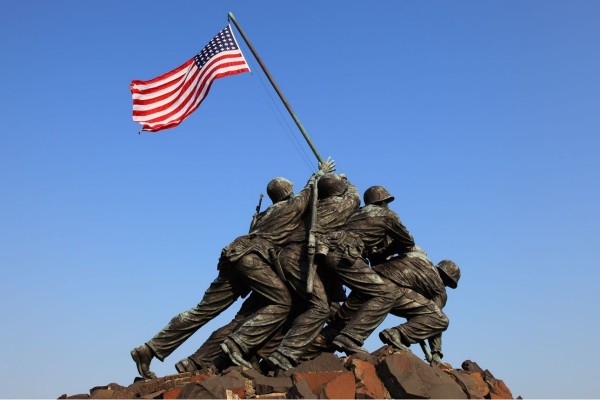
In the mid-1960s my family (I, wife Nancy, and baby daughter Jenny) lived in Arlington, Virginia, and from our apartment window we could see the famous Marine Corps Iwo Jima statue. Sometimes we would walk over there with Jenny in her stroller. It wasn’t until some four or five decades later that I realized the truth of the flag raising at Iwo Jima was much more complicated than we knew back in the 1960s.
The discrepancy between that simplified half-baked knowledge of the 1960s and the complicated truth discovered decades later sheds light on heroism, celebrities, values, and truth. It was Clint Eastwood’s 2006 film Flags of Our Fathers (available on Showtime) that first jolted my mind to reconsider that image of the Iwo-Jima flag raising.
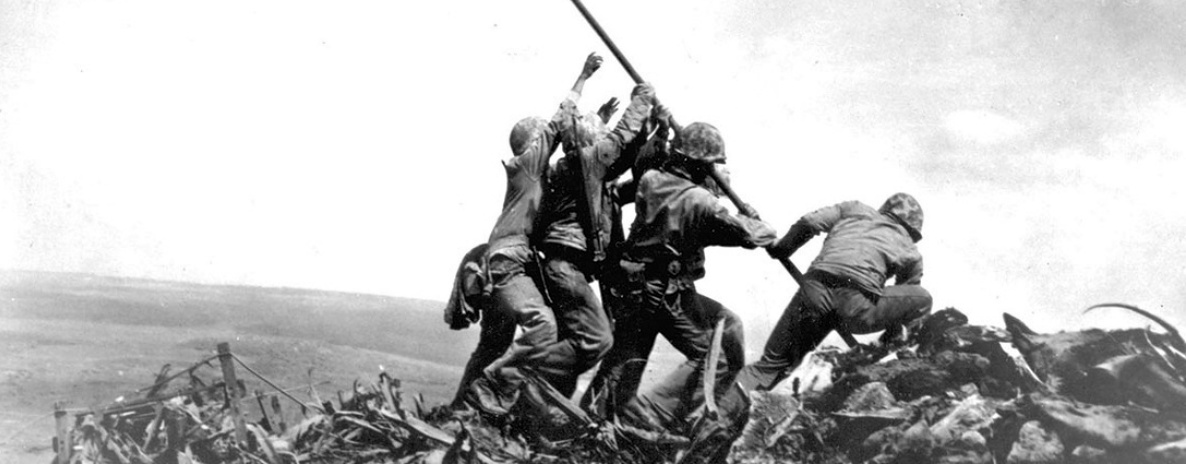
The Eastwood-directed film correctly pointed out that there were actually two flag raisings, one in the morning atop Mount Suribachi, the highest point on the island, and then another in the afternoon when a larger flag was hoisted up, replacing the smaller one. Additionally all of the same troops were not involved in both hoists. The second hoisting was photographed, became famous and the basis for the Marine Corps memorial.
Flags of Our Fathers not only depicts much of the fighting, but also the U.S. war-bond tour of three veterans of that battle and the confusion over the flag raisings, and it prompts thoughts about heroism and the “selling” of it.
The fighting itself was brutal and deadly. In about five weeks of fighting on the island (Feb. and March, 1945) U. S. forces sustained a little over 24,000 killed and wounded, and almost as many Japanese died—they suffered relatively few wounded who survived.
In his film Eastwood clearly emphasizes the PR purposes to which three of the veterans were put—they were Marine Privates Rene Gagnon and Ira Hayes, and Navy Corpsman John (Doc) Bradley (more about their private lives later). Supervising the three combat veterans on their tour is the Treasury Department’s Bud Gerber, played at his cynical best by John Slattery.
Before they start the tour Gerber, in a room containing a framed picture of the flag hoisting, tells the three men a more accurate name for their bond tour might have been “We're Flat Fucking Broke And Can't Even Afford Bullets...So, We're Begging For Your Pennies” bond drive. (All quotes are taken from the film script.) He also tells them, “If we don't raise $14 billion...this war is over by the end of the month.” (The actual Iwo Jima bond drive visited over 30 cities and raised $26 billion.)
The Treasury’s Gerber is also cynical after he’s told there was not one flag raising but two, and that one of the Marines raising the second flag was misidentified. His response, “You know what, I don't give a shit, you're in the picture...you raised the flag, that's the story we're selling, boys.”
Eastwood hints early in the film why the iconic Iwo Jima hoisting picture had such an impact. He has one of the former Marine commanders in that battle explain that “the right picture can win or lose a war.” And the former officer contrasts the Iwo picture with that of a “South Vietnamese officer...blowing that fella's [a suspected Viet Cong] brains out of the side of his head, whammo! That was it. The war was lost [for the South Vietnamese government and its U. S. supporters].”
As the three young veterans tour the country, appearing before great crowds on streets and stadiums, they are often mentioned as three of the six men in the famed picture (the Marine memorial was not made public until 1954). And they are called heroes. Through their voices and those of others, Eastwood comments on heroism. Rene says at one point, “The real heroes are dead on that island.” On another occasion before Ira is sent back to military duty because of his drinking, he states, “I can't take them calling me a hero. All I did was try not to get shot. Some of the things I saw done...things I did...they weren't things to be proud of, you know?”
Toward the end of the film, what eventually happened to Rene, Ira, and Doc is revealed. Rene, who had married a woman who seems to have swooped him up because he was considered a hero, ended up being a janitor. Doc married, had children, one of whom wrote a book about him, and owned a funeral home. His writer son said, “He never spoke about the war, or about the flag-raising...never told us anything.”
The most tragic fate occurred to Ira Hayes, a “Pima Indian” from Arizona, who his fellow Marines often called “chief.” Long before Eastwood’s film Johnny Cash had told us about him in the 1960s when he sang “The Ballad of Ira Hayes.” The chorus goes:
The sympathetic Cash relates how “the white man stole” the Pima’s water rights and that “when war came, Ira volunteered / And forgot the white man's greed.”
He continues relating,
Ira Hayes returned a hero
Celebrated through the land
He was wined and speeched and honored
Everybody shook his hand
But he was just a Pima Indian
No water, no home, no chance
At home nobody cared what Ira'd done
And when did the Indians dance
And Cash tells us of his tragic end,
Then Ira started drinking hard
Jail was often his home
They let him raise the flag and lower it
Like you'd throw a dog a bone
He died drunk early one morning
Alone in the land he fought to save
Two inches of water and a lonely ditch
Was a grave for Ira Hayes
Flags of Our Fathers indicates some of Ira’s difficulties. Of the three veterans, he was the most reluctant to go on tour; he was the most critical of the Treasury’s Bud Gerber; he sometimes got drunk; and he was the most pugnacious—in one of the film’s scenes he’s fighting off policemen because he caused a ruckus when he was refused a drink by a man who said, “I don't make the rules. We don't serve Indians.”
The film also indicates that not long after the unveiling of the Marine Memorial in 1954, Ira died [in 1955]. It shows him lying in a field and states, “The papers said he died of exposure. There was no autopsy.” The movie does not mention him being drunk when he died, but that might also have been the case.
After 2006, when the film first appeared, the story of the flag raising becomes even more complicated. In 2016 it was revealed that Doc was not one of the second flag raisers, and in 2019 that Rene was not either. Thus two of the three central “Iwo Jima heroes” and central figures in Eastwood’s film, who he thought had hoisted the second flag, in fact did not. Only Ira, among the “three,” was an actual hoister in that famous photo of the second raising.
He also briefly appeared as himself in the 1949 film Sands of Iwo Jima, starring John Wayne. And that leads us to consider the changing image of heroes in the media. In 1977 Rumor of War, by former Marine officer Philip Caputo, appeared. In it he recalled how as a young college student in 1960 he enrolled in a Marine officer training program partly as a result of the romantic heroism of such war movies as Sands of Iwo Jima. He explained his motivation as such: “The heroic experience I sought was war; war, the ultimate adventure; war, the ordinary man's most convenient means of escaping from the ordinary...Already I saw myself charging up some distant beachhead like John Wayne in Sands of Iwo Jima, and then coming home a suntanned warrior with medals on my chest...I needed to prove something—my courage, my toughness, my manhood.”
By 1977, when Caputo’s book appeared, ideas about heroism had changed. Macho heroes like Wayne were no longer in fashion. One major reason was disillusionment with U. S. involvement in Vietnam, which reached its apex in the late 1960s, followed by the the complete U. S. withdrawal in 1973.
In his book A Call to Heroism: Renewing America's Vision of Greatness (2002), Peter Gibbon wrote about this disillusionment. He also had a chapter which he labeled “Heroes to Celebrities” in which he talked about how media had inappropriately contributed to making celebrities like Princess Diane into “heroes.”
In 1985, Neil Postman’s Amusing Ourselves to Death claimed that TV was turning public life into entertainment. Twenty years later, in an introduction to a new edition, his son Andrew argued that all the new media since then had just accentuated the trend.
One of our culture’s most powerful forces is advertising, which is intrinsically connected to entertainment. Increasingly as the 20th century progressed, entertainers and sports stars earned increasing amounts of money from endorsing products, often with little connection to their professional expertise. Babe Ruth did so in the 1920s and early 1930s; and after retiring, Joe DiMaggio became identified in the minds of millions not only for his past baseball heroics (and having briefly been married to film actress Marilyn Monroe), but also as a spokesman for Mr. Coffee.
In the 1980s and 1990s basketball star Michael Jordan became the leading celebrity advertiser of all time. He not only advertised Wilson sporting goods, Gatorade, and Nike athletic shoes, products an athlete might have some insights about, but he also endorsed a wide variety of other products including those of McDonald's, Coke, Wheaties cereal, MCI telecommunications, Ball Park Franks, Hanes underwear, Chevrolet vehicles, Rayovac batteries, Oakley sunglasses, and Bijan, which featured a Michael Jordan cologne.
Very few people actually believed that celebrities really thought that all the products they endorsed were actually superior, but this lack of respect for truth pervaded our culture. The falsehoods that Eastwood’s Bud Gerber (John Slattery) was willing to use to sell war bonds in 1945 soon spread to politics as documented by Joe McGinniss in his The Selling of the President, 1968.
Our heroes reflect our values. If making money is a top priority a Warren Buffett or an earlier Donald Trump of TV’s “The Apprentice” might be one of our heroes. If we desired above all else to become a professional basketball player it might be Lebron James. But a central problem in our culture is very few people give great thought to their values and in what order to rank them.
Truth, love, and tolerance should all be in the top tier and above all wisdom, which contains the ability to prioritize such values. I have written about these qualities many times, and my heroes were people who manifested them. About some of them I wrote “wisdom portraits.” They include the poet and Lincoln biographer Carl Sandburg and his wife Paula; two Russians, the writer Anton Chekhov and dissident and peace activist Andrei Sakharov; the economist and environmentalist E. F. Schumacher; and the co-founder of Hospitality Houses for the needy, Dorothy Day. Others among my heroes include Martin Luther King, Jr., Nelson Mandela, and my own wife, Nancy, who in her last nine years bravely battled Alzheimer’s while continuing to be the loving person I had always known.
None of my heroes was perfect. They all had their flaws. For such is the human condition. But more often than not they exemplified the great values I cherish. Take, for example, what Dorothy Day had to say about love. “If we could only learn that the only important thing is love...to keep on loving, and showing that love, and expressing that love, over and over, whether we feel it or not, seventy times seven, to mothers-in-law, to husbands, to children—and to be oblivious of insult, or hurt, or injury—not to see them, not to hear them...not judge, not do anything, but love, love, love.”
As compared to earlier times, debunking traditional heroes like Presidents Washington, Jefferson, and Lincoln has become increasingly popular, and there is no doubt they had their faults. But as long as we remember the words of Alexander Pope that “To err is human,” having heroes is not such a bad thing. If we have the right ones, people with excellent values, they can remind and inspire us to keep persisting (as Nelson Mandela did throughout 27 imprisoned years) for the noble ideals in which we believe.
