


This interweaving of family problems with Shakespeare’s play is compellingly appropriate because just as Romeo committed suicide, as Dan explains to his fellow cast members, so too “My . . . s-son . . . Brian . . . died last year.
The 2024 film Ghostlight (now on Hulu) is kind of a sleeper–no big stars and not a great deal of publicity. But it is well acted, been well reviewed, and it is powerful. Powerful because it deals with a potent subject–the suicidal death of a 17-year-old son (Brian) and the grieving process of his family–mom, dad, and sister. According to the CDC, in 2023 suicide was “the 2nd leading cause of death for . . . [the] 1-44 age group, and numbers of suicides continue to rise.”
The production’s main character is the dad, Dan Mueller (Keith Kupferer), who is a construction worker. His daughter, Daisy, and his wife, Sharon, are his real life daughter (Katherine Mallen Kupferer) and wife (Tara Mallen). Daisy complains that her dad won’t talk about Brian’s death. She tells him (Dan) that “if me or mom talk about him [Brian] . . . I’m worried you’ll blow up or leave.” (All film quotes are taken from the film script.) She admits that she doesn’t know whether he feels guilty or angry, but she herself confesses to missing her brother “so much.”
Dan’s guilt and anger might have come from how he handled Brian’s request to move along with his girlfriend, Christine (actress Lia Cubilete, born in the Dominican Republic). As Dan tells it, “He was pretty obsessed. . . . Christine’s family was moving to Arizona. . . . Brian told us he wanted to go with her and, uh, finish high school out there with her. We wouldn’t . . . I-I wouldn’t allow it. He . . . He wasn’t 18. He was still a kid. And there were blowups, got pretty bad. We told him he couldn’t see her anymore. He tried to run away, and we took away his phone. Uh, we hid the car keys, credit cards.”
Later on, Dan describes the suicide scene: It was an early May morning and he saw Brian and Christine lying still on the Mueller’s backyard trampoline. “They had empty . . . prescription bottles around them, uh, Klonopin, Xanax.” He “called an ambulance . . . performed CPR until they got there. Christine woke up.” But Brian never did.
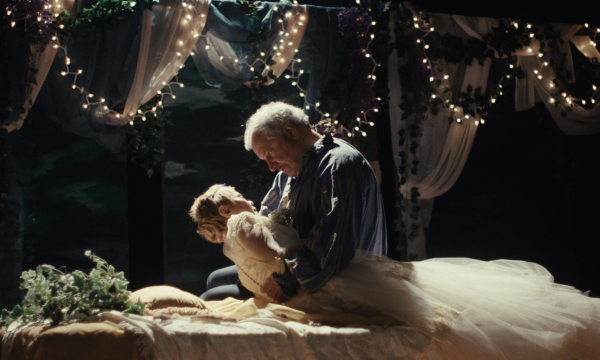
While the tragedy is only slowly being revealed, an unhappy and angry Dan is plodding along in his road construction work until a middle-aged actress, Rita (Dolly De Leon), in the local community theater recruits him to play a part in Shakespeare’s Romeo and Juliet.
From this point on scenes from the group’s preparation and then performing (for just one night) Romeo and Juliet are interwoven with the Mueller family’s personal drama–Daisy is a rebellious teenager, is having disciplinary problems at school, and the Muellers are pursuing a deposition against Christine and her family for facilitating Brian’s death.
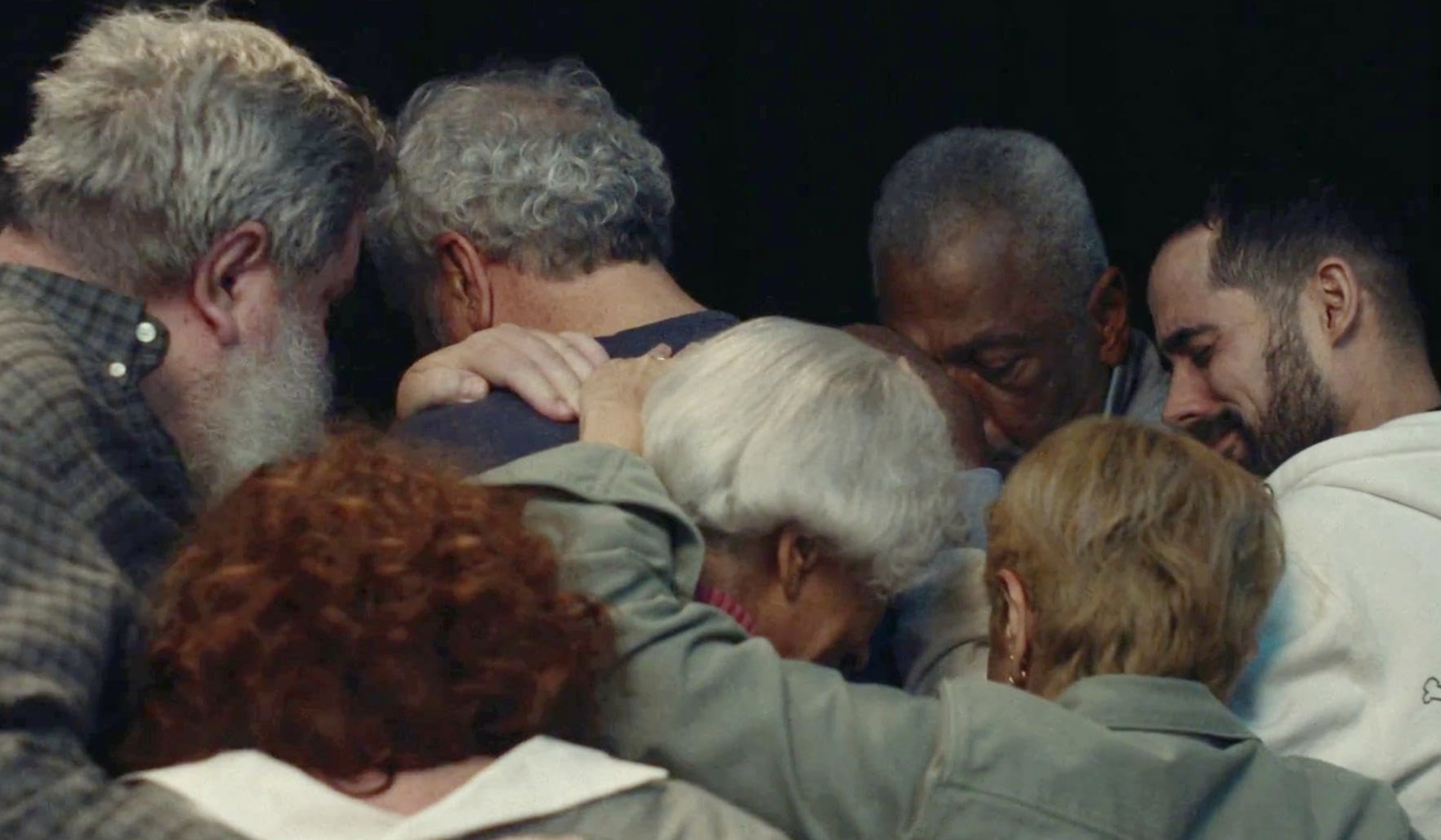
This interweaving of family problems with Shakespeare’s play is compellingly appropriate because just as Romeo committed suicide, as Dan explains to his fellow cast members, so too “My . . . s-son . . . Brian . . . died last year. He was 17. He did it himself.”
Never before did Romeo and Juliet seem so sad, so tragic, to me. Dan eventually takes over the part of Romeo, with the middle-aged Rita his Juliet. And both middle-aged actors, despite some grumbling from a cast member about their ages, seem appropriate in their roles.
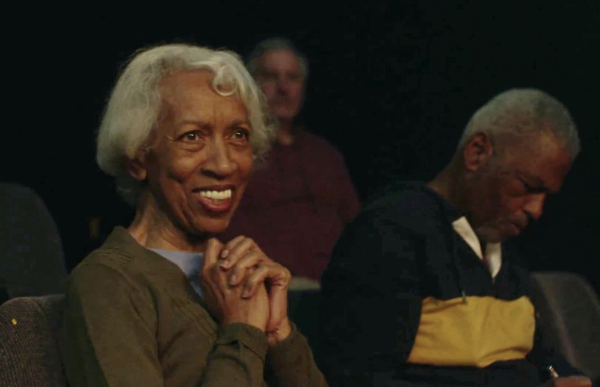
When near the end, Dan as Romeo discovers what he thinks is Juliet’s dead body–she is not really dead–and says the following words, we are deeply moved. “Death that hath sucked the honey of thy breath . . . hath had no power yet upon thy beauty. Why art thou yet so fair? Here, here will I remain, [he holds Juliet's body] here I will set up my everlasting rest. Eyes, look your last. Arms, take your last embrace. And lips, oh, you the doors of breath . . . seal with a righteous kiss.” His drinking poison and lying down beside her compound the tragedy, as does her awakening and saying, “Poison I see hath been his timeless end, drunk all and left no friendly drop to help me after. Oh, happy dagger, this is thy sheath. There rust, and let me die.”
With Dan’s wife, Sharon, shown in the audience with tears in her eyes, Juliet kills herself by plunging the dagger into her stomach. And when at the end daughter Daisy, who has herself become a cast member, utters the play’s last words–“For never was there a story of more woe . . . than this of Juliet and her Romeo”–we are ready to believe her.
For what can be sadder than the self-destruction of two teenagers (Shakespeare’s Juliet is only 13) before they have hardly begun to live–or in Brian’s case one teenager and the sorrow and guilt that Christine must live with?
And yet, somehow acting in Shakespeare’s play helps restore and renew Dan and his family. How does this happen?
We can only guess. But mine is that the play helps them gain more wisdom. We do not all become wiser as we age, but sometimes some of us do. Let’s examine the question further.
The literary critic Harold Bloom once wrote, “The deepest motive for reading has to be the quest for wisdom. . . . Shakespeare . . . also is the wisest of teachers.” It’s true, however, that most of us do not read primarily to gain wisdom. And it’s also true that for most of us our teenage years are not the wisest period of our lives–for me, most of them were probably my dumbest years.
Our culture and our formal education certainly don’t place much emphasis on the gaining of wisdom. The economist and environmentalist E. F. Schumacher (1911-1977) wrote that in general education didn’t give us much help in going beyond “mere training, something more than mere knowledge of facts, and something more than a mere diversion.” He was very critical of what eventually became the dominant purpose of higher education—career preparation for work in our modern industrial societies, which were “incessantly stimulating greed, envy, and avarice.” The main problem he perceived with modern education was that it had abandoned the incorporation and guidance of traditional wisdom, which helped us answer questions like “What is our purpose in life?” and “What are our ethical obligations?”
As for informal education, as U. S. humorist Dave Barry once said: “Another possible source of guidance for teenagers is television, but television's message has always been that the need for truth, wisdom and world peace pales by comparison with the need for a toothpaste that offers whiter teeth and fresher breath.”
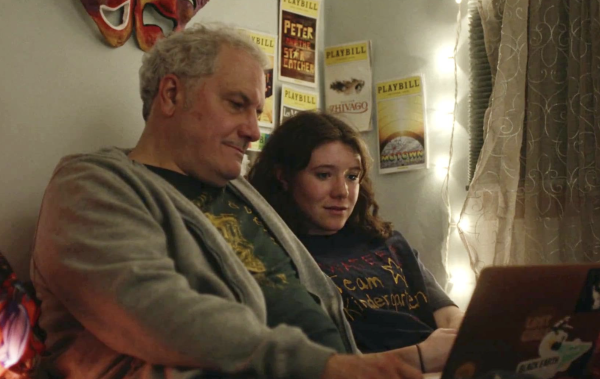
It’s true that there have been some attempts to teach more wisdom. (See, e.g., Robert Sternberg’s essay in the Chronicle of Higher Education, entitled “It's Not What You Know, but How You Use It: Teaching for Wisdom.”) But in the face of deemphasizing the liberal arts and stressing career preparation–especially now in the second Trump administration–there seems little hope that Sternberg’s advice is going to be heeded.
But back to the question of how acting in Shakespeare’s play helped Dan and his family cope with son Brian’s death. A decade and a half ago, I attempted to indicate how seeing another play–Arthur Miller’s Death of a Salesman–might help college students become wiser. And months after my wife, Nancy’s, death in 2022, I wrote "How Tennyson’s Poem 'Ulysses' Helps Me Cope." I’m not sure Bloom was correct when he wrote that the “deepest motive for reading has to be the quest for wisdom,” but I am convinced that the arts have a certain restorative power–and that Schumacher and Sternberg are right to stress the need for a more liberal education.
