

Hart-Broken: Loved, But Not in That Way


Blue Moon is for moviegoers interested in musical theater, biopics, LGBTQ issues, Lorenz Hart, substance abuse issues, and stellar acting.
Blue Moon Film Review
According to press notes for Blue Moon, “Rodgers and Hammerstein went on to become the most successful songwriting team in American musical theater history (South Pacific, Carousel, The King and I, Sound of Music).” Less remembered are the musicals that preceded Rodgers and Hammerstein’s partnership which began with their 1943 Oklahoma! - Pal Joey, Babes in Arms, The Boys from Syracuse, and On Your Toes, with music composed by Richard Rodgers (Andrew Scott), and lyrics by Lorenz Hart, the duo who also co-wrote the 1934 song Blue Moon. The new movie entitled Blue Moon is a biopic about Lorenz Hart, starring Ethan Hawke in one of the best performances of his prolific career filled with exemplary characterizations.
The film’s screenplay by Robert Kaplow comes close to following Aristotle’s three dramatic unities of time, place, and action, as prescribed in the Greek philosopher’s Poetics from 335 BC. Blue Moon opens at (presumably) Broadway’s St. James Theatre, where an extremely uncomfortable Hart watches Oklahoma! – while this may well be the premiere of Rodgers and Hammerstein’s legendary collaboration, it also signals the closing of the Rodgers and Hart team, which after a long run, appears to Lorenz to be coming to an end, with Oscar Hammerstein II (Simon Delaney) looming as his replacement in the words department. (By the way, the nimble movie director Rouben Mamoulian, who helmed Hollywood classics such as 1940’s The Mark of Zorro, also directed the play Oklahoma!)
Before the curtain falls on the musical (and the work relationship with his longtime composer), the unnerved Hart flees across the street to seek refuge at Sardi’s. Most of the rest of Blue Moon’s action takes place here, at the Great White Way’s famed watering hole, its walls festooned with framed caricatures of show biz luminaries, which the cast and crew have rented for their post-premiere opening. Entering the still mostly empty saloon, Hart – who is supposedly on the wagon – is surprisingly frank (for the 1940s) about his same sex dalliances with the bartender Eddie (Bobby Cannavale). Hart appears to be a habitue of Sardi’s, and Eddie a confidante of Lorenz for some time.
But there’s a twist, as the 47-year-old lyricist also waxes poetic about a female he is wooing, Elizabeth Weiland (Margaret Qualley, who played Pussy Cat in Quentin Tarantino’s 2019 Once Upon A Time… In Hollywood). Eddie – and viewers, including this Eddie – wonder: Have they or haven’t they done the deed?
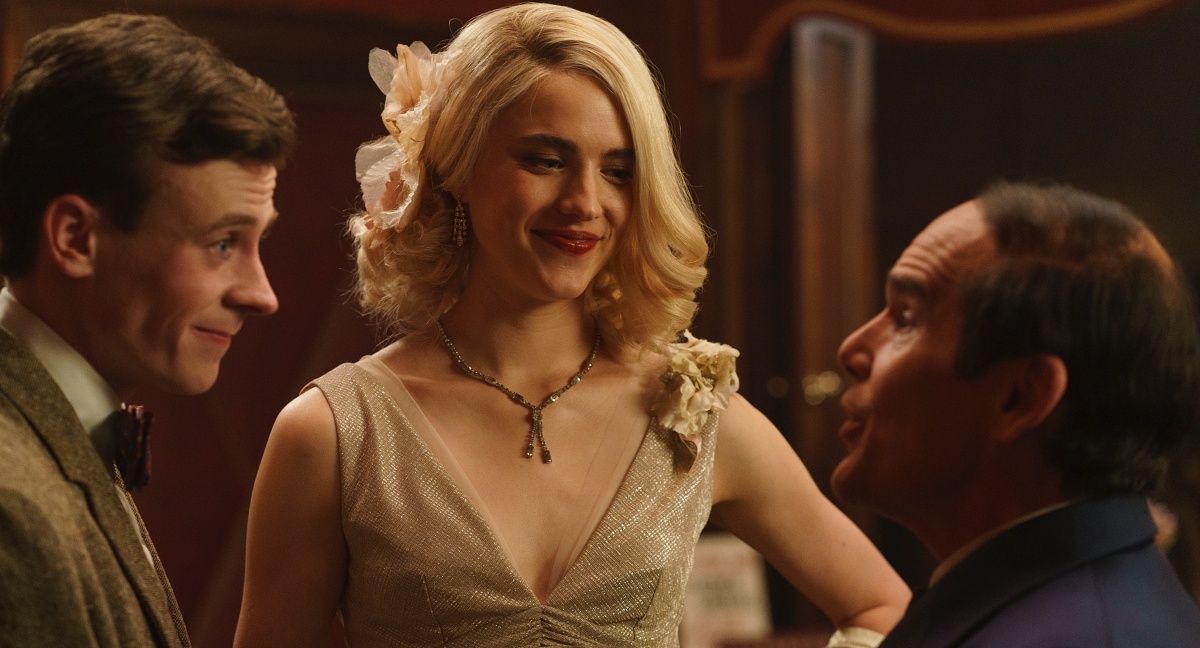
Elizabeth is a beautiful blonde Yale coed less than half Lorenz’s age. According to press notes, “The film draws inspiration from letters written between Hart and a young woman, which Kaplow researched for the script. The unidentified woman – whose first name was Elizabeth – would keenly correspond with Hart, and this sparked ideas in Kaplow’s mind.”
As guests invited to Oklahoma!’s after party filter into Sardi’s, alluring Elizabeth is among them, and Hart corrals her for heart-to-Hart talks. At one point, for maximum privacy, the well-heeled lyricist bribes the hatcheck girl to leave her post for Lorenz and Elizabeth to continue their tête-à-tête tell all in the cloak room, wherein the Yalie regales her older, would-be suitor with her amorous adventures on campus, which excites the lyricist. (Perhaps he gets a “Hart-on”?)
But during their confidential confab Elizabeth blithely notes that although she and Hart seemed to have spent a (likely chaste) getaway two-gether, she loves Lorenz: Just not in that way...
This unrequited love also seems to be the case for Hart’s other major relationship, with his collaborator Richard Rodgers. Turned off by Lorenz’s alcoholism, which has rendered his behavior and moods under the influence increasingly unpredictable, Rodgers has, for the most part, spurned Hart in favor of Hammerstein, a more stable, dependable writing partner who is not only gifted, but even shows up for work on time.
Throughout the night, Lorenz goes off the wagon, downing one drink after another. I suspect that Hart had a conflicted sexuality and that he romantically pursued the youthful, nubile Elizabeth precisely because she was ill-suited for the far older wordsmith. Feeling blue, Lorenz seems to have self-medicated himself with alcohol as a coping mechanism for his unresolved sexual identity and unfulfilled love life. But what do I know? I’m just a movie reviewer. (Paging Dr. Freud!)
“Bi” the way, I have no idea whether Hart was bisexual, straight, or gay, and it doesn’t seem to have occurred to the filmmakers that whatever the case may be, this outstanding artist’s private life is none of our (literally!) fucking business.
Be that as it may, this entire movie hinges on Ethan Hawke’s depiction of Lorenz Hart. I was completely convinced by his performance, but although it rang true for me, I hasten to add that I know little about the songwriter, so I can’t vouch for its authenticity. (Unlike, say, Billy Zane’s zany reenactment of Marlon in Waltzing with Brando, a figure I’ve read and observed lots about, and I knew some of his cohorts in Tahiti depicted in the biopic, including Tarita.) Viewers who buy into Hawke’s Hart as a truthful portrayal, including Academy voters, are likely to consider the actor’s portrait to be a once in a blue moon caliber tour-de-force that’s Oscar-worthy.
So far, Hawke has been nominated for four of those coveted golden statuettes, three of them for movies directed by Richard Linklater, who also helms Blue Moon, their ninth collaboration. The last one was 2014’s Boyhood, which was Best Picture-nommed, while Hawke was up for Best Supporting Actor and Linklater for Best Director and in the Best Writing, Original Screenplay category, while Patricia Arquette snagged a Best Supporting Actress Academy Award. Hawke can currently be enjoyed on the FX series The Lowdown, and my favorite of his roles was as the greatest white American of all time, abolitionist John Brown, in the 2020 Showtime series The Good Lord Bird. As for Linklater, I’m looking forward to his upcoming movie Nouvelle Vague, about Jean-Luc Godard making Breathless, more than any other film I’m aware of.
The acting in Blue Moon is uniformly good. A special treat is a brief but droll appearance by The New Yorker’s E.B. White (Patrick Kennedy). As Richard Rodgers, Irish thesp Andrew Scott – who also excelled as the title character in the 2024 Netflix mini-series Ripley and played the priest in Amazon’s 2019 series Fleabag – is a study in exasperation as he contends with his talented but tormented onetime (and perhaps future?) collaborator. (Interestingly, Scott like Hawke has played Hamlet in screen versions of Shakespeare’s masterpiece.) Margaret Qualley – who turns 31 this month and also played a younger woman vis-à-vis an older, male writer in 2020’s My Salinger Year – strikes the right note as the Waspy, blithe, and unobtainable Elizabeth, who the tortured Hart may yearn for, but is beyond his reach. As she is Waspy and Hart the Jewish son of immigrants, there is a bit of The Heartbreak Kid type of ethnic subtext and longing also going on here. (Or should I say The Hart-break Kid?)
Blue Moon is for moviegoers interested in musical theater, biopics, LGBTQ issues, Lorenz Hart, substance abuse issues, and stellar acting. Blue Moon is being theatrically released Oct. 17 in L.A. and New York and Oct. 24 nationwide.
Critic Ed Rampell is moderating a panel on “The Role of Theater in the Resistance” at the Left Coast Forum at 2:45 p.m.-5:00 p.m., Saturday, Oct. 25, in Room 3, Building F5, Los Angeles Trade Tech College in Downtown L.A. Panelists include: Actress/ director Iona Morris Jackson; actress Tania Verafield; playwright/former Fountain Theatre Artistic Director Stephen Sachs; actress/director/playwright Mariana Da Silva; and Rogue Machine’s Artistic Director Guillermo Cienfuegos. For info see the Left Coast Forum.
Aloha oe (farewell to thee), Diane Keaton, one of the greats.
