

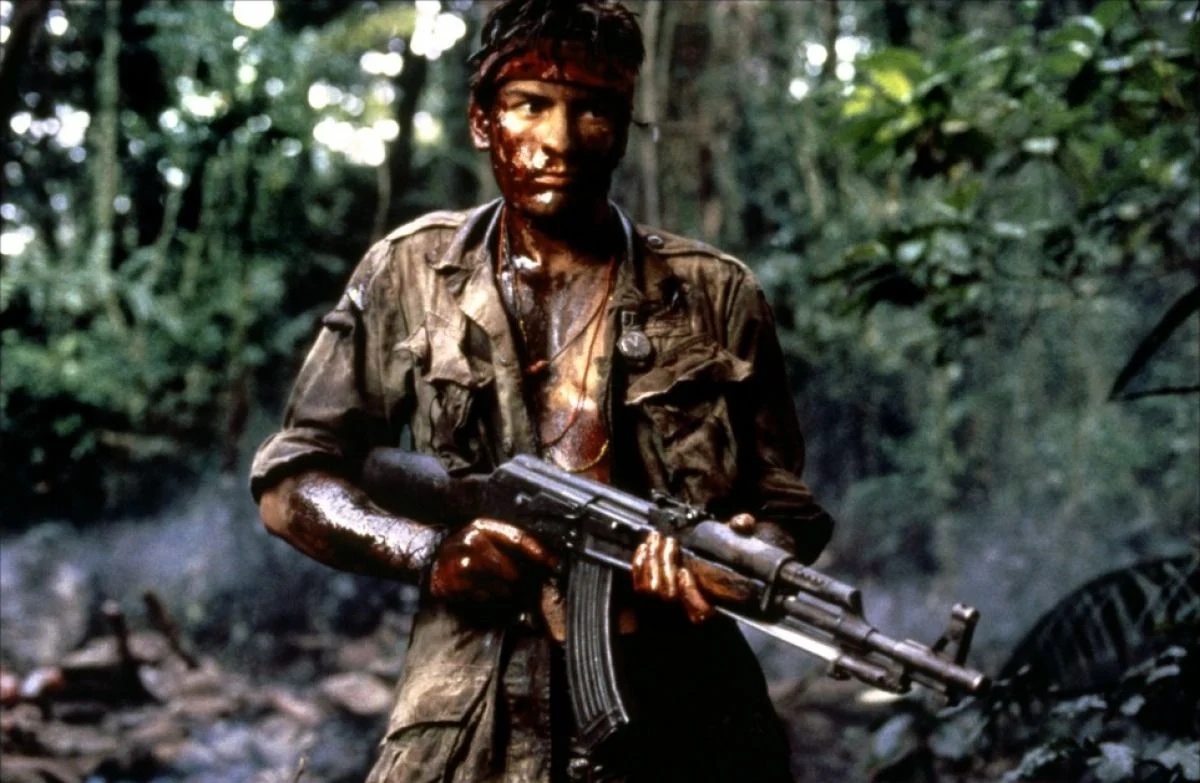
Hollywood Realism


In my war, when people died, they stayed dead. My war didn’t last 127 minutes. My war didn’t have a sound track.
How about that ten-minute D-Day landing sequence near the beginning of Saving Private Ryan? Is that gritty realism or what? Blood. Vomit. Bodies and body parts flying all over the beach. You sure didn’t see stuff like this back in 1949 when John Wayne was starring in The Sands of Iwo Jima. Or even when he was starring in 1962’s The Longest Day. Hollywood has come a long way in portraying war as it really is.
Oh, really? You think so? Just how many people die in that D-Day landing sequence, do you think? Well, I’ll tell you. None. Zero. Zip. Zilch. Nada. Nary a one. They’re all pretending. They’re all actors. When the camera stops rolling, they all get up and go eat lunch. You call that realistic? I wish I’d have been in a war where nobody died.
At least since 1986, when Platoon first came out, every time a new movie is released, people ask me how realistic it was. I spent years as a high school teacher, so of course my students would always ask me. But lots of other people would ask, too. After awhile, the question became, “What’s the most realistic movie about Vietnam?”
My answer was always the same: Vietnam is a country, not a war. But there is no such thing as a realistic war movie. Not about the Vietnam War. Not about any war.
In my war, when people died, they stayed dead. My war didn’t last 127 minutes. My war didn’t have a sound track. (Don’t kid yourselves, folks; Michael Herr not withstanding, it was not a “rock-n-roll war.” I never even heard Armed Forces Radio during my entire 13 months in Vietnam.) My war didn’t star Tom Hanks or Charlie Sheen. My war smelled bad. Human insides turned inside out have a distinct and unpleasant odor. Burning human flesh has an odor you will never forget. So does rotting human flesh. My war didn’t have a beginning, a middle, or an end. It was already underway when I got there, and it went on and on and on long after I left. It didn’t conclude with some actor in a helicopter pontificating about how the real enemy was ourselves, or some other actor standing in a cemetery, hoping he’d done right by the dead.
Years ago, when it first came out, I went to see Born on the 4th of July with my cousin and her husband. The movie has an uplifting ending with Ron Kovic in his wheelchair, dressed in a suit and just about to go onstage to speak at the Democratic National Convention in 1976. At that moment, a reporter leans over and says to him, “Welcome home.”
After the movie, Jane and Tim asked me what I thought, and I said that the ending was a sappy whitewash, just a way of letting the audience off the hook. “I couldn’t have stood it without that ending,” Jane said. “It would have been too depressing.” I honestly don’t remember if I said this out loud or not, but I remember thinking that Kovic would be in that wheelchair for the rest of his life; he would never walk or dance or make love. For him, there would be no happy or uplifting ending.
For many years, I taught a course called “The US & Vietnam” at the Haverford School for Boys. We watched some very good documentaries about the war: Episodes 1 and 5 of Vietnam: A Television History, The Anderson Platoon, The Year of the Pig, Hearts and Minds, The War at Home, The World of Charlie Company, The Most Dangerous Man in America.
But when the boys would ask me why I never showed any of the popular Hollywood movies, I would tell them, “If Hollywood were in the business of education, we’d all be out at King of Prussia Mall eating popcorn and earning our high school diplomas. Hollywood is in the business of entertainment, not education.”
As the great historian Arnold Toynbee observed, “Wars are exhilarating when fought elsewhere by other people.” If Hollywood could somehow figure out how to make a “realistic” war movie, theater-goers would be throwing up, passing out, and demanding their money back. War is not entertaining.
But if you really want a realistic war movie, I have a very good suggestion. Hire a sniper to sit up in the projection booth and shoot one or two folks each night. Booby-trap half a dozen of the seats each night at random so that a few of the movie-goers get a foot blown off or a sucking chest wound or maybe go home dead. That might even allow some of the people sitting near the casualties to experience some of the olfactory realism, too.
Hey, wait a minute, we want the illusion of realism, not real realism.
The simple fact is that “Hollywood realism” is like riding a roller-coaster. Cheap thrills. Both experiences get your adrenalin going and your heart rate up, but in both situations, you know you are actually perfectly safe.
So go to the movies, and be entertained, and imagine you’ve gotten a small peek at what war is like. But you haven’t. And you should hope and pray that you never do.
