

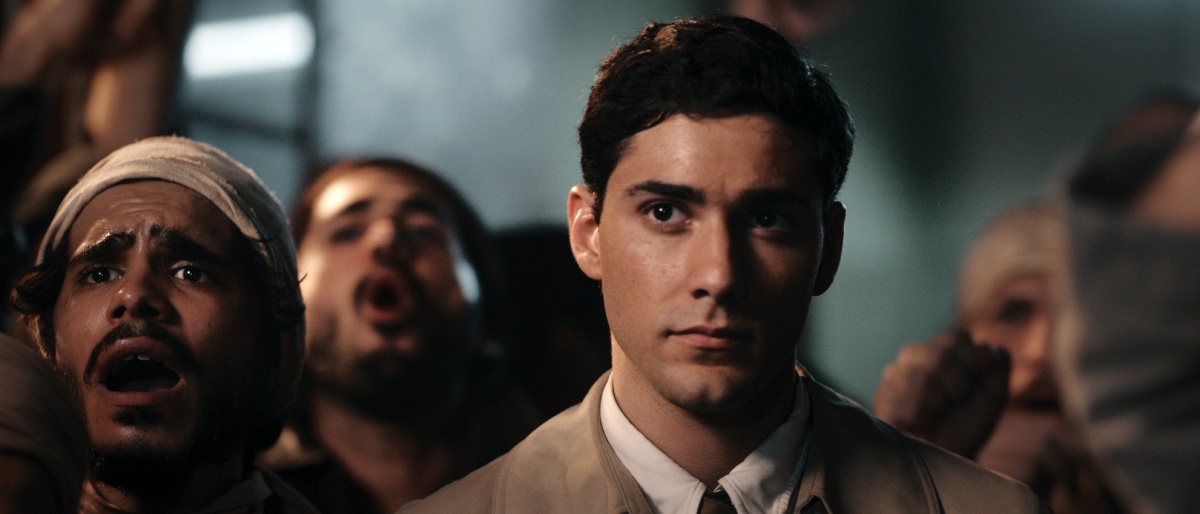

Throughout the film, the viewpoints of Arabs and Israelis and of warriors and war doubters are aired.
The Israeli film “Image of Victory” (2021) is now on Amazon Prime, and after it first appeared, the reviewer in The Jerusalem Post wrote, “In more than two decades of professional movie reviewing and even more of movie-going, it is one of the best movies I have ever seen.” But the movie could not be used as a propaganda piece for the present Israeli incursion and occupation of the Gaza strip. Why? Because, as the reviewer writes, it “is a great anti-war epic, both powerful and exhilarating.”
And yet the present occupation is certainly relevant. Like the current war, the film begins with an Arab attack around a Jewish kibbutz. Only it is not 2023 and an attack on a music festival near the Re'im kibbutz that killed more than 360 Israelis and abducted about 40 more. No, it is 1948 and Arab Egyptians are attacking the Israeli kibbutz Nitzanim, which is about only 50 kilometers from the Re’im kibbutz. Nevertheless, the basic hostility between Arabs and Jews in this part of the world has not changed much.
To understand this enmity, however, a brief history might help. In 1947, Israel did not yet exist. Instead there was Palestine, which in the interwar years was controlled by Great Britain and peopled (by 1947) by Arabs (two-thirds) and Jews (one-third), with Arabs owning about four-fifths of the land. (Partly because of the Holocaust, which killed about 6 million Jews, and partly because of Zionism, which advocated a Jewish national state that would protect Jewish people, the fraction of Jews had increased since late 1945 as many Jews migrated into the Palestinian area, their ancient homeland--see below.)
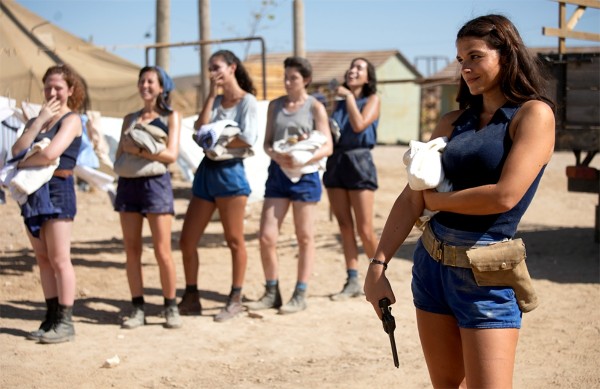
Due to a variety of postwar problems, including a desire to please world Jewry as well as petroleum-producing Arab states, the British turned the problem of future Palestinian status over to the recently formed United Nations (UN).
The UN then recommended the division of Palestine into two states, an Arab one and a Jewish one. But both sides faulted the plan, which was to go into effect with the scheduled British withdrawal in May 1948. The Palestinian Arabs because the Jewish state was to get about half of the Palestinian territory, including more fertile areas. (Moreover, in that proposed Jewish state, only about half of the people were Jewish in 1947.) Many Jewish Zionists were unhappy with the plan because they thought it should allocate the whole Palestinian area to them.
“Image of Victory” begins with one of the two main characters in the film, Egyptian newsreel director and journalist Mohamed Hassanein (Amir Khoury), reacting angrily to the 1979 news that Egyptian President Anwar Sadat had signed a peace treaty with Israel’s Prime Minister Menachem Begin (brokered at Camp David by U. S. President Jimmy Carter). Coming after Arab-Israeli wars in 1948, 1956, and 1967, it did not grant any land to the Palestinian Arabs, who never got the land envisaged by the UN Peace plan of 1947. Hassanein’s words to his TV set (and then his wife) are, “We fought the Israelis for years to help our Palestinian brothers but this peace agreement doesn't solve anything! Sadat's a traitor! . . . If there was no reason for the war, and they are making peace just like that . . . then I've been misleading the people who read my newspaper columns.” (All quotes are taken from the filmscript, which accurately transcribes the film’s dialogue.)
Prior to his rant, Hassanein had mentioned the film’s other main character, the Jewish kibbutz-member Mira (Joy Rieger). He says, “Of all the men and women I met in my life . . . It's her I cannot forget. And I know it doesn't make sense. Because she's the enemy, right?” The two Israeli actors, Khoury and Rieger, playing Hassanein and Mira, are both excellent, with Rieger being especially memorable. And in general the whole cast does a first-rate job.
Shortly after Hassanein’s initial angry words, we are flashed back to the last day of 1947 and the beginning of 1948. He goes to a meeting of potential Egyptian volunteers to fight against Jews. A main speaker says, “The Zionists act
like heinous predators and they deserve retribution. I've studied the Jewish soul and realized that they have boundless ambitions. They believe it's the land of their forefathers. They come to Palestine from every direction, from Europe, from South America, from Asia, like locust descending on a field of crops. And how will they . . . get rid of the good people? Good Arabs, living on their lands for centuries.These foreigners colonized our sacred land in order to expel our brothers.”
Soon afterwards, Hassanein is on the road with his photographer to report and film on the Egyptian attack on the Nitzanim kibbutz, which had been founded in 1943 after a Jewish organization had purchased about 400 acres of land. Eventually, many Jewish immigrants settled there, including some Holocaust survivors. Most of the remainder of the movie deals with members of the kibbutz (especially Mira), “crappy soldiers straight from prison” who were sent to aid them against Egyptian attacks, and finally the battles between the Nitzanim Israelis and Egyptian forces, which eventually overcome Israel's resistance by killing and capturing Israelis.
Although the Israelis ended up winning the 1948 war--the state of Israel came into existence; it gained about a third more land than the original UN partition plan; an Arab Palestinian state failed to materialize; and the Gaza Strip was administered (until Israel won the 1967 war) by Egypt--Egypt still won the 1948 battle of Nitzanim.
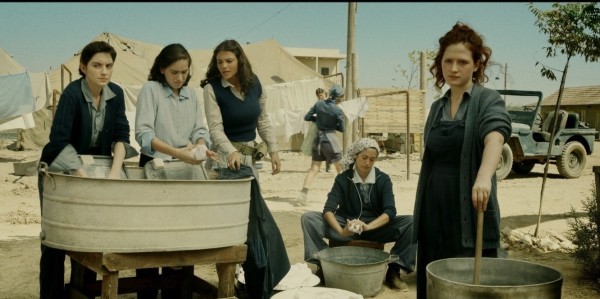
Throughout the film, the viewpoints of Arabs and Israelis and of warriors and war doubters are aired. At one point, a kibbutz woman says, “So we will kill them and they will kill us? How will that solve the problem? Is revenge the solution? This must be solved. These lands used to belong to them.” But she is answered by an Israeli military spokesman: “All lands in the world used to belong to someone else . . . and the argument will go on forever. We paid the landlord good money for this land. His tenant farmers should be angry at him. . . . When we crawled out of the crematorium chimneys, some people here know exactly what I'm talking about, we realized that with all due respect to culture and civilization, people are also animals. And animals respond to ‘an eye for an eye.’”
At another point Hassanein says, “You see your enemy as a regular person
and it does something to you.” That line reminded me of the beginning of Thomas Hardy’s poem “The Man He Killed.”
Had he and I but met
By some old ancient inn,
We should have sat us down to wet
Right many a nipperkin! [have a drink together]
But ranged as infantry,
And staring face to face,
I shot at him as he at me,
And killed him in his place.
I have written before of the folly of most wars, especially World War I; quoted Wendell Berry, who in 1968 said, “We have been led to our present shameful behavior in Vietnam by this failure of imagination, this failure to perceive a relation between our ideals and our lives”; and indicated that at present in Gaza Israeli Prime Minister “Netanyahu lacks the imagination and empathy to lead Israel to a peaceful path.”
Too often in wars, massive killings--e.g., in WWI three out of every ten French men between the ages of eighteen and twenty-eight--with all the individual and family tragedies those deaths entail, occur because of insufficient reasons.
In “Image of Victory,” the battle of Nitzanim offers several examples. Some of the Israeli deaths depicted at the end occur after mistakes following an Egyptian officer’s command to “shoot only if shot at.” And the whole bloody battle was fought only because, after failing to reach Tel Aviv, as Hassanein reflects, the Egyptian king needed a victory “before the soldiers come home.”
Too often, the heroism and bravery of warriors is praised at the expense of the benefits of peace. In a previous LA Progressive piece, I indicated some of them: “Peace is ploughing and sowing and reaping and making things . . . and getting married and raising a family and dancing and singing and opera.” It’s “children, friends, wealth, health, wheat, wine and pleasure.”
Contrast such benefits with the many tragedies of war. As Ian McEwan observed in his novel Black Dogs (1993), war involves a “multiplicity, a near-infinity of private sorrows . . . a boundless grief minutely subdivided without diminishment among individuals . . . all those unique and solitary deaths, all that consequent sorrow, unique and solitary too, which had no place in conferences, headlines, history, and which had quietly retired to houses, kitchens, unshared beds, and anguished memories.”
