

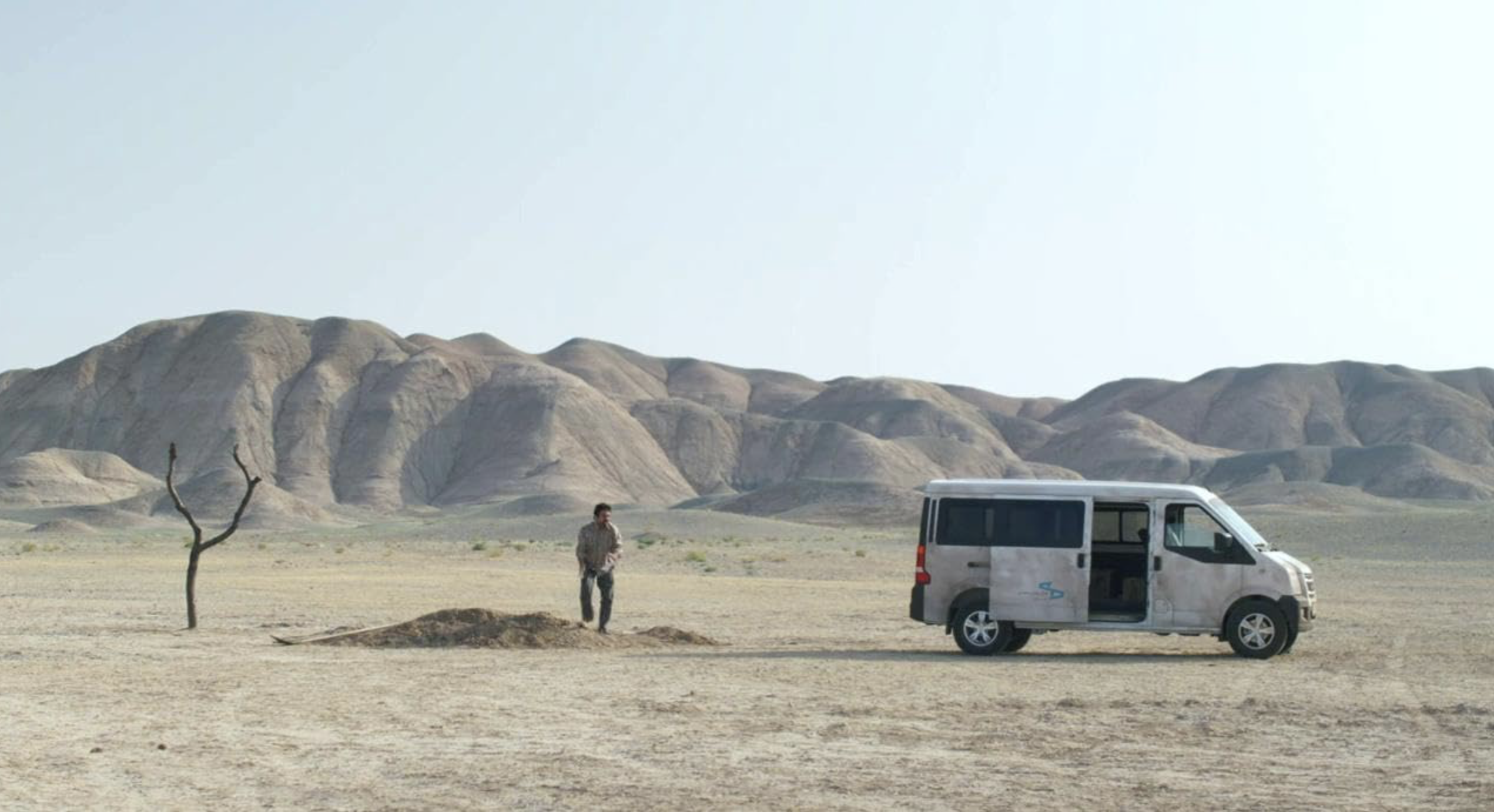

The plot revolves around whether or not the four opponents of the regime of Supreme Leader Ayatollah Ali Khamenei are going to kill a man they think might be a government agent who had overseen their prison treatment.
Now that the USA and Israel are attacking Iran, it seems like it’s an appropriate time to review Iranian dissident director Jafar Panahi’s latest film, It Was Just an Accident (now available on Hulu). It was nominated at the March 2026 Oscar ceremony in the Best International Feature and Best Original Screenplay categories and earlier won the Palme d’Or at the 2025 Cannes Film Festival.
It partially reflects his own experience in Tehran’s Evin Prison, where he was held for seven months before being released in 2023. Although currently out of Iran, he recently announced that he intends to return because his “family is there” (his son, mother, brothers, sisters, colleagues—“everyone is there.”)
Appropriately, his new film deals with a small group of Iranian regime opponents that, like him, were earlier imprisoned. Included in the group are Vahid (Vahid Mobasseri), a mechanic; two females, Shiva (Maryam Afshari) and bride-to-be, Golrokh (Hadis Pakbaten); and Hamid (Mohammad Ali Elyasmehr). At one point Vahid says to Shiva, “Two or three weeks after your arrest...I too was arrested, on the same charges as everyone else: collusion, conspiracy and propaganda against the regime.” As a result of his arrest, Vahid says, “He [Eghbal, see below] took everything from me. My honor, my wife, my job. I have nothing left!” (Film quotes are taken from the filmscript, which is almost identical to that of the Hulu version.)
The plot revolves around whether or not the four opponents of the regime of Supreme Leader Ayatollah Ali Khamenei (in power from 1989 until his killing in February 2026 by coordinated U. S.-Israeli airstrikes) are going to kill a man they think might be Eghbal, a government agent who had overseen their prison treatment.
Vahid almost buries him alive, but stops when the man he thinks is Eghbal denies that identity. Most of the film’s remainder involves Vahid trying to ensure that his captive, who he binds up and places in a box, is really Eghbal. That’s where Shiva, Golrokh, and Hamid—all former prisoners of Eghbal—come in. Of the three, Hamid is most certain that the captive is really Eghbal—going so far examining his legs. He first examines Eghbal’s left leg (which has a partial artificial limb) and then looks at the older scars on the right leg. He says, “He always told me he took it out on guys like us because he lost his leg in Syria. [For about a decade and a half beginning in 2011, Iran aided the Syrian Assad regime against Syrian rebels.] . . . I’ve been running my hand over that leg of his in my nightmares for years. It’s him, the filthy bastard!”
The decision whether to kill Eghbal or not is postponed until almost the end of the film—and I’ll not ruin the suspense by revealing the choice, or whether the captive is indeed Eghbal. At one point Shiva says to Hamid, “You really want to kill him? That’s exactly what he wants, someone to put an end to his cursed life...so that the next regime will be based on murder....the same endless cycle....Is that really what you want for the future of your country and your people?!”
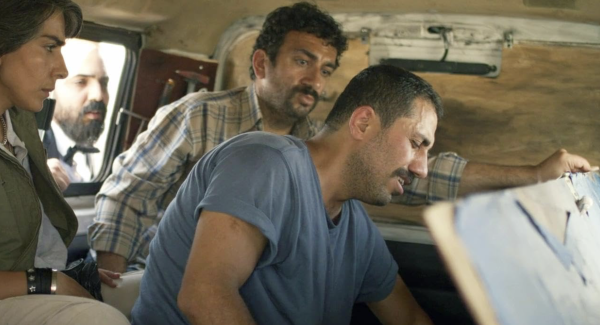 Vahid Mobasseri, Majid Panahi, Mariam Afshari, Mohamad Ali Elyasmehr, and Hadis Pakbaten
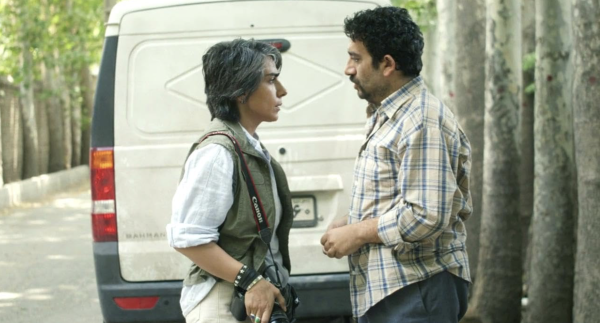 Vahid Mobasseri and Mariam Afshari
The decision is also complicated by a phone call from Niloufar, the daughter of the captive. She had tried to call her father, but he is bound and in the box, so Vahid locates the phone and answers it. But before he can explain that he is not her father, Niloufar says, “I'm scared Mommy will die.” It turns out that the mom is pregnant, her water broke, and Vahid manages to deliver her to the hospital, and after a while he is informed that she delivered a boy.
Up until almost the film’s end, we are wondering whether the regime’s opponents are going to kill the man they suspect is Eghbal. Near the end, Vahid ties the captive to a tree and tells him that he took his—if he really is Eghbal—wife to the hospital to have a baby.To the captive’s query whether she is okay Vahid says, “She's fine. But I'm going to deprive you of her. You'll be dying to see her, you bastard.” But the captive replies, “I'll tell you something. You are not a killer. Otherwise you wouldn't have taken care of her. Think about it.”
Shortly after this exchange, Shiva slaps the bound captive several times and tells him she’ll make him “a martyr right now.” She adds, “You trash, if you say one more word, I'll break your face with the shovel....You plunder the country.You bastard.”
Yet, Shiva is still not convinced that she should kill the captive. Nor is Vahid. Even the final scene of the movie leaves viewers in doubt about the fate of the captive and his four opponents who considered killing him. But readers should watch the suspenseful film before accessing this final link. And give some thought to Shiva’s question: “You really want to kill him? That’s exactly what he wants, someone to put an end to his cursed life...so that the next regime will be based on murder...the same endless cycle...Is that really what you want for the future of your country and your people?!”
