

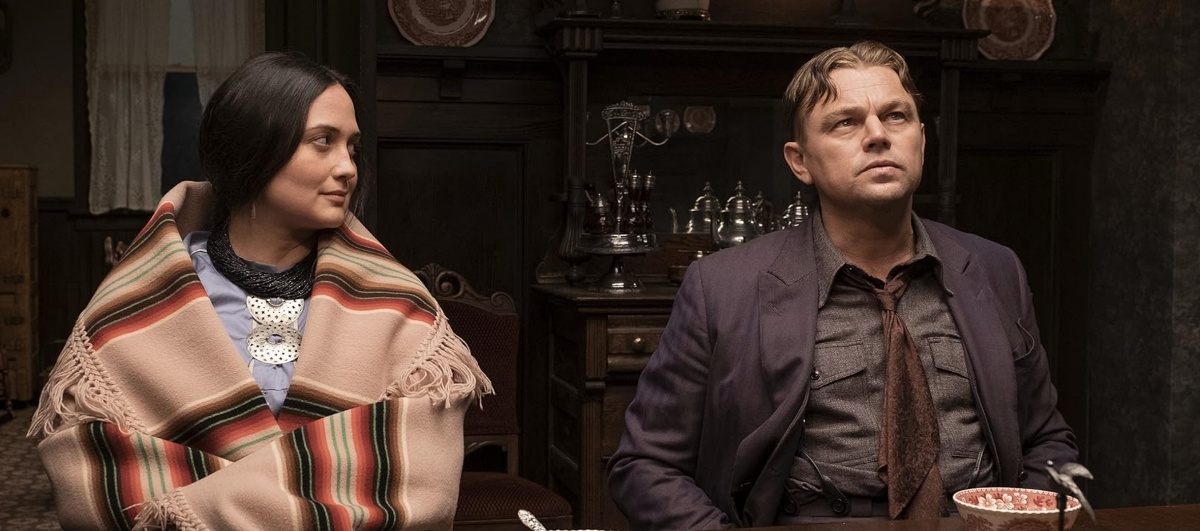


It is easy to criticize the pervasive historical ignorance of the American public, especially of events centered in Native American/Indigenous experience.
Today's release of Martin Scorsese's Killers of the Flower Moon serves as the latest reminder of the place Native American/Indigenous people occupy in the larger, one might say consuming, narrative of American history as typified by absence and obscurity. The reasons that so few Americans have an awareness, much less any detailed knowledge, about the settler violence perpetrated against the Osage people, or Wazhazhe in their own language, from the late 1910s into the early 1930s, are as frustrating as they are complex.
It is easy to criticize the pervasive historical ignorance, especially of events centered in Native American/Indigenous experience, of the American populace. Such exercises are ineffectual and largely pointless, however, if we fail to consider the reasons for this condition and then look honestly at an educational system that has failed so miserably in presenting an accurate and representative view of our shared national past.
The significance of Native people and cultures within the dominant narrative has long been framed by historians and popular culture as a function of their relationships to Euro-American settler culture. For the largest span of American history, Native people and the families, societies, and cultures they are a part were rarely presented on their own terms or having important significance beyond the colonial context.
This has contributed to a system of historical representation in which Native people have been commonly placed into one of two binary categories. First, as combatants who fought to resist colonial expansion as with popular representations of historical figures such as Metacomet, Tecumseh, and Geronimo. And second, as friends and allies who aided or assisted colonial figures as in Squanto and the mythical first Thanksgiving, or Sacagawea in her role as a guide for the Lewis and Clark expedition. Since the twentieth century, the constituents of both groups have been shuffled into another category that, while defined by nostalgia and mourning, is just as problematic and damaging, being recast as noble but tragic figures, or merely as vanished victims.
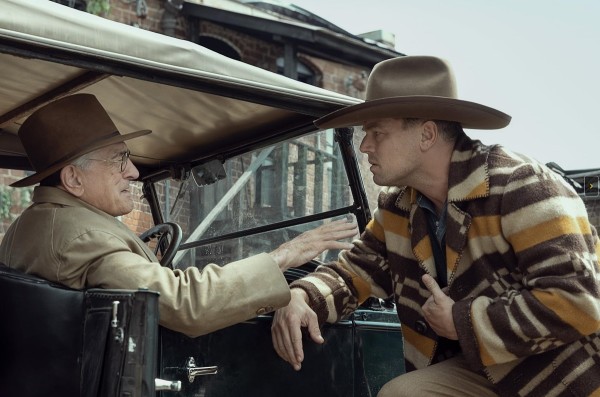 Robert De Niro and Leonardo DiCaprio
The recognition of such historical attitudes and habits seems to explain why so many events significant to Native/Indigenous peoples remain unknown, grossly misunderstood, or presented in hopelessly simplistic terms. This was something I became aware of regarding the Sand Creek Massacre of November 29, 1864, after I first came to Colorado. It's an exceedingly horrific event that Cheyenne and Arapaho elders, historians, educators, and their allies have made significant efforts to promote greater understanding of over the last several decades, and with some success.
For many Coloradans and Americans, more broadly, the Sand Creek Massacre, if one has any awareness of it at all, just doesn't fit into the historical master narrative that most Americans learn while growing up, founded on the ideals of truth, liberty, and justice. For many, such events are better left unexplored, if not being angrily rejected.
Similar gaps and limitations extend to other traumatic events experienced by Native peoples across America, whether referring to massacres perpetrated against Blackfeet people at the Marias River in Montana, the Northern Shoshone at Bear River in Idaho, the Southern Cheyenne at the Washita River in Oklahoma, or further back in time, to the incomprehensibly brutal murders of Mohican and Lenape people at Gnadenhutten, Ohio in the late eighteenth century. This list, sadly, goes on and on . . .
The events known as the Osage "reign of terror" occupies another stark blind spot in the American historical consciousness. Scorsese’s The Killers of the Flower Moon, which was adapted from David Grann's work of historical investigation of the same title, seeks to remedy the kind of blatant historical neglect noted above in giving treatment to these events with a run time of nearly three and a half hours. While the story presented is based on a book and script produced by non-native writers, its validity is bolstered by the casting of numerous Osage and other native people, including Lily Gladstone, Tantoo Cardinal, Cara Jean Myers, JaNae Collins, Jillian Dion, William Belleau, Yancey Red Corn, and Tatanka Means who were given major screen time.
The combined star power with Scorsese in the director's chair and Robert DeNiro and Leonardo DiCaprio in lead roles playing the real-life historical villains of William Hale and Ernest Burkhardt, ensures a robust viewership for the film, with extensive promotion and media coverage.
The hardboiled vision Scorsese brings to the film from previous work whether drawn from his Mean Streets, Taxi Driver, and Cape Fear to Goodfellas, The Departed, and The Irishman is fitting for Ernest and the larger cast of murderous rouges that descended on the Osage like "buzzards, circling to pick us over," as an Osage leader in the film describes them. But this approach can feel gratuitous when pondering the dire situation of the Osage. For theirs was a condition inextricably shaped by the forces of westward expansionism, forced migration, and the theft of land, which are expressive of the most extreme violence and trauma of Native colonial experience.
Despite a history whereby the Osage were well acquainted with movement and migration, as they'd moved from the Ohio Valley to Missouri and Kansas before being compelled to relocate to Oklahoma during a time when it was still defined as Indian Territory—set aside as a permanent enclave for Native peoples—they ended up on land, blessed or cursed depending on the perspective, that held enormous oil reserves. Like practically all the other promises made by American leaders, government officials, and military commanders, including those laid out in treaties with the backing of the US Constitution, the assurance to have their own lands free from the incursions of settlers, turned out as another bitter reminder of the expedient deceptions that lie at the heart of American domestic and foreign policy.
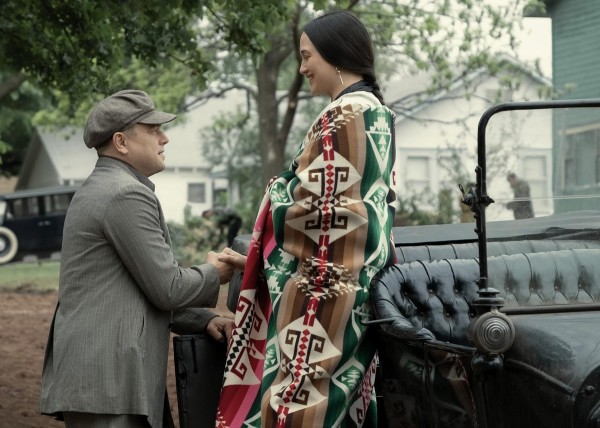 Leonardo Dicaprio and Lily Gladstone
As the lands the Osage reestablished their communities on had been deemed of little worth by previous settlers and land speculators, the subsequent discovery of oil and the fevered boom years of the early twentieth century made them among the wealthiest in the United States. At the same time, of course, it made Oklahoma and Osage country a veritable magnet for all who wanted to come to seize their piece of America's inexhaustible bounty and "strike it rich," as Ernest declares, with little care if gained by fairness or deceit. As the Osage leader, Chief Bonnicastle played by Red Corn, observes about their plight, "evil has come here, there's something it wants."
As the violence in Killers of the Flower Moon driven by this deceit rises and we contemplate the genocidal implications of the story, Scorsese's depictions of the senseless murder of Osage people can become overwhelming. The historical weight of the film becomes even more difficult to bear when we realize that so much of the violence of the film is directed against Osage women, prompting its horrifying recognition as part of a deeply entrenched pattern that links to the present in the ongoing epidemic of missing and murdered and Indigenous women.
As with the inattention and lack of resources law enforcement agencies have committed to this tragic situation in recent years, we find that a similar routine of neglect and failure, if not outright refusal, persisted nearly a hundred years earlier in the protection of Osage lives from the murderous schemes of men like Hale, Burkhart, and numerous others who go unnamed in the story.
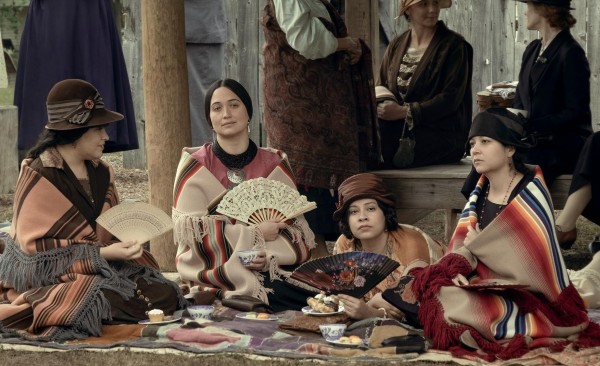 Lily Gladstone, Janae Collins, and Jillian Dion
Grim details such as these bring us to what appears as one of the film's greatest ironies and revealed in the subtitle of Grann's book. Namely, the role of the Bureau of Investigation, the forerunner to the FBI, in addressing the flagrant crimes at the center of these events. The federal law enforcement agents led by Tom White, played by Jesse Plemons, emerge as among the good guys and heroes of the story in bringing Hale, Burkhart and some of their assassins some degree of punishment.
This portion of the narrative is not as straightforward as it appears, though, as it also threatens to obscure decades of subsequent negligence, civil rights abuses, and what some scholars have pointed to as outright oppression by the FBI against Native communities. For those seeking more information on this issue, the reign of terror occurring on the Pine Ridge Reservation in South Dakota, culminating in the occupation of Wounded Knee during the mid-1970s—featured in Michael Apted's Thunderheart and also alluded to in Jonathan Wacks' Powwow Highway—as well as the unsolved murder of Anna Mae Aquash, stand as but a few heartrending examples.
Although Scorsese and DiCaprio are being hailed by critics as shoo-ins for Oscar nominations, for my money the true star of the show and most Oscar-worthy performance was turned in by Gladstone. Cast in the film's lead female role as Mollie (Kyle) Burkhart, who marries Ernest, she projects a broodingly intense presence that movingly summons the vulnerability and emotional turmoil of her imperiled position, but also the strength of a young Osage woman whose life is thrown into mortal danger by the greed and viciousness of others.
Over and above these qualities, though, what distinguishes Gladstone's amazing performance is the subtle but unmistakable humor and heart she brings to Mollie's life and story in the face of such extreme violence and oppression. Like many other Osage people during this period who were deemed "restricted" after the extension of allotment to their reservation in 1906, which signified that they were considered incapable of managing their own affairs, Mollie's status as a constrained beneficiary of her rightful Osage oil headrights speaks to broader plight of Native peoples whose human rights and sovereignty remain under assault to this very day.
The determination and fortitude Gladstone projects in respectfully evoking the profound difficulties of Mollie's lived presence and honoring her legacy, which is further reflected in her refusal to be pulled down to the level of her vile tormenters, stands as a humble and reverent tribute to a figure that she can, no doubt, strongly and intimately relate to as a Native woman living within a society still very much entangled in the legacy of colonialism.
The telling of the horrifying story that The Killers of the Flower Moon brings to light is certainly overdue in exposing this long suppressed, and largely unpunished, crime of racial hatred, greed, and colonial violence to American audiences.
The vitality of Gladstone's performance is most impressive, perhaps, in her capacity to present Mollie's life within this story in a down-to-earth and respectful way. She delivers such a scintillating portrayal of Mollie, with the support of Cardinal and Myers in the roles of her mother, Lizzie Q, and sister, Anna, through her capacity for taking such care of a story, which at times seems as though it is being steered towards tragedy and victimry by Scorsese's, at times, glib framing and graphic depictions, in tenderly molding and reshaping it into one that still sings of agency and what Gerald Vizenor calls Native liberty.
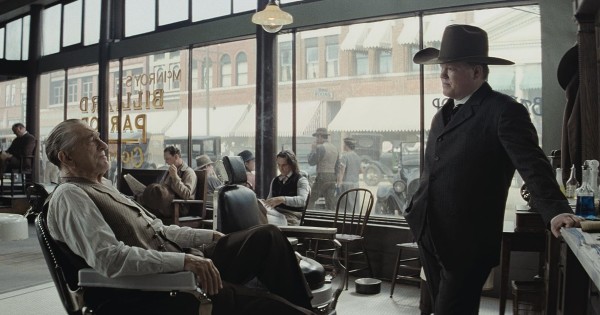 Robert De Niro and Jesse Plemons
The telling of the horrifying story that The Killers of the Flower Moon brings to light is certainly overdue in exposing this long suppressed, and largely unpunished, crime of racial hatred, greed, and colonial violence to American audiences. A set of events that, we are reminded by Donald Fixico, is tantamount to an "invasion," while being a situation that should also make us wonder who might still be benefitting from all that corruption, theft, and murder?
Despite the weight of such concerns, we can still look forward to the day when other accounts of these gruesome events like those produced by John Joseph Mathews, Linda Hogan, and Tom Holm, and so many other horrific occurrences that have been excised from the narrative of American history, can be put forth by a new generation of Native, and especially Osage writers, storytellers, and directors. For in telling their own stories of hurt, grief, and trauma, Native people can also do so comforted by the strength and honor of their ancestors, and with the capacity to share a fuller sense of generosity, grace, and survivance.
