

Of Buffalo and Men


Reading and seeing one’s way through catastrophe and absence in John William’s and Gabe Polsky’s Butcher’s Crossing
Butcher's Crossing, directed by Gabe Polsky, is a grueling cinematic experience. How could it not be given its focus on the theme of buffalo extermination in the nineteenth-century American West, plunging viewers into the depths America's own heart of darkness? Where Joseph Conrad used the example of the Congolese ivory trade to expose the violence and avarice of Belgian colonial agents working on behalf of King Leopold II in his 1899 novel, Heart of Darkness, Polsky’s adaptation of John Williams' novel of the same title, directs his viewers’ focus to the almost complete eradication of the American bison driven by similar forces.
Whenever filmmakers attempt to translate such weighty historical themes to film, as was also apparent in Francis Ford Coppola’s adaptation of Conrad’s novel as Apocalypse Now, the images and visual scenes produced can be deeply unsettling. The historical context Polsky presents in Butcher’s Crossing carries a similar set of narrative challenges in trying to chart the sprawling effects of Manifest Destiny. All this through a novel that in the words of Michelle Latiolais, served not merely as a critique of the romanticism of the western genre, but of “the manic energies underlying westward expansionism,” forming what John Plotz writing in The Guardian labelled an “anti-western.”
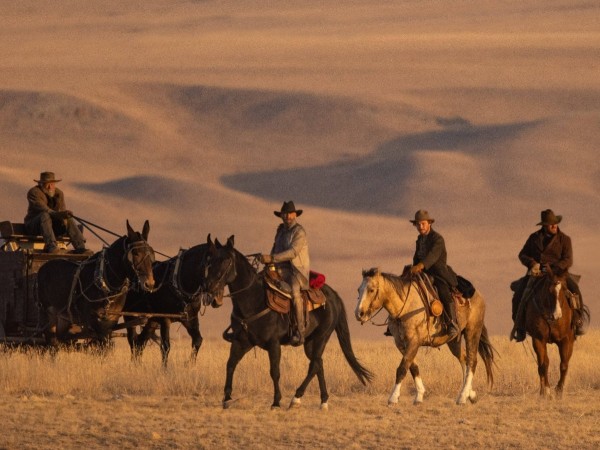
With the publication of Butcher’s Crossing in 1960, Williams—who also founded the Denver Quarterly and was honored with a National Book Award for his subsequent novel, Augustus—challenged many of the conventional tropes that had come to define the classic western. As such, he stands as a forerunner to writers such as Cormac McCarthy, Percival Everett, Annie Proulx, Stephen Graham Jones and Hernán Diaz whose works have been cast (and at times criticized) as “revisionist westerns” for their efforts to provide a corrective to a narrative frame that has been blatantly revisionist since its inception.
While an admittedly slippery term that strains under the weight of historical denialism, I refer here to literary efforts whereby the emergence of previously marginalized or suppressed points of views can provide a means to see and think beyond the mythologized histories that promote dominant ideologies. In terms of the western, such works can act to critique the triumphalism used to bolster imperialism, white supremacy and other forms of oppression that functions to indoctrinate the public with false conceptions of our collective past.
Despite its limited theatrical release on October 20th, Polsky’s film has generated significant critical attention. It certainly didn’t hurt that the release of Ken Burns' two-part series, The American Buffalo premiered on PBS a few days earlier. Either way, Butcher’s Crossing serves as a provocative supplement to Burns’ film, which as Josh Alvarez, writing in Texas Monthly, aptly observed, is not "really about bison" but "the violence that white settlers wrought upon the West."
A similar tone is set in Polsky’s opening sequence depicting Will Andrews’ (Fred Hechinger)—the film’s protagonist—arrival into the landscape of the West. Andrews is introduced as a Northeastern tenderfoot having recently left Harvard seeking “to find a stronger purpose and more meaning in life.” Beyond the vagary of his mission, Polsky makes Andrews’ naiveté apparent through mesmerized reactions to his new surroundings when looking up from his reading of Ralph Waldo Emerson’s Nature, Addresses and Lectures, interspersed with an array of images of the West.
These include historical photographs showing the famous Long Branch Saloon of Dodge City, Kansas and a Turtle Mountain Chippewa and Métis buffalo hunting camp, to a wood engraving of “The Levee at St, Louis,” from Harper’s Weekly, before cutting to a shot of John Gast’s painting, “American Progress,” framed within an advertisement created in the style of the day exhorting readers with the phrases, “GO WEST! | WILD FRONTIER | INDIAN LAND FOR SALE.”

This collection of dramatic images are bookended between a nineteenth-century lithograph of a herd of grazing buffalo and photographs featuring heaps of buffalo hides and skulls that dramatically underscore the destructive effects of westward expansionism and Manifest Destiny.
The prolonged assaults against the buffalo, which Shepard Krech III dates the most intensive being from 1867 to 1884, stands as another dishonorable chapter in America’s history. This atrocious industry, which had pushed the species to the edge of extinction by the end of the nineteenth century, was just another tragic outcome of the malignant conception of human dominion over “every creeping thing that creepeth upon the earth.” So, maybe Radiohead was right after all.
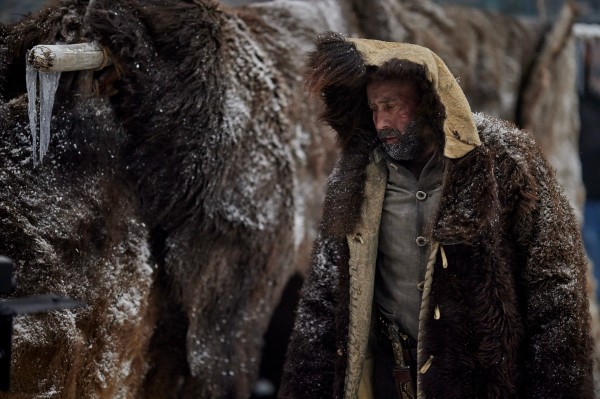
The nature of anthropocentric dominance alluded to is a product of what environmental philosophers and thinkers from Lynn White, Arne Næss, Vandana Shiva and Chellis Glendinning, to Val Plumwood, Robin Wall Kimmerer and Timothy Morton have all identified in differing ways as a distinctly patriarchal, Western and Christian epistemological order. These knowledge structures, and the behaviors they incite, are forcefully rendered through Nicolas Cage’s chilling performance in the co-starring role as Miller, a fanatical buffalo hunter living at the titular West Kansas outpost in 1874. And it is at this desolate place that he is drafted by Andrews’ as his teacher and guide.
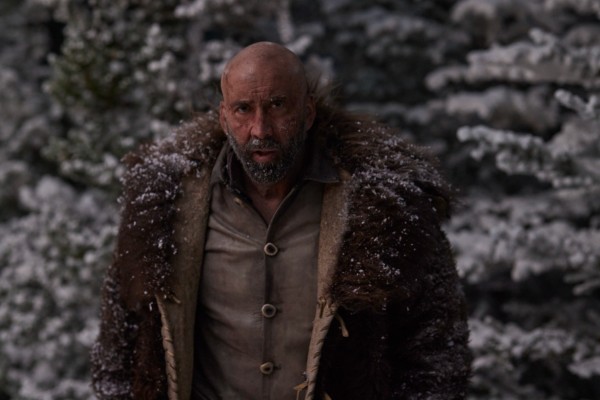
The Emersonian experience Andrews seeks under Miller’s tutelage is driven by the desire to uncover his authentic self through immersion in the wilderness of the West. Paradoxically, the way Andrews wants to go about this goal is by conceptualizing himself as a detached witness reduced to the form of “a transparent eyeball. Gathered in by field and wood,” being “nothing” but seeing “all.” This foolish conception of conscious embodiment, in which Andrews can somehow transcend his inherent interconnectivity with the natural world whilst hunting buffalo, quickly gives way to a searing vision that conjures all the horror of Conrad's meditation on colonial violence and racism, and then some.
General William Tecumseh Sherman offered a particularly revealing statement, drawn from an extensive archive of similar pronouncements, illustrating just how entangled the notion of “progress” became with the violence of the exploration and settlement of the American West. The caustic words Sherman expressed in June 1869 on the connection between buffalo and Native peoples are especially instructive: "the quickest way to compel the Indians to settle down to civilized life was to send ten regiments of soldiers to the plains, with orders to shoot buffaloes until they became too scarce to support the redskins."
Striking a similar tone, General Philip Henry Sheridan’s celebration of buffalo extermination as a tactic crucial to the success of the so-called ‘Indian Wars’ is similarly damning. In a statement from 1875, Sherman went so far as to claim that "these men [buffalo hunters] have done more in the last two years, and will do more in the next year, to settle the vexed Indian question, than the entire regular army has done in the last forty years. They are destroying the Indians’ commissary. Send them powder and lead, if you will; but for a lasting peace, let them kill, skin and sell until the buffaloes are exterminated."
Notwithstanding the emphasis on the interconnection between buffalo populations and Native cultures, and especially those whose territories spanned the Great Plains and the Rocky Mountain West, it is significant that Native people appear in Polsky’s film only as an absent presence.
Although Williams positions Native people in the shadows of his novel, he nonetheless includes numerous direct references to ‘Indians” throughout the narrative. In what turns out to be the novel’s most substantive depiction, Williams includes a fleeting encounter between Miller’s crew and a unnamed group of Native people described as living in dugouts near the river that gave the Smoky Hill Trail its name.
The lack of any direct interaction between Miller and Andrews, now also accompanied by the wagon driver and “camp man,” Charlie Hoge, with Fred Schneider filling the role as the skinner, increases the tension of the scene. As Miller notices the group’s presence, he dismissingly refers them as “River Indians,” before the narration shifts to some Native children who look back “at them with dark, liquid eyes.” Denied the means to present any details of their own experiences or history, their spectral presence nonetheless positions them as uncanny witnesses to an enduring sense of Native cultural survivance within a world transformed by the blood and fire of settler colonialism.
The chilling words Miller “contemptuously” utters at the scene’s close takes this line of thought further. In a disturbing substantiation of the genocidal context Williams steeps the narrative in, which also serves as a reminder of the unspeakable issuance of scalp bounties that blight the colonial histories of America and Mexico, Miller casually observes, “they ain’t worth shooting anymore.”
It's a vile remark that discloses the economics of murder at the root of a litany of horrors perpetrated throughout the American West since the arrival of the earliest Euro-American settlers. This includes a long line of people, some of whom honored as statesmen and military heroes, that Acoma Pueblo poet Simon Ortiz identifies in his collection, from Sand Creek, as those who “splattered blood/ along their mad progress;/ they claimed the earth/ and stole hearts and tongues/ from buffalo and men . . .”
Through Ortiz’ poetry, readers are confronted with the reality of the Sand Creek Massacre that took place on November 29, 1864. Infamous in the annals of the American West, this massacre was directed by the Methodist minister and Army Colonel, John Chivington and, in the words of his fellow Methodist, Colorado Territorial Governor, John Evans, “ridded the plains of the Indians.” That these horrific deeds overlap the timeframe of the “Fall of ’64,” which Miller gives in the film for his discovery of a large herd buffalo in a valley within the Rockies of Colorado that “no man had ever seen before,” is no mere coincidence.
The large-scale removal of the Cheyenne and Arapaho that this atrocity precipitated, which itself grew out of the refusal of government officials such as Evans, along with a large number of the settlers to the territory, to acknowledge the basic rights and humanity of Native peoples already living in Colorado, is made explicit in Williams’ novel. This occurs in the disclaimer Miller provide when speaking on the exceptional nature of the herd he claims to have discovered. After implying he’s the only one who knows of them, he corrects himself, stating, “maybe some Indians a long time ago, but no man.”
In the world Polsky recreates, however, one of the few places Native people can be seen as existing alongside settlers occurs in a scene where the buffalo hunters arrive at a remote outpost that appears to be abandoned. The scene becomes more ominous as Miller and his companions approach the door and discover the resident trader’s body—a rack of antlers positioned upon him. Although they all stand silent before the grisly scene, within the film’s broader context the display is taken as an indication of the unseen presence of Native peoples who continue to stalk the land.
Later, when the hunting party finally arrives at their destination in the isolated valley Miller had promised, they are met with another reminder of human habitation in a circle of campfire rocks. Miller, though, ever the pied piper of erasure, refuses to acknowledge this evidence as a sign of any enduring presence or claims to the land, and instead, fancifully characterizes it as an “Indian burial ground.” Thus, what is clearly the remnants of a previous Native encampment gets blithely modified into another emblem for an absent Native presence.
In Miller’s evocation of this well-worn horror trope, Native peoples are relegated to an irrecoverable past that co-exists primarily within colonial settler culture as a haunting presence. This is similar to the use of the Indian burial ground trope featured in films including, The Amityville Horror, The Shining, Pet Sematary and more recently, The Darkness, but not Poltergeist as often believed. As a vector of hegemonic knowledge the trope’s strongest effect, perhaps, is in how it operates to deflect, obscure and erase colonialist culpability from the violence and destruction perpetrated against Native cultures, often in the name of civilization.
For his part, Hoge has already gone about spreading strychnine over the site, which he uses as “wolf poison”—a continuation of centuries-long efforts to eradicate North American wolf populations and another analogue to the genocidal patterns the film reveals. Even when Miller acknowledges a Native presence in saying, “Indians have been hunting these here buffalo for ages,” he can’t help but to negate their relevance, forcing them into an irretrievable past as he continues, “the times are a changin’.”
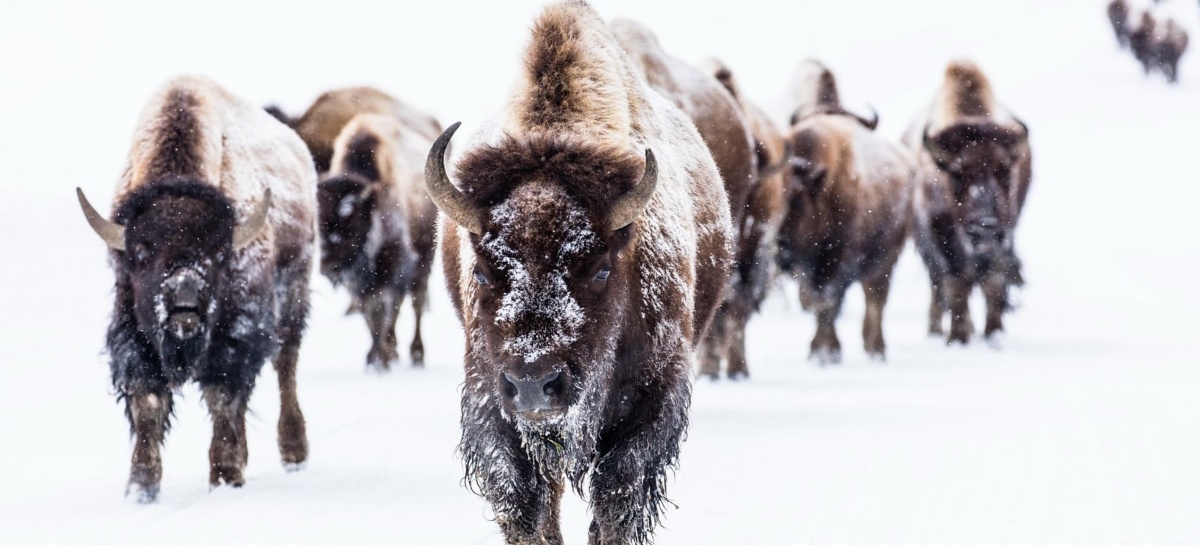
As a means of subverting examples such as these in his film, Polsky selected the lands of the Blackfeet Nation in Montana as the filming location for the depictions of the Colorado Rockies. Moreover, the actual buffalo featured in the film, which Miller and his crew slaughter and skin in the pivotal scenes beginning with their Autumn arrival in the valley, extending “six months” to the next Spring, were those that make up the Blackfeet's herd. Viewers are given this detail explicitly via screen text that appears before the credits at the film’s end, providing a message of solace against the grim events the film bears witness to, and which, despite their brutality, did not spell the end of the buffalo nor the Native peoples that relied upon them.
The utilization of Native land and the inclusion of buffalo under the nurturing care of the Blackfeet Bison Project in the film, can thus be seen as an implicit observance of Native cultural survivance. The sense of cultural persistence displayed in this context also extends to the buffalo themselves as a species—on a spiritual level and as relatives—in the face of the devastation wrought by mass extermination and the broader military campaigns that it paralleled throughout the latter half of the nineteenth century.
Given Polsky’s directorial choices, the lack of a physical Native presence in the film does not have to be seen as playing into those outdated narratives of tragedy and victimry. Instead, they can be more effectively read as an allusion to the popular figure of the "vanishing Indian," serving the dual purpose of a tragically propitious myth at the time.
The phantasmagoric journey Miller, Andrews, Hoge, and Schneider take viewers on as they become lost in America’s own heart of darkness culminates with Miller’s killing of what they claim to be 4500 buffalo over several weeks. Although Polsky refrains from the use of graphic images in the film’s depictions of the relentless hunt, which, if displayed, would simply be overwhelming, seeking instead to invoke the audience’s own sense of revulsion at the foreknowledge of this senseless slaughter.
The burden of this history makes the film’s revelation of what happens to the product of the buffalo hunters’ gory deeds seem almost an afterthought, as viewers have no doubt already been forced to wrestle with the selfishness and cruelty at the core of this quintessentially American environmental and ethnocidal catastrophe. In speaking through the inescapable absence and the unmistakable presence of the buffalo in both Williams’ and Polsky’s renditions of Butcher's Crossing, we are offered a means of escape from the tyranny and despair of what often seems an unspeakable past, with a passage into the life and intensity of new tomorrows.
