

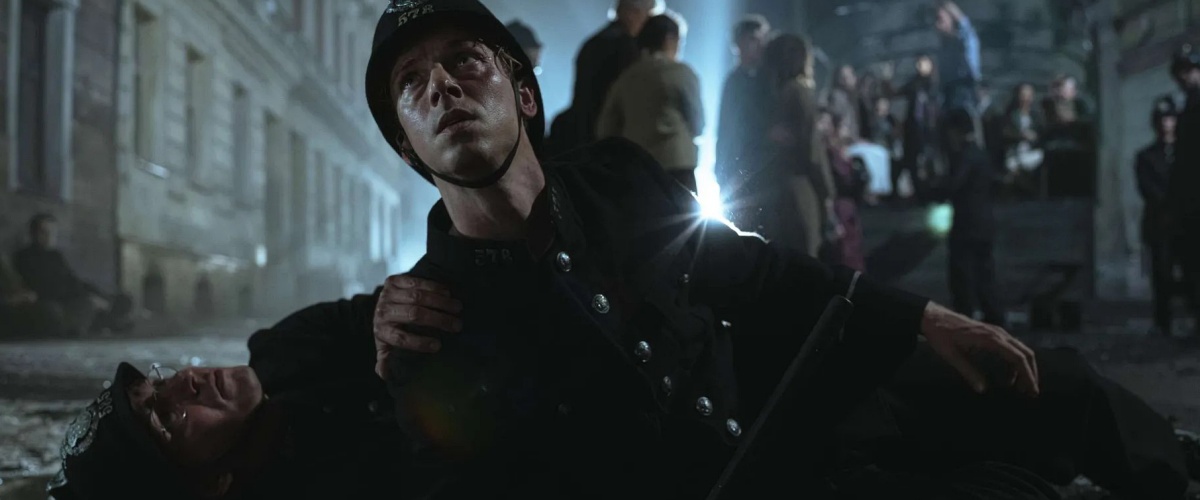

The chief victims of the Antwerp occupation were the port city’s Jews, the largest concentration of that minority group in any Belgian city.
If you’re occupied by a foreign power—as so many European countries in WW2 were by Nazi Germany—what moral choices do you make? Do you risk your life and possible torture by joining the resistance? Or do you cooperate with the German soldiers? Or do you try to steer a course somewhere in between?
About a 72-episode “French Village” series aired six years ago I wrote, “Never having lived under military occupation by a hostile foreign power, most North Americans have little appreciation for how complex everyday life could become under such conditions. Although most people would like to think that they would resist the Nazi invaders and not cooperate with them in any way, the reality for occupied peoples—under the Germans or other occupiers—was usually much more varied. FV [‘French Village’] depicts this well. Some collaborated; some cooperated partly; only a small minority engaged in active resistance.”

The new Belgian film “Will” (also sometimes referred to as “Wil”), which in early 2024 won seven awards, reflects the same ambiguity. At one point, Will hides a Jewish family, and he aids the Belgian Resistance. On another occasion, he helps his fellow policemen round up Jews from their homes, including children, and load them up on trucks, sending them off to some unknown fate. (See below on three such roundups in the summer of 1942.) At the beginning of the film (in earlier 1942), he is a new recruit of the Antwerp police force, and its main job during the German occupation of the city (mid 1940-Sept. 1944) was to aid German military rule.
At the beginning of the movie, Will’s voice says, “They say history is important. . . . But nobody knows what history really is.” He reflects that after World War II, people would make various comments, pro and con, about you being a policeman in the war. “People are judgmental,” he concludes. Yet “it's always after the fact. But if you're in the middle of it, if you don't know what tomorrow will bring, and nobody knows that, not you, not me—well, then maybe you don't know shit.”
Will is right: “People are judgmental.” They too easily conclude that they would never have helped Nazi occupiers—or they never would have seized lands from Native Americans or held slaves.
Will is right: “People are judgmental.” They too easily conclude that they would never have helped Nazi occupiers—or they never would have seized lands from Native Americans or held slaves. But they do so without adequately considering all the concrete specificities. They do so without sufficient empathy, without ingesting the social, historical and psychological details that would enable them to see the world through a past person’s eyes. Only after absorbing such details can one then make an imaginative leap to the past and guess how one might have acted—but even then, we can’t be sure.
The chief victims of the Antwerp occupation were the port city’s Jews, the largest concentration of that minority group in any Belgian city. In 1940, near the beginning of the German occupation they numbered about 55,000, up from about 35,000 in 1927, largely due to an influx of German and Austrian Jews after Hitler came to power in 1933. But thousands of Belgium’s Jews fled to France (which fell about a month later than Belgium) in the weeks after German troops crossed into Belgium.
Most of those Jews who remained lived and worked in the “Diamond district,” a square-mile area near the main shopping street of Antwerp. Although the city had been involved in the diamond trade since the 15th century, by 1880 the number of Jews in the city still only numbed about 1,000. The large increase in the next half century was due mainly to East European Jews fleeing persecution, including pogroms, and poverty.
According to one Jewish source, “in mid August 1942, 845 persons were arrested by the Nazi occupiers and their Belgian helpers” and sent away. It was the first of three such round-ups “in summer of 1942, which led to the deportation of 4,000 Antwerp Jews to the death camps. Local authorities had played a supporting role in the round-up of Jews.” (By mid November 1942, 15,000 Jewish men, women, and children had been deported from all of Belgium.) By the time the Nazi occupation ended in September 1944, only about 1,200 Jews remained in Antwerp. Many of those rounded up and taken away ended up dying in the “death camps.”
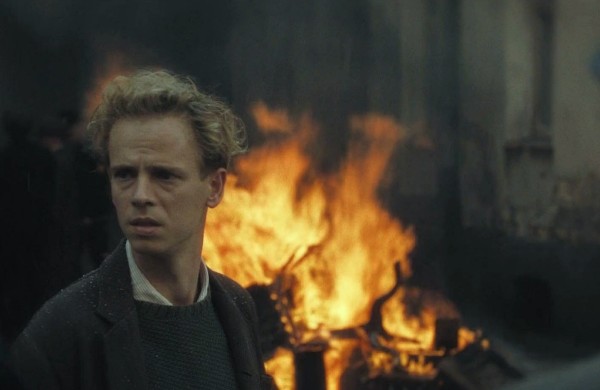
Although many Antwerp citizens were “tolerant of the Jewish presence,” others were not. The film depicts some gentile city residents just curiously watching the desecration of a Jewish synagogue and the violence being perpetrated on those driven from it. Even worse, it displays a scene inside a movie theater where many Belgian citizens view a film that compares Jews to rats. Then a Belgian grabs a microphone and further degrades the Jews. Almost all of crowd rises and cries out, “Jews out.”
Subsequently, they head to ransack a Jewish synagogue and attack its attendees. They are led by a man named Felix, who is an older acquaintance of Will. He had earlier claimed to be an “idealist.” But he told Will, “I feel that through history we've allowed the Jewish nation to degrade our art.” And he talks of Belgium being “freed of the Jews.” He later urged Will to kill three members of a Jewish family, whom Will had been hiding, but while Will is wavering one of the Jews attacks and kills Felix, and Will later helps the Jewish family catch a train to Brussels.
A German officer named Gregor takes an interest in Will. After showing him some tortured Belgium resistance fighters and punching Will, he tells him that if he helps him he’ll see to it that Will and his family survive.
Meanwhile, Will has become romantically (and sexually) involved with Resistance member Yevette, who is the sister of his policeman partner, Lode. Toward the end of the film Will tells her about an upcoming raid on a Jewish neighborhood, but that Gregor wants him and the Resistance to pass on false information regarding which neighborhood will be raided. But Yevette says to Will that she couldn’t do that. “I could never ever forgive myself.” To which Will responds, “This is about survival. Conscience is a luxury.” Yevette asks him, “Is that what you'll tell your child?” And adds, “I’d rather die.”
A little over a decade ago a Jewish source noted that the Antwerp mayor said that the Belgian city authorities during the occupation had lacked “responsibility, courage, force and a moral compass.” This same source quoted a speech from the president of Belgium’s Jewish religious umbrella body. He asked, “How do we live and act to prevent genocidal crimes?”
He recalled that the Holocaust was carried out not only by Nazis but “by impeccably tidy public servants and armchair intellectuals, goaded and poisoned as they may or may not have been by contemporary media, because hate seems to be more contagious than brotherly love.” He acknowledged a minority, who like the Resistance “were willing to take the greatest risks to save lives.” But “in the meantime [there was] a more populous group of official and private accomplices [who] were ideologically and opportunistically conspiring in degrading vicious acts while the majority remained at the sidelines watching the persecuted being chased into the gutter.”
For us today in various countries we can only speculate which grouping we might have joined. In a recent review of Hulu five-part series “Deutsches Haus,” I indicated that we might hope that we would have acted nobly, but who knows? It all comes down to values. Will they be like Will’s, who says “Conscience is a luxury," or like Yevette’s who would rather die than mislead Antwerp’s Jews. As one source has noted, “Human value priorities . . . stand out as the most strategically powerful causal control now shaping world events. More than any other causal system with which science now concerns itself, it is variables in human value systems that will determine the future.”
In the USA, amid a pivotal presidential election year, it is not yet clear what our national “human value priorities” are. We can only hope, to use words Lincoln once said, that come November we reveal the “better angels of our nature."
