

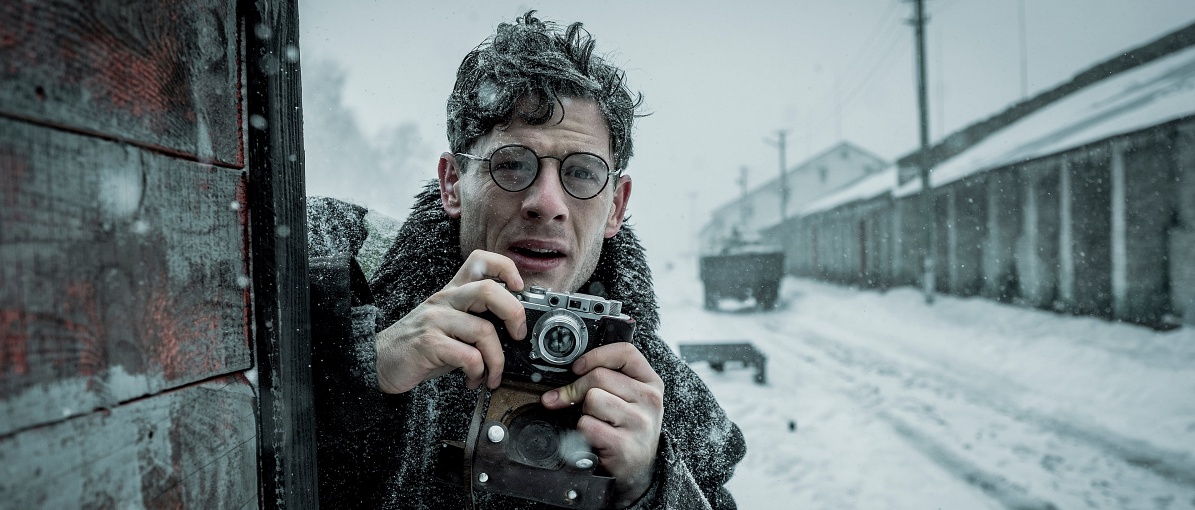

One of the most horrifying parts of Mr. Jones is the depiction of famine suffering and death as seen through the eyes of Jones, who travels to Ukraine in early 1933.
I recently viewed Mr. Jones (2019) on Amazon Prime. It is based on actual events that occurred in 1933 and is just one indication that “fake news” is nothing new, whether coming from the Right or Left.
The film’s main character, Gareth Jones, is played by an excellent James Norton, who appeared as an English vicar in the first few seasons of the PBS Masterpiece series “Grantchester.” Jones is a Welsh reporter, and most of the film is set in the USSR in 1933. His chief non-Soviet rival is The New York Times journalist and Moscow bureau chief Walter Duranty, who had received a 1932 Pulitzer Prize for his earlier reporting. Peter Sarsgaard, who had appeared in the Hulu series “Dopesick” as one of the “good guys,” here convincingly portrays Duranty as a spewer of false information regarding the USSR and its famine of the early 1930s.
 James Norton
The film (Mr. Jones) reminded me that a Russian attack on Ukraine and “fake news” was nothing new. “Reminded” not discovered, for already in 2005 I had written, “Stalin was also mainly responsible for a famine of 1931–1933 that killed millions of additional people, a famine he refused to acknowledge publicly or seek foreign help to alleviate….Many Ukrainians perceive it as a ‘terror-famine,’ famine-genocide, or Holodomor (a unique term emphasizing the Ukrainian suffering and mass starvation of 1932–1933) and believe it resulted almost entirely from Stalin’s collectivization policies and hostility to the peasants and Ukrainians, who suffered a disproportionate number of deaths.”
After indicating some scholarly difference about the exact causes of the debate, I added, that it “is overshadowed by the inconceivable suffering, which all scholars admit occurred, and which the writer Vasili Grossman….described well in his novel Forever Flowing”: “Everyone was in terror. Mothers looked to their children and began to scream in fear. They screamed as if a snake had crept into their house. And this snake was famine, starvation, death….Only famine was on the move. Only famine did not sleep. The children would cry from morning on, asking for bread. And what could their mothers give them—snow? And there was no help. The Party officials had one answer to all entreaties: ‘You should have worked harder, you shouldn’t have loafed.’”
One of the most horrifying parts of Mr. Jones is the depiction of famine suffering and death as seen through the eyes of Jones, who travels to Ukraine in early 1933. The film, directed by the Polish director Agnieszka Holland, does pretty well depicting some of the suffering that Grossman described and part of which Jones himself wrote about later in 1933: “In almost every village, the bread supply had run out two months earlier, the potatoes were almost exhausted, and there was not enough coarse beet, which was formerly used as cattle fodder, but has now become a staple food of the population, to last until the next harvest. Many cottages had not even cattle fodder, and the peasants assured me that the occupants of those cottages were dying of hunger. In each village I received the same information–namely that many were dying of the famine and that about four-fifths of the cattle and the horses had perished….One word was drummed into my memory by every talk. That word was ‘golod’ – i.e., ‘hunger’ or ‘famine.’ Nor shall I forget the swollen stomachs of the children in the cottages in which I slept.”
Granted that deliberately starving millions of Ukrainian peasants in 1932-33, as well as countless others in regions such as the North Caucasus, Kazakhstan, and the Volga area, is not the same as Russian aggression against Ukrainians in 2022-23, the earlier policy of Stalin could still be considered an “attack.” Especially since Stalin was particularly hostile to Ukrainians. (As I earlier wrote, “In 1930, forty-five intellectuals were charged with belonging to a Union for the Liberation of Ukraine. During the next several years, more Ukrainian groups came under attack—for example, its Academy of Sciences, its Orthodox Church, and its Communist party….In August 1937, amidst the Great Purge, Stalin sent Molotov and Ezhov to Ukraine to wipe out what he considered the remnants of Ukrainian ‘bourgeois nationalism.’”)
Moreover, although admitting some of Stalin misdeeds, Putin has been less critical of him than either of his two predecessors, Gorbachev or Yeltsin; and in his dealings with Ukraine he has, as The Washington Post indicated last October, resurrected at least “one of Stalin’s tactics in Ukraine.”
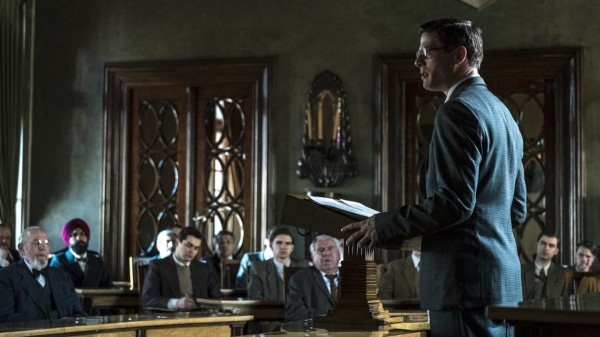
In addition to portraying some of the horrors of starving people to death–one scene depicts bags of grain headed for Moscow being loaded on a truck while hungry Ukrainian people look on–Mr. Jones emphasizes the dishonesty of Duranty and how he tried to discredit Jones’s honest reporting about the famine. At one point Jones says, “I don't have an agenda. Unless you call truth an agenda. The truth. There is only one kind. Journalism is the noblest profession. You follow the facts, wherever it leads. You don't take sides.”
 James Norton
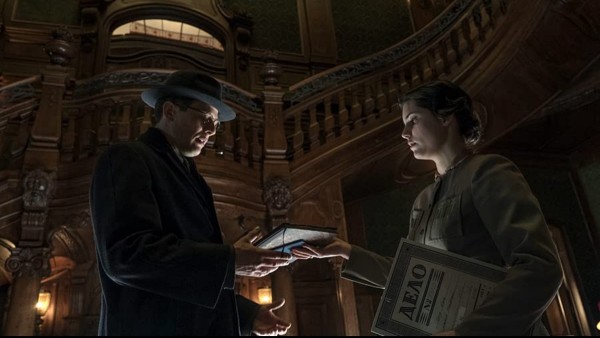
Duranty’s motivation? It is hard to be certain. The film has him say, “My dear Mr. Jones: There comes a time in every man's life when he must choose a cause greater than himself, than all his miserable little ambitions put together.” On another occasion, he defends Stalin’s policies by telling Ada Brooks, an apparent fictional female journalist, “You can't make an omelette without breaking a few eggs. What's being done here will transform mankind.” In his The Fellow-Travelers, David Caute lists Duranty as one such supporter of many of Stalin’s policies. About this group the author writes, “They heartily welcomed the torments and upheavals inflicted on the Russian peasantry during collectivization, arguing that only by such drastic social engineering could these backward illiterates be herded, feet first, into the modern world.” Such fellow-travelers reflected a reality that existed in the 1920s and 1930s–leftists who downplayed the brutalities of the Soviet regime, including the taking of human lives, because they believed that Soviet communism was a progressive force.
But there is another explanation, or at least a partial one for Duranty’s support for Stalin. At one point, Ada Brooks says to Duranty, “Along with whatever else the Kremlin has on you.” Another writer, this time a real-life one, Robert Conquest adds substance to her Kremlin-has-on-you remark by writing that Duranty “seems to have been blackmailed on sexual grounds by the secret police.” (One scene in the film, a party hosted by Duranty with some semi-nude guests, suggests he was amenable to sexual permissiveness.)
Conquest’s earlier book The Harvest of Sorrow (1986) had been one of the first to identify the famine of 1932-33 as a “terror-famine” primarily victimizing the Ukrainians. But it was perceived by some on the Left as reflecting a right-wing and pro-Ukrainian bias.
Whatever Duranty’s exact motivations, Mr. Jones suggests that political bias has not been limited to the Right, despite the fact that Donald Trump has been the most prominent recent dispenser of falsehoods. (Former Arizona Senator Jeff Flake stated, “2017 was a year which saw the truth—objective, empirical, evidence-based truth—more battered and abused than any other in the history of our country, at the hands of the most powerful figure in our government. It was a year which saw the White House enshrine ‘alternative facts’ into the American lexicon, as justification for what used to be known simply as good old-fashioned falsehoods.)
 James Norton and Vanessa Kirby
But the public falsifying of reality, the lack of respect for truth, didn’t begin with Duranty–although it did seem to reach new presidential heights with Trump–it was already much in evidence earlier in another character that appears briefly in Mr. Jones–William Randolph Hearst (1863-1951), the most influential newspaperman of his day. Near the end of the film, after The New York Times and other papers had discredited Jones’s reporting on the famine, he is able to persuade Hearst to publish his (Jones’s) more accurate depiction of that tragedy. But it was not because of Hearst’s great respect for truth.
As one reviewer of a biography on him wrote, “his papers baldly submerged fact with fiction,” and “his papers lied like a rug.” And this was important because by “the 1930s, one in four Americans got their news from Hearst, who owned twenty-eight newspapers in nineteen cities….Without a doubt, he deserves considerable blame for much of media’s fixation on goals, from political motives to profits, other than pursuing truth.” After Hearst came out in opposition to Franklin Roosevelt (who began his presidency in 1933, the same year Jones travelled to Ukraine) FDR said “there was no man….as vicious an influence as Hearst.”
Hearst, Duranty,Trump–the media falsifying reality, not respecting truth, lying, has apparently gotten worse in our Internet age, but it is certainly not new. Yet, as Hannah Arendt pointed out in her essay “Truth and Politics” (1967), truth possesses a stubborn staying power that lies lack. Among those who often defend truth, she mentions reporters. And while Duranty was not such a reporter, Mr. (Gareth) Jones was. Arendt also includes historians among those who sometimes stand up for truth. And, indeed, “Tell the truth” should be as central to our mission, as “First, do no harm” is to doctors and nurses. Sure, we all have our biases, but it is a prime responsibility of historians to minimize their effect on our perception of past realities. One of the positive attributes of Mr. Jones is that it reminds us of this truth.
