




Oppenheimer’s tragedy of playing a major role in a developing arms race stemmed primarily from his being human, and as the poet Alexander Pope once wrote, “To err is human.”
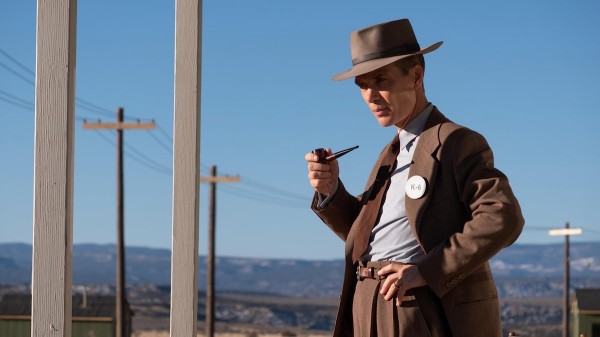
After watching “Oppenheimer,” which just recently became available on Peacock, I decided to write a review. But after a quick check I realized that others on Hollywood Progressive had already written about this film staring Cillian Murphy as Oppenhimer. One of them by a leftist activist was entitled “Oppenheimer: A Revolutionary Fighting Inside a Reactionary System" (hereafter OR), which declared, “This essay is an interrogation of the history of the times.”
As a professional historian, who taught university history courses for four decades and authored a few history books, I thought my reflections on the Oppenheimer film and its fidelity to “the history of the times” might be useful.
OR is correct that the film omits several topics—one, for example, that would interest progressives is what the author refers to as the “all white” treatment of Los Alamos, New Mexico, where most of the Oppenheimer’s testing of the Atomic Bomb occurred. The film, in OR words, “did not in any way challenge the racism of the times or even show Black, Indigenous, or Chican@ characters who did exist—such as the 2,000 Indigenous and Latinx support workers at Los Alamos. Why was New Mexico segregated?” To partially correct that omission, OR usefully refers readers to the article, “Doctor Atomic’ & Nuclear Colonialism in Northern New Mexico: A Tewa Perspective.”
OR also faults the film for not showing any of the Hiroshima or Nagasaki “scenes of the death, dying, deformities, excruciating pain, and trauma” of the Japanese people. “How in the world,” it asks, “could he [director Christopher Nolan] not show scenes of obliterated bodies on the ground, children and adults screaming, or pictures of entire communities 5 years later suffering the aftershocks.”
Defending its fault-finding OR continues, “There is no such thing as ‘history.’ There is only the struggle over historical interpretation.” And without such an interpretation, or “worldview, how can you evaluate a film’s historical accuracy.”
History should not be thought of primarily as a tool or cudgel to be used in besting our ideological opponents. No, it should be mainly a means of discovering truth about the past.
The problem I have with this approach is the same one I have with that of right-wing critics’ disapproval of correcting our acknowledgment of our racist past—it too easily sacrifices truth on the alter of ideology. History should not be thought of primarily as a tool or cudgel to be used in besting our ideological opponents. No, it should be mainly a means of discovering truth about the past.
Still another HP article on the Oppenheimer film is entitled “Oppenheimer: Primum Non Nocere.” The three Latin words in the subtitle mean “First Do No Harm,” and the article states that the words indicate “the essence of the torment of J. Robert Oppenheimer.” In a 2020 essay on the History News Network website I also quoted these ancient words, but in an admonition to my fellow historians: “‘Tell the truth’ should be as central to our mission, as ‘First, do no harm’ is to doctors and nurses.”
Telling the truth means trying to reach beyond our biases, whether of the Left or Right. And professional historians have long recognized that that remains one of our chief obligations. But in the OR review, ideology seems to motivate its declarations more than any search for unbiased truth.
I have no opposition, and indeed considerable admiration, for leftist activists. But when they write history, they must too (at least in my view) strive for objectivity, i.e., keep their biases—we all have them—on a tight leash.
Another leftist activist, but this time also a historian, had written an earlier HP review entitled J. Robert Oppenheimer’s Tragedy―and Ours,” but it did not question the historical accuracy of the movie. And in an earlier article on reconciling history and activism its author had written, “Another complication has to do with objectivity. As a teacher and a writer, I am determined to be fair and impartial. But I don't always feel like being fair and impartial. And so there is always a bit of an internal struggle when, for example, I grade a student paper that glorifies the atomic bombing of Hiroshima. Even so, I scrupulously avoid letting my political views affect my grading and interactions with students, and lean over backwards to be civil to those who don't share my values.” Note that he strives to be “fair and impartial” not only as a teacher, but as a writer (of history and on other subjects).
In contrast, the OR review makes a number of statements that seem driven more by ideology than by a search for truth. For example, “The United States and Franklin Delano Roosevelt [FDR] were never anti-fascist, and in fact, tried to co-exist with fascism in an anti-communist bloc until the Japanese attacked Pearl Harbor on December 7, 1941.” And the “central historical distortion of the film” was the director’s “conscious choice to erase the central objective of the Nuclear program—to build a weapon of terror to be used against the Soviet Union.” Moreover, “with the defeat of Germany by the Soviet Union, the U.S. was planning a world war against communists and the Soviet Union.”
To state that FDR tried to “co-exist with fascism” until December 1941 simply goes too far. All the credible experts on FDR—take, e.g., Robert Dallek—would disagree. In fact, FDR was criticized by isolationists like Charles Lindbergh for wanting to lead us into a war with Germany. Furthermore, while the “central objective of the Nuclear program” might have eventually transitioned away from defeating Germany, in its early stages it was not intended to be “a weapon of terror to be used against the Soviet Union.” Nor is there any credible evidence, as OR states, that “with the defeat of Germany by the Soviet Union, the U.S. was planning a world war against communists and the Soviet Union.”
Besides such unsubstantiated claims, there is the whole question of the differences between historical works and fictional ones, whether in books, movies, or TV. Although all media should aim at some sort of truth-telling, fictional portrayals may exercise some artistic freedom, and such freedom is an important value.
One such freedom—for example, in adapting a book for a movie—is that of choosing what topics to include and which to omit. Even in pure historical works, authors have some discretion in this regard. One might validly argue that a historical work dealing with USA voting rights should not ignore the effects of pre-1960s segregation in the South. But in over a hundred book reviews, I generally limited my criticism to what a book included, rather than what it left out.
Besides allowing for insufficient directorial freedom, the OR review ignores the central point of the film. It is captured in the subtitle of the historical work it is based on—American Prometheus: The Triumph and Tragedy of J. Robert Oppenheimer—and by the title of another HP review mentioned above, “J. Robert Oppenheimer’s Tragedy―and Ours.” Tragedy. Tragedy, as in Prometheus Bound, by the ancient Greek dramatist tragedian Aeschylus. Oppenheimer’s tragedy was by developing the atomic bomb and supporting its use, originally against Germany but then against Japan, he played a major role in a developing nuclear arms race. But he then bemoaned this race. However, his efforts, rather than succeeding, just alienated him from the U.S. government. In the mid 1950s, he was denied a security clearance and discredited. (Also part of his tragedy, but the film never develops it except to show him often smoking, was that he died when he only 62 from throat cancer brought about by his chain smoking.)
In a History-News-Network essay of 2016, “Historians Need to Write and Teach with Empathy,” I quote favorably the words “history cannot be scientifically written unless the historian can re-enact in his own mind the experience of the people whose actions he is narrating.” To be empathetic is not the same as being sympathetic or justifying past behavior, but it does mean trying to understand it.
Oppenheimer’s tragedy of playing a major role in a developing arms race stemmed primarily from his being human, and as the poet Alexander Pope once wrote, “To err is human.” But to fully understand Oppenheimer’s tragedy, like understanding slavery, we have to try to understand how many people of that time felt. To most Americans, winning the war against Japan was the main goal after Germany’s surrender in May 1945. Earlier in March, most U.S. citizens supported the firebombing of Tokyo, which killed more people than were later killed in August by A bombs in either Hiroshima or Nagasaki.
Only later, did an increasing number of U.S. citizens (including Oppenheimer), but certainly no majority, think the U.S. should exercise much more restraint in its nuclear development plans. In the early 1950s, the U.S. was still mired in the McCarthy anticommunist era, and in his deep concern about ending the arms race between the USA and USSR, Oppenheimer was “ahead of his time.”
From the “Oppenheimer” film, viewers can learn much about the period from the late 1930s to the mid 1950s. There’s the role of Jewish scientists, including the American-born Oppenheimer and some Jewish immigrants such as Leo Szilard and Edward Teller, which reminds us of how Hitler inadvertently furthered the dream of Frederick Douglass in helping the U.S. become a more “composite,” multiethnic nation.
We also learn about the scientific revolution ushered in by scientists, not only Oppenheimer but earlier Albert Einstein, Niels Bohr, Werner Heisenberg, etc. And Oppenheimer’s view that that revolution is connected to a larger one—as he says in the film to a colleague, “You embrace the revolution in physics, can’t you see it everywhere else? Picasso, Stravinsky, Freud, and Marx.”
In Oppenheimer’s support of the anti-Franco forces in the Spanish Civil War of 1936-39, we see mirrored the attitude of many U.S. leftist intellectuals. And in his sympathies but later disillusionment with the Soviet Union--though he never joined the Communist Party—we see a reflection of that phenomenon that Louis Fischer depicted in The God that Failed, which treated writers such as Richard Wright.
The movie’s treatment of the political atmosphere in the 1940s and early 1950s is also fairly accurate. Truman (Gary Oldman) is seen in the film, and comes across as sufficiently “cold warish.” The role of Robert Strauss (Robert Downey Jr.), aided by the McCarthyite spirit of the times, in helping eventually bring down Oppenheimer reflects the era’s reality.
In an article about the film in Slate, we read that “the entire film is an experiment in immersion, an attempt to make us feel what it’s like to be Robert Oppenheimer, and it succeeds to a remarkable degree.” For a Hollywood movie to help us empathize with the mind of an individual as complex as Oppenheimer, a man who died more than a half-century ago, is no small achievement.
