


Looking at our present time of renewed racism, racial antagonism seems more likely than it has for decades.
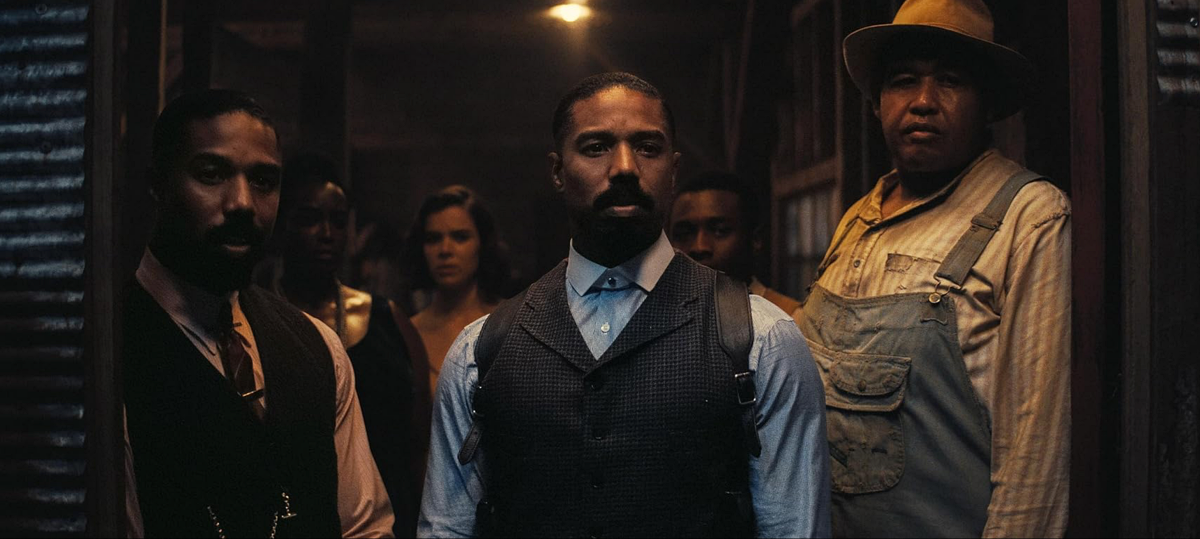
The film Sinners (now on HBO), directed by Ryan Coogler, is on many critics’ top ten list for 2025–Manhola Davis of The New York Times has it as her number one choice. Coogler’s first notable film was Fruitvale Station (2013), which stared Michael B. Jordan, who, playing twins, is also the star of Sinners. After his 2013 film, Coogler directed the Rocky series spinoff Creed (2015 and also staring Jordan), as well as a few Black Panther films (2018 and 2022).
His new movie begins in October 1932, and within the first few minutes we are introduced to sharecropper Sammie (Miles Caton) and his father, who is conducting a religious service in his church, which is located in Clarksdale, a Mississippi town in the northwest of the state. We also first meet Jordan’s identical twins, Smoke and Stack, who have returned to their hometown after 15 years, mainly in Chicago.
For a little over a half hour of this two-and-a quarter-hour film, it seems like a well-done realistic one, but then Smoke meets Annie (Wunmi Mosaku), a former lover who is also a practitioner of Hoodoo. According to Wikipedia, “Hoodoo is a set of spiritual observances, traditions, and beliefs—including magical and other ritual practices—developed by enslaved African Americans in the Southern United States from various traditional African spiritualities and elements of indigenous North American botanical knowledge.”
From meeting Annie until the end of the movie, we move further and further away from a realistic approach to one that relies increasingly on Coogler’s imagination and symbolism–he wrote, as well as directed, the film. But the combination of realism, imagination, and symbolism works well and point to important truths.
To begin with, there is the portrayal of Clarksdale in the early thirties and the twins absence from it in the previous 15 years. Early in the Wikipedia article about this city we read that “many African American musicians developed the blues here and took this original American music with them to Chicago and other northern cities during the Great Migration.”
The blues and music generally are important topics in the film, and it often features scenes of singing and dancing. Although we are not introduced to Annie until later on, her wise words are the first ones the movie conveys to us: “There are legends of people...born with the gift of making music so true...it can pierce the veil between life and death.Conjuring spirits from the past and the future. In ancient Ireland, they were called Filí. In Choctaw [a Native American tribe once centered in Mississippi] land, they call them firekeepers. And in West Africa...they’re called griots. This gift can bring healing to their communities...but it also attracts evil.” (Sammie’s father, the preacher Jedidiah, tells his guitar-playing son, “You keep dancing with the devil, one day he’s gonna follow you home.”) (All film quotes are taken from the filmscript.)
The mention of “The Great Migration,” of which the twins were a part (engaged in part in illegal activities), also reflects reality. According to a history website, “the relocation of more than 6 million Black Americans from the rural South to the cities of the North, Midwest and West from about 1916 to 1970 was driven...by unsatisfactory economic opportunities and harsh segregationist laws.” Many “Black Americans headed north...began to build a new place for themselves in public life, actively confronting racial prejudice as well as economic, political and social challenges to create a Black urban culture that would exert enormous influence in the decades to come.”
The “racial prejudice” that characterized much of the South was on full display after the Northern-imposed Reconstruction period ended in the late 1870s. By 1875 conservative white Democrats regained control of state government and before too long passed Jim Crow laws, including segregation of public facilities. Although in 1860 there were three times as many slaves as whites in the the county in which Clarksdale was located, by the final decades of the nineteenth century, many Black families worked as sharecroppers or tenant farmers,” especially in cotton fields–as was the case with the twins’ cousin, the guitar-playing Sammie.
The plight of Blacks in Clarksdale continued to be substandard throughout the first half of the century and into the early 1960s. There, in that city in 1919, a Black man was suspected of having a relationship with a White woman and was lynched. Like Smoke, he was a veteran of World War I–Smoke also had an intimate relationship with a woman, Mary (Hailee Steinfeld) who appeared White, but admitted that “my mama’s daddy was half Black. He raised her to keep the Klan from killing her.”
In the USA, primarily in the South, there were over 5000 “racial terror lynchings” between 1877 and 1950, many of them by the Ku Klux Klan (KKK). As one historian wrote, Such “violence was unquestionably the worst outbreak of domestic terrorism in American history.” In 1951 two White teenagers, based on “overwhelming evidence against them,” were arrested for raping two Black women, but the judge freed them. It was not until the 1960s, under Presidents Kennedy and Johnson that matters began to improve for Blacks in the South. For example, between 1964 and 1969, the percentage of Black registered voters increased almost tenfold in Mississippi.
One additional way that Sinners reflects the reality of Clarksdale is through the portrayal of the store-owners Bo and Grace, as well as their daughter Lisa. They are Chinese-Americans, and in one description of post-WWI Clarksdale, we read that the city “also become home to a multi-cultural mixture of Lebanese, Italian, Chinese and Jewish immigrant merchants.”
During most of the second part of Sinners a great deal of violence is depicted, mainly between the twins, along with their Black allies, on one side, and a group of mainly Whites, including some KKK members, on the other. Many of the latter group are vampires, along with some haints–malevolent supernatural spirits “derived from African spiritual traditions that can...paralyze, injure, ride (the way a person might ride a horse), or even kill innocent victims.” The film’s final scene has Smoke riddling a Klansman with bullets.
Pitting the Black-oppressing vampires and haints against the twins and their allies is the opposite of the dream Martin Luther King had–“I have a dream that one day down in Alabama...little black boys and black girls will be able to join hands with little white boys and white girls as sisters and brothers...With this faith we will be able to transform the jangling discords of our nation into a beautiful symphony of brotherhood. With this faith we will be able to work together, to pray together, to struggle together, to go to jail together, to stand up for freedom together.” But looking at our present time of renewed racism–e.g., President Trump giving preferential treatment to White South Africans and calling the Somali-American community of Minnesota “garbage”–racial antagonism seems more likely than it has for decades.
Combined with the racism of the Trump administration is its denigration of any history that attempts to admit past sins and tragedies such as the White treatment of Native and African Americans. Falsely criticizing such history because it “deepens societal divides and fosters a sense of national shame, disregarding the progress America has made and the ideals that continue to inspire millions around the globe.”
Six years ago one of my essay’s final paragraphs contained these words, “Which kind of America do we want? A ‘composite nation,’ as [Frederick] Douglass advocated, one that takes pride in its ethnic and religious diversity and sets an example for other countries who are fearful of immigrants? Or an America afraid of immigrants, especially if not lily white, Christian ones, as Trump and many of his followers desire?” Today these sentences are more relevant than ever.
