

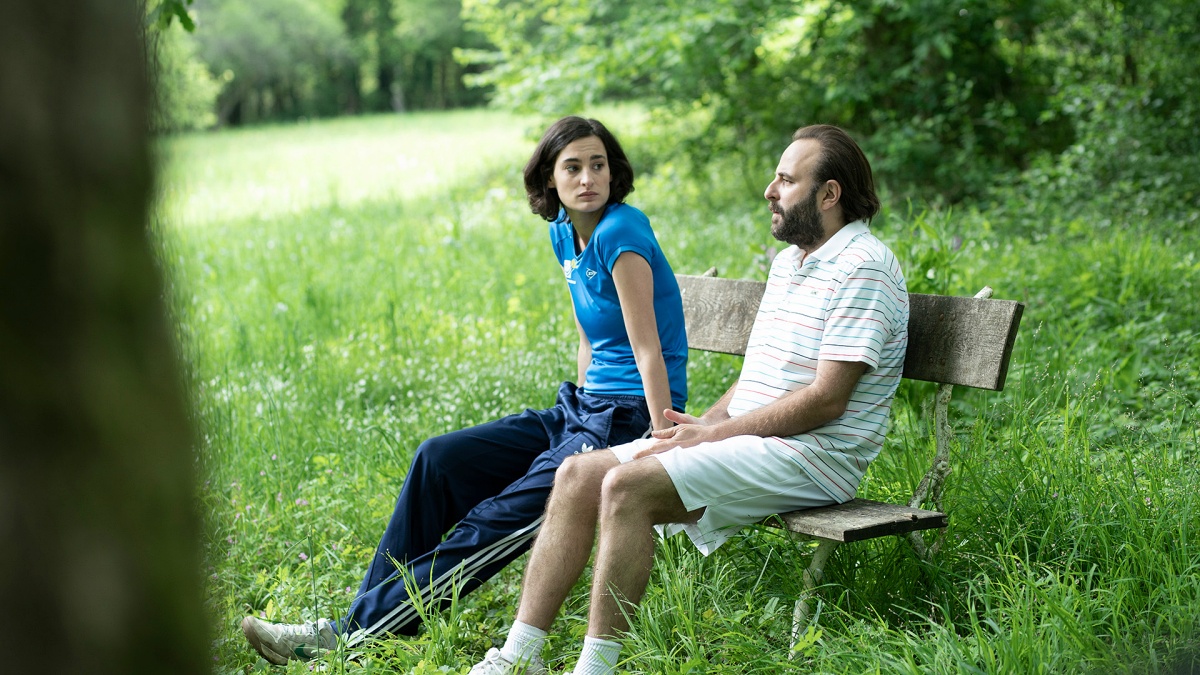

Suspended Time is about how the foursome deal with one another and their isolation from the outside world, which they come into contact with as infrequently as possible in order to avoid catching the dreaded you-know-what in those daunting pre-vaccine days.
SUSPENDED TIME: FILM REVIEW
Olivier Assayas is one of the best French writer/directors currently making movies today. Some of his features have a political edge, unlike his latest offering. As its title suggests, Suspended Time (Hors du Temps) is about life during the pandemic. Set in that far away and long-ago time of 2020, to escape exposure to COVID, along with their lovers two brothers retreat to their childhood home in France’s provincial countryside at the Chevreuse Valley, located about an hour’s drive southeast of Paris.
Paul Berger (Vincent Macaigne) is a film director and more or less the central character in this 105-minute movie. His brother, Etienne Berger (Micha Lescot), is a rock and roll critic who writes for Rolling Stone type outlets. (The first name of Olivier’s real-life brother is Michka.) Paul has decamped with his girlfriend Carole (Nora Hamzawi), a documentarian. Etienne, who has a penchant for cooking crepes, is joined by his new romantic interest, Morgan (Nine d’Urso).
Suspended Time is about how the foursome deal with one another and their isolation from the outside world, which they come into contact with as infrequently as possible in order to avoid catching the dreaded you-know-what in those daunting pre-vaccine days. Much of their shopping is carried out online, with a reliance on home deliveries, and what they can’t obtain via e-shopping is garnered by hunting and gathering – using masks, bleach, etc., to protect one’s self and the pod as much as possible from contamination – at nearby village shops. In addition to cooking, the surcease from the hustle-bustle of the workaday world affords the characters time to read and reflect.
The film focuses on the brothers’ interactions while confined at their birthplace, as well as on the romances of the two sets of lovers, as they shack up at the chateau. Forced to face one another at such close quarters – where they actually had grown up – the brothers work out lingering issues leftover from their childhood. (One could imagine Tom Smothers shouting in certain scenes: “Mom always liked you best!”) Paul is especially anxious about following pandemic protocols, which gets under Etienne’s skin.
Although this is a French film, you’ll be disappointed to learn there is, alas, no partner swapping! But over the course of the story, we do follow the growth in the various relationships, which for Paul is complicated by an ex-wife and their daughter (which mirrors Assayas’ actual status), who he tries to stay in touch with during the pandemic as much as possible via Zoom.
Counseling sessions with a shrink (Dominique Reymond) are also conducted by way of Zoom, as the Internet connects the secluded nook with the outside world. Of course, the foursome enjoys a privilege which most people – many of them in intergenerational, often crowded, households – did not have access to as the pandemic swept across the globe, especially in those days before the vaccine was invented and readily available. (Assayas is the son of screenwriter Jacques Remy, whose oeuvre includes the popular TV series about Inspector Maigret, a sort of French Sherlock Holmes created by Belgian fiction writer Georges Simenon. So, no wonder the brothers had such a bucolic retreat to escape from the pandemic at.)
I suppose that Paul is meant to be an alter ego for Olivier Assayas. In the film-within-a-film(-within-a-film) in Assayas’s 2022 HBO Irma Vep (see here; the limited series which grew out of Assayas’s 1996 feature of the same name, which in turn was inspired by the 1915 French silent movie Les Vampires helmed by Louis Feuillade), the bearded Vincent Macaigne also plays a film director. Perhaps it’s a bit like how Jean-Pierre Leaud was Francois Truffaut’s onscreen incarnation in about four autobiographical films. (Speaking of which, Leaud played the movie director in 1996’s iteration of Irma Vep, and like Macaigne’s character, he had the same name, Rene Vidal…)
If Paul is meant to be an autobiographical character, one of the most interesting aspects of Assayas’s life is left unspoken in this meditation on solitude. 2012’s autobiographical Something in the Air focuses on the director’s period as a student revolutionary, which is far more fascinating than Suspended Time is. (See my interview with Olivier about this far better film here.) 2012’s Carlos, about the infamous terrorist Carlos the Jackal, is another great political work by the auteur.
Suspended Time also includes some lovely scenery shot in the French countryside. Other than that, there’s not too much to add. It is always well-directed and well-acted, and if you enjoy French cinema and/or arthouse films, you’ll likely be charmed by Suspended Time, and enjoy it, as I did. But if you aren’t a fan of these types of movies you’ll probably find Assayas’s latest to be talky and dull, as nothing very much happens – except for people living their lives under unusual circumstances, as they discover what’s most important about life. After all, one man’s shack is another man’s chateau.
However, it doesn’t require a willing suspension of disbelief to believe that lovers of fine films will have a rewarding time viewing Olivier Assayas’s rustic rumination on the pandemic, Suspended Time.
Suspended Time is in English with French subtitles and theatrically opens in theaters August 15 in New York at Film at Lincoln Center; on August 22 in L.A. at Laemmle Royale; and August 29 in Chicago at Siskel Film Center.
