

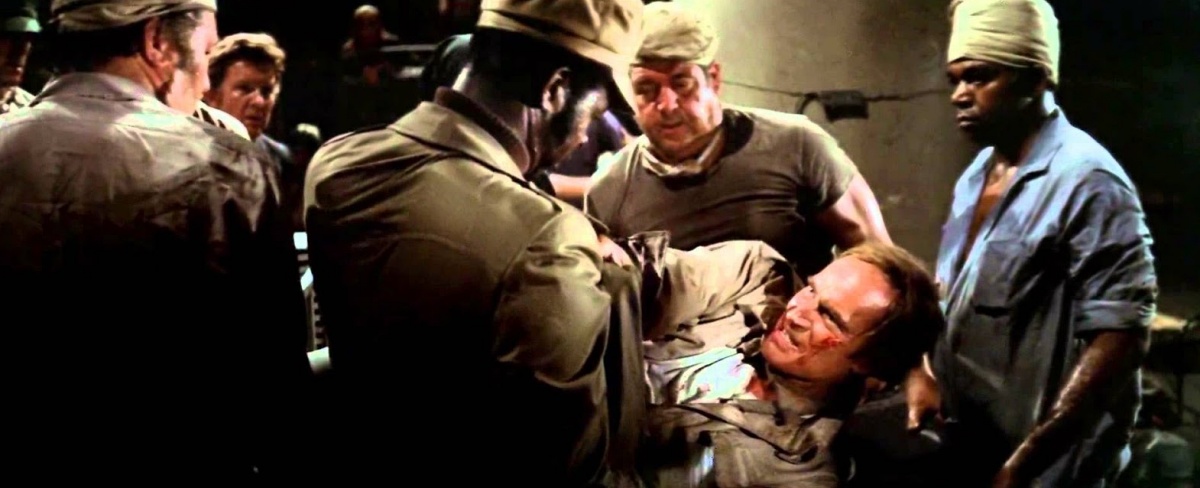


Given the direction of contemporary society...the alarm sounded in Soylent Green has only become louder and more urgent.
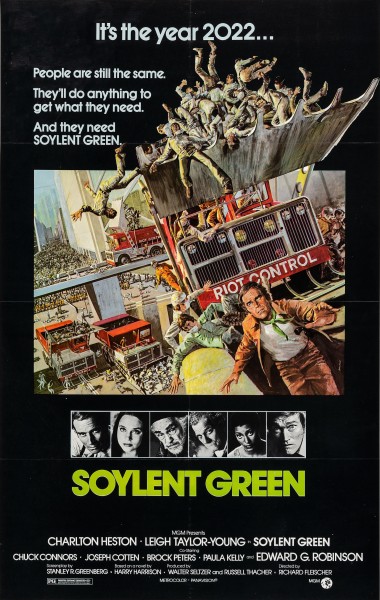
Richard Fleischer’s dystopian masterpiece, Soylent Green, premiered in Los Angeles on April 18th, 1973. The film, released a mere three years after the establishment of Earth Day and less than a year following the United Nations Conference on the Human Environment—the first world conference of nations focused on the environment as a major issue—sought to address some of its day’s most urgent problems. Among the film’s central concerns were overpopulation, pollution, global warming and the imperiled condition of the world’s oceans. In the intervening years since, such matters have come to be understood as what Timothy Morton defines as “hyperobjects,” which refer to assemblages and systems that “are massively distributed in time and space relative to humans.”
With the significant human influence upon these problems in mind, we can also see how the themes addressed in Soylent Green offer a compelling vision of our current era, which numerous scientists and philosophers now describe as the Anthropocene. This is a term Paul J. Crutzen formulated to designate “the present...human-dominated, geological epoch,” which has resulted from the development of industrialism and the massive effects humans have come to have on the global environment as a consequence.
The prophetic engagement with these issues has certainly contributed to Soylent Green’s status as such an influential American film and enduring icon of popular culture. This is apparent from its numerous appearances on The Simpsons, to the music of punk legends, the Dead Kennedys, and even across the Atlantic as an influence on German industrial music. As a film focused directly on the tremendous damage industrial societies have wrought upon the earth, perhaps, its greatest impact derives from the way it turns our attention from the specific environmental problems it depicts, and onto the interrelated social forces most responsible for the crisis itself.
These include the stains of gross economic inequality, injustice and oppression, which are forces that emerge as symptoms of irrational and dishonest decision-making emboldened by rampant political corruption and the insatiable pursuit of greed and power. Given the direction of contemporary society and the declining state of the environment over the fifty years since this film’s release, the alarm sounded in Soylent Green has only become louder and more urgent.
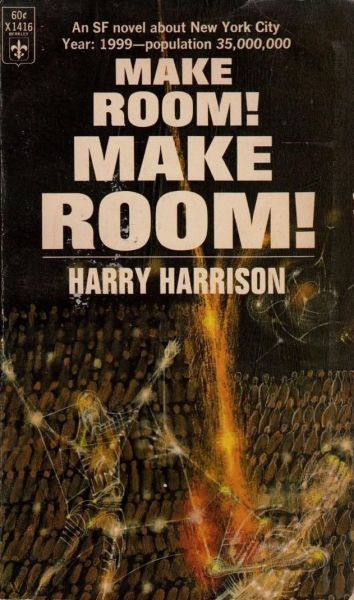
The story the film conveys, adapted from Harry Harrison’s 1966 sci-fi novel, Make Room! Make Room!, takes place in a future New York City in the year 2022 that has swollen to a population of 40 million, with half of those unemployed and crowded into sprawling tenements. The social deterioration this apocalyptic context has engendered is introduced via an opening montage that traces its origins to the ideologies of progress and radical individualism, long celebrated central facets of America’s capitalistic system.
In place of the kind of triumphalism that was a common feature of American Cold War media at the time of the film’s release, viewers are instead confronted with the woeful results of so-called civilization as depicted in stock footage culminating in depictions of a city once representative of human progress through boundless possibility and liberty, now overcrowded and awash in pollution and decay. By the montage’s end, the technological brilliance of New York's vibrant urban center has been eclipsed by a nightmarish vision of a future in which all vestiges of democracy have given way to an existence in which the vast majority of people are destitute and powerless.
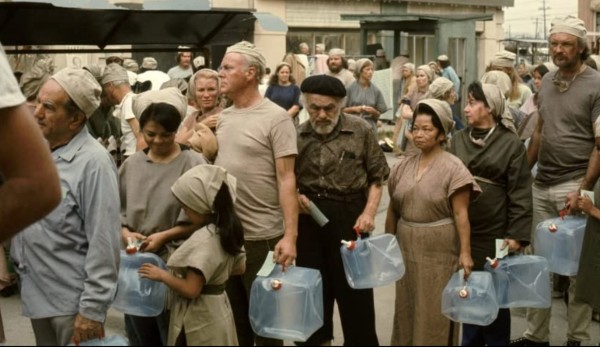
Contrasted with this condition are a wealthy and powerful elite whose privilege has allowed them to maintain access to goods and commodities that are, at best, a fading memory within the larger population. Calling attention to the stark distinctions between the haves and the have nots, the rich live in swanky high-rise condos with the best furnishings and new-fangled computer technologies, along with running water, all protected by networks of motes and fences topped with barbed wire.
The film’s main characters, a police detective named Thorn (Charlton Heston), along with his partner, Sol Roth (Edward G. Robinson), who serves as his “book,” or research librarian/historian (because, yeah, books, à la Fahrenheit 451, are now illegal, too), speak to these disparities in a scene focused on the paucity of available food directly following the montage. It’s a masterful cinematic transition that introduces the product of Soylent Green, as the purported “miracle food of high-energy plankton gathered from the oceans of the world,” while effectively dropping viewers into the midst of an unsettling world.
In response to an ongoing repartee, Thorn says, “I know, Sol, you've told me a hundred times before. People were better, the world was better...” Sol’s simple response, “ah, people were always lousy...but there was a world, once,” delivers a note of poignancy about human nature that is tempered by an ironic sense of nostalgia for a lost past that builds as the film advances towards its horrific climax.
The society Thorn and Roth inhabit is ruled by the shadowy entity of the Soylent Corporation, and backed by a totalitarian government that wields power through the oppressive and corrupt police force in which both men are also employed. It’s a complicated world; ironies abound. The story takes off from there and is largely narrated through Thorn’s perspective as he is assigned to investigate the murder of a wealthy businessman named William R. Simonson (Joseph Cotton). The plot thickens as it is revealed that the victim is politically connected, while also serving on the board of, yep, you guessed it, the Soylent Corporation.
While conducting his search of Simonson’s condo, Thorn interviews two people associated with Simonson who are at the scene, a bodyguard, Tab Fielding (Chuck Connors), and his seeming love interest, Shirl (Leah Taylor-Young). In addressing Fielding, Thorn immediately refers to Shirl as “furniture.” This disclosure of women as reduced to mere property tied to each unit, emphasizes yet another dystopic feature of the film’s story world—one that grows ever more grim with each passing scene.
With his survey of the crime scene complete, Thorn arrives at the conclusion that Simonson may not be the casualty of a simple burglary gone bad as it was made to appear. It’s also notable that in the process of his investigation, Thorn helps himself to various belongings of the deceased. The items in question are mostly things viewers would consider common, which have become scarce luxuries in an apocalyptic world wracked by global warming and dwindling resources. These include pencils and paper, a bottle of bourbon, a filet of beef and some fresh fruit and vegetables. The blatant theft of which serving as another example of the unchecked power of police in this future society that also bore an uncanny resemblance to the reality many minority and marginalized people were subjected to in the 60s and early 70s.
The complex web of dystopian contexts that mark Thorn’s existence are made clear to the audience when he returns to the station and reports his findings to a supervisor named Hatcher (Brock Peters). Asked for his take on the homicide, Thorn responds, “it was carefully set up to make it look like he was killed after he caught some punk burglarizing his apartment.”
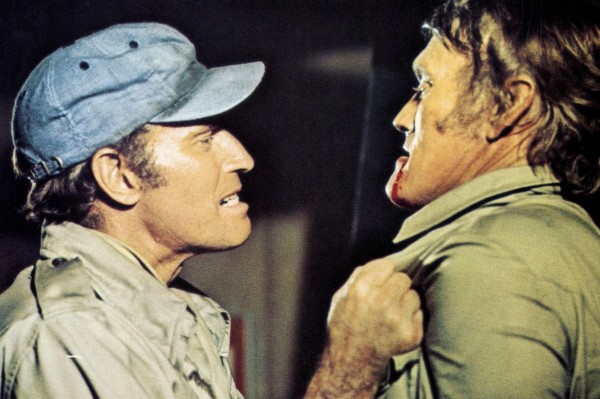 Charles Heston and Chuck Connors
With Hatcher pressing further, Thorn calls Simonson’s killing “a well-planned assassination,” serving as an ominous indication of the machinations of some larger conspiracy. This suggestion further underscores the distinct lack of agency and power of citizens living in this futuristic world, whereby most have been reduced to a status Giorgio Agamben refers to as “bare life.” Thus, disposable.
The themes of corruption and conspiracy are effectively unified in Hatcher’s follow up: “well, if the punk didn't take anything from the apartment, what did you take?” Thorn’s quick retort, “everything I could lay my hands on,” is spoken with relish. Presented as such, it also serves to emphasize the Hobbesian dog eat dog world their society has devolved into, unmoored from any kind of “center” envisioned by the poet, William Butler Yeats. Things in Fleischer’s 2022, have indeed, fallen apart.
These resonances are highlighted by the realistic and nuanced portrayals of the film’s setting and characters, conferring to Thorn, and the others, an immediacy and proximity as much more than representatives of binary figures in some modern-day morality play. As Roger Ebert noted in his review at the time, “Soylent Green’s” real achievement is to create a 21st Century world that’s convincing as reality; we somehow don’t feel we’re in a s-f picture.”
Aside from images and scenes of social and environmental degradation, along with the intensive suffering and violence they precipitate, what makes the Soylent Green even more disturbing and relevant today is that the oppression forming the foundation for much of the destructiveness and death depicted in the film corresponds so closely to recent history. This is apparent in a seemingly endless list of disturbing examples that can be generated with a quick internet search on the nature of violence directed against people from across the world who have stood up against the exploitation of the planet by corrupt corporations and governments.
This blueprint for tyranny is one that marginalized, vulnerable and exploited peoples around the world, along with the activists working to assist and protect them, are also all too familiar with. As they, too, have also been subjected to campaigns of terrorism and violence. Often for the mere act of speaking out.
The non-governmental organization, Global Witness, for example, released a report in 2022 that put the number of environmental activists who have been murdered in the preceding decade at a staggering 1,733. The report goes on to suggest that the actual figures are likely much higher, with murders often perpetrated by “hitmen, organised crime groups and their own governments.” The difficulty of confirming such data is complicated by the fact that this type of targeted political violence is especially prevalent in remote locations, and in the global south particularly, where such killings “disproportionately affect lower-income countries and Indigenous communities.”
In addition, dissidents and whistleblowers are also frequent targets of harassment, violence and assassination around the world, as numerous incidents from countries such as Russia, especially related to Vladimir Putin’s government, his family and associates; Saudi Arabia, as exposed by the shocking murder and dismemberment of Jamal Khashoggi in the country’s consulate in Istanbul; and in South Africa, as the cases of Babita Deokaran and Cloete Murray testify.
And as much as we may want to believe that such human rights abuses are confined to countries marred by oppressive political systems, widespread corruption and civil unrest, similar incidents including coordinated campaigns of harassment and forms of sabotage, to state-sanctioned violence and numerous assassinations have long been part of American history, as well.
This is all due to the fact that regardless of where corrupt officials and the leaders of criminal organizations, corporate and otherwise, are found, they tend to share a common goal of seeking to strengthen their grip on power, along with the associated accumulation of wealth that it brings. Terror and murder, or course, have long been the preferred tools of the wealthy and the powerful against those who dare question their power or organize against them.
Within a dystopian context, the repressive functions of institutions such as the church and courts, as well as the related carceral or disciplinary structures of schools, reformatories, asylums and prisons become distributed across an entire society through a totalitarian superstructure in which power is concentrated in the hands of an autocratic minority. Such arrangements engender a form of life where practically all boundaries between people and structures of coercive authority fall away.
Regimes of this nature are a core presence in dystopian literature, whether manifested in the One State of Yevgeny Zamyatin’s We, Mustapha Mond of Aldous Huxley’s Brave New World, the Big Brother of INGSOC in George Orwell’s Nineteen Eighty-Four or the Republic of Gilead of Margaret Atwood’s The Handmaid’s Tale.
The historical examples noted stand in eerie relief against these literary and fictive representations, threatening to expose the more immediate and dreadful ways people are transformed into what Michel Foucault has described as “docile bodies.” But, what then? Simply give in to hopelessness? Some, like Sol, certainly do.
But others direct their anger and frustration against easier targets: celebrities, each other, or back onto oneself. And when directed outward, it is often via a faceless internet. Or, we direct it against the trivial and pointless, like when a fast-food chain adjusts its menu. Apathy as survival mechanism.
 Edward G. Robinson
The tactics of political corruption and brutality stemming from the microphysics of power here alluded to, take a particularly horrifying shape in the film as those in power will stop at nothing to cover up Simonson’s murder, and the larger mystery his “necessary” elimination is intended to keep secret. When political pressure and bribery are not enough, hit men are then dispatched in a language of plausible deniability to eliminate those who are thought to have become “unreliable,” as Simonson’s assassin conveys to him, along with anyone else who threatens to expose the truth. No one is safe, as the ruthless murder of a priest who had learned of Simonson’s haunting truth during confession shows.
The revelation of the secret ingredient that makes up Soylent Green is so unspeakable that Roth can’t bring himself to even name it, exclaiming in disbelief, “Good God!” He then goes to a Thanatorium where he can die peacefully, while declaring to Thorn, “I’ve lived too long.”
Thorn, in carrying out Roth’s dying wish to “prove” the awful truth, sneaks into a Soylent factory and sees the process for himself. After surviving multiple attempts on his life, he finally reveals the secret of Soylent Green in film’s final and most famous scene, desperately shrieking to Hatcher that the “ocean's dying, plankton's dying . . . it's people. Soylent Green is made out of people!”
As dramatic as Thorn’s disclosure of this grotesque reality is, even this terrible truth becomes almost trivial in the film’s final accounting. The crucial questions Fleischer challenges us with, instead, is will humans ever be able to turn away from their propensity thoughtlessness and pettiness, cruelty, hatred and violence? And, more vitally, can this be done before we make the world a place that is not worth living in, and that is also beyond repair . . .
